Unit of Clinical Pharmacology and Pharmacogenetics, Department of Clinical and Experimental Medicine, University of Pisa, 56126 Pisa, Italy.
Division of Thoracic Oncology, European Institute of Oncology, 20141 Milano, Italy.
Int J Mol Sci. 2019 Aug 14;20(16):3951. doi: 10.3390/ijms20163951.
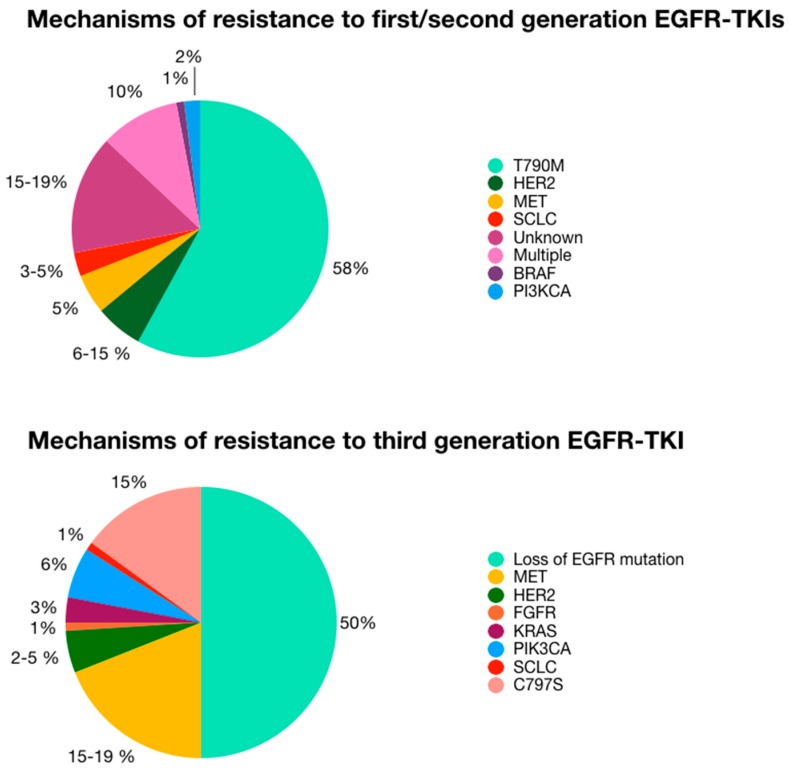
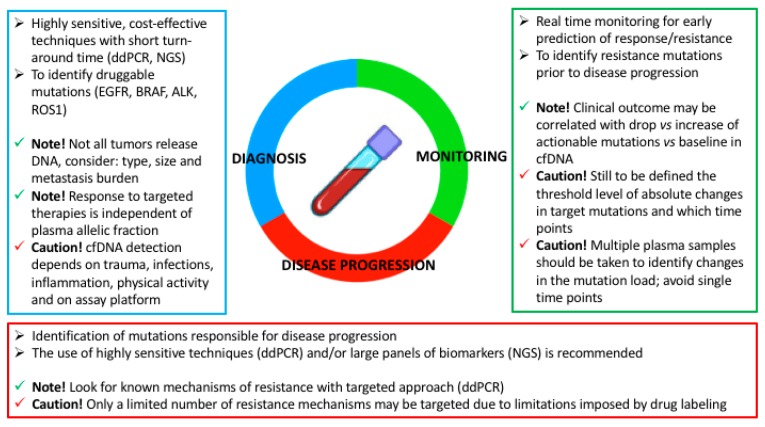
Liquid biopsy has emerged as an alternative source of nucleic acids for the management of Epidermal Growth Factor Receptor ()-mutant non-Small Cell Lung Cancer (NSCLC). The use of circulating cell-free DNA (cfDNA) has been recently introduced in clinical practice, resulting in the improvement of the identification of druggable mutations for the diagnosis and monitoring of response to targeted therapy. -dependent (T790M and C797S mutations) and independent (Mesenchymal Epithelial Transition [] gene amplification, Kirsten Rat Sarcoma [], Phosphatidyl-Inositol 4,5-bisphosphate 3-Kinase Catalytic subunit Alpha isoform [], and RAF murine sarcoma viral oncogene homolog B1 [] gene mutations) mechanisms of resistance to EGFR tyrosine kinase inhibitors (TKIs) have been evaluated in plasma samples from NSCLC patients using highly sensitive methods (i.e., digital droplet PCR, Next Generation Sequencing), allowing for the switch to other therapies. Therefore, liquid biopsy is a non-invasive method able to detect the molecular dynamic changes that occur under the pressure of treatment, and to capture tumor heterogeneity more efficiently than is allowed by tissue biopsy. This review addresses how liquid biopsy may be used to guide the choice of treatment strategy in -mutant NSCLC.
液体活检已成为一种替代的核酸来源,可用于管理表皮生长因子受体 ()-突变型非小细胞肺癌 (NSCLC)。循环无细胞 DNA (cfDNA) 的使用最近已引入临床实践,从而提高了对可靶向治疗的基因突变的识别,用于诊断和监测治疗反应。已经在 NSCLC 患者的血浆样本中使用高灵敏度方法(即数字液滴 PCR、下一代测序)评估了依赖于表皮生长因子受体 (EGFR) 酪氨酸激酶抑制剂 (TKI) 的耐药 ()-dependent(T790M 和 C797S 突变)和独立 ()-independent(间质上皮转化 []基因扩增、Kirsten Rat Sarcoma []、Phosphatidyl-Inositol 4,5-bisphosphate 3-Kinase Catalytic subunit Alpha isoform []和 RAF murine sarcoma viral oncogene homolog B1 []基因突变)机制,从而能够切换到其他治疗方法。因此,液体活检是一种非侵入性方法,能够检测到治疗压力下发生的分子动态变化,并比组织活检更有效地捕获肿瘤异质性。这篇综述探讨了液体活检如何用于指导 -mutant NSCLC 的治疗策略选择。