Aird Alejandra, Lagos Macarena, Vargas-Hernández Alexander, Posey Jennifer E, Coban-Akdemir Zeynep, Jhangiani Shalini, Mace Emily M, Reyes Anaid, King Alejandra, Cavagnaro Felipe, Forbes Lisa R, Chinn Ivan K, Lupski James R, Orange Jordan S, Poli Maria Cecilia
Clínica Alemana de Santiago, Facultad de Medicina Clínica Alemana-Universidad del Desarrollo, Santiago, Chile.
Clínica Las Condes, Santiago, Chile.
Front Pediatr. 2019 Jul 30;7:303. doi: 10.3389/fped.2019.00303. eCollection 2019.
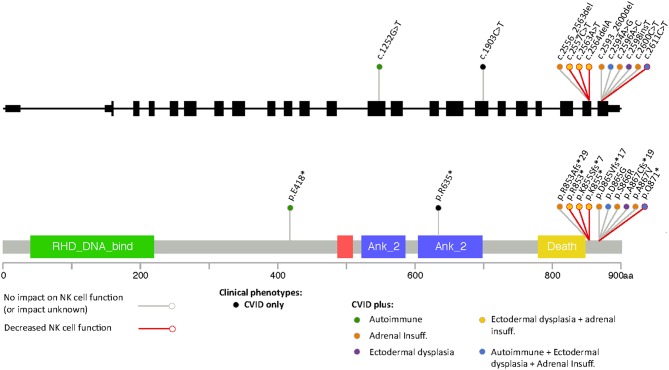
Nuclear factor kappa-B subunit 2 (NF-κB2/p100/p52), encoded by (MIM: 164012) belongs to the NF-κB family of transcription factors that play a critical role in inflammation, immunity, cell proliferation, differentiation and survival. Heterozygous C-terminal mutations in have been associated with early-onset common variable immunodeficiency (CVID), central adrenal insufficiency and ectodermal dysplasia. Only two previously reported cases have documented decreased natural killer (NK) cell cytotoxicity, and little is known about the role of NF-κB2 in NK cell maturation and function. Here we report a 13-year-old female that presented at 6 years of age with a history of early onset recurrent sinopulmonary infections, progressive hair loss, and hypogamaglobulinemia consistent with a clinical diagnosis of CVID. At 9 years of age she had cytomegalovirus (CMV) pneumonia that responded to ganciclovir treatment. Functional NK cell testing demonstrated decreased NK cell cytotoxicity despite normal NK cell numbers, consistent with a greater susceptibility to systemic CMV infection. Research exome sequencing (ES) was performed and revealed a novel heterozygous nonsense mutation in (c.2611C>T, p.Gln871) that was not carried by either of her parents. The variant was Sanger sequenced and confirmed to be in the patient. At age 12, she presented with a reactivation of the systemic CMV infection that was associated with severe and progressive nephrotic syndrome with histologic evidence of pedicellar effacement and negative immunofluorescence. To our knowledge, this is the third NF-κB2 deficient patient in which an abnormal NK cell function has been observed, suggesting a role for non-canonical NF-κB2 signaling in NK cell cytotoxicity. NK cell function should be assessed in patients with mutations in the non-canonical NF-κB pathway to explore the risk for systemic viral infections that may lead to severe complications and impact patient survival. Similarly NF-κB2 should be considered in patients with combined immunodeficiency who have aberrant NK cell function. Further studies are needed to characterize the role of NF-κB2 in NK cell cytotoxic function.
核因子κB亚基2(NF-κB2/p100/p52),由(MIM: 164012)编码,属于转录因子NF-κB家族,在炎症、免疫、细胞增殖、分化和存活中起关键作用。该基因的杂合C端突变与早发性常见可变免疫缺陷(CVID)、中枢肾上腺功能不全和外胚层发育异常有关。之前仅有两例报道记录了自然杀伤(NK)细胞细胞毒性降低,而关于NF-κB2在NK细胞成熟和功能中的作用知之甚少。在此,我们报告一名13岁女性,她6岁时出现早发性反复鼻窦肺部感染、进行性脱发和低丙种球蛋白血症病史,临床诊断为CVID。9岁时她患巨细胞病毒(CMV)肺炎,对更昔洛韦治疗有反应。功能性NK细胞检测显示,尽管NK细胞数量正常,但NK细胞细胞毒性降低,这与对全身性CMV感染的易感性增加一致。进行了研究外显子组测序(ES),发现该基因存在一个新的杂合无义突变(c.2611C>T,p.Gln871),其父母均未携带。该变异经桑格测序,在患者中得到确认。12岁时,她出现全身性CMV感染复发,伴有严重且进行性肾病综合征,组织学证据显示足突消失且免疫荧光阴性。据我们所知,这是第三例观察到NK细胞功能异常的NF-κB2缺陷患者,提示非经典NF-κB2信号在NK细胞细胞毒性中起作用。对于非经典NF-κB途径突变的患者,应评估NK细胞功能,以探索可能导致严重并发症并影响患者生存的全身性病毒感染风险。同样,对于NK细胞功能异常的联合免疫缺陷患者,也应考虑NF-κB2。需要进一步研究来明确NF-κB2在NK细胞细胞毒性功能中的作用。