Dyson School of Design Engineering, Imperial College London, London, UK.
School of Population Health and Environmental Sciences, King's College London, London, UK.
BMJ Open. 2019 Aug 15;9(8):e030385. doi: 10.1136/bmjopen-2019-030385.
Effective secondary stroke prevention strategies are suboptimally used. Novel development of interventions to enable healthcare professionals and stroke survivors to manage risk factors for stroke recurrence are required. We sought to engage key stakeholders in the design and evaluation of an intervention informed by a learning health system approach, to improve risk factor management and secondary prevention for stroke survivors with multimorbidity.
Qualitative, including focus groups, semistructured interviews and usability evaluations. Data was audio recorded, transcribed and coded thematically.
Stroke survivors, carers, health and social care professionals, commissioners, policymakers and researchers.
Stroke survivors were recruited from the South London Stroke Register; health and social care professionals through South London general practices and King's College London (KCL) networks; carers, commissioners, policymakers and researchers through KCL networks.
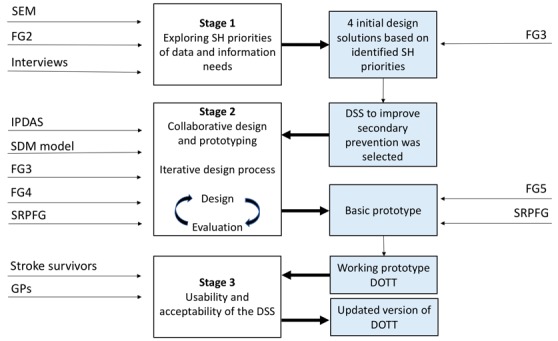
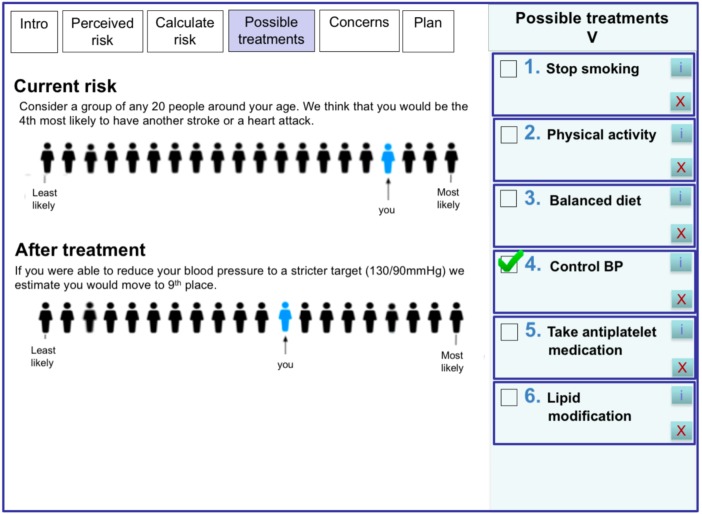
53 stakeholders in total participated in focus groups, interviews and usability evaluations. Thirty-seven participated in focus groups and interviews, including stroke survivors and carers (n=11), health and social care professionals (n=16), commissioners and policymakers (n=6) and researchers (n=4). Sixteen participated in usability evaluations, including stroke survivors (n=8) and general practitioners (GPs; n=8). Eight themes informed the collaborative design of DOTT (Deciding On Treatments Together), a decision aid integrated with the electronic health record system, to be used in primary care during clinical consultations between the healthcare professional and stroke survivor. DOTT aims to facilitate shared decision-making on personalised treatments leading to improved treatment adherence and risk control. DOTT was found acceptable and usable among stroke survivors and GPs during a series of evaluations.
Adopting a user-centred data-driven design approach informed an intervention that is acceptable to users and has the potential to improve patient outcomes. A future feasibility study and subsequent clinical trial will provide evidence of the effectiveness of DOTT in reducing risk of stroke recurrence.
有效的二级卒中预防策略并未得到充分利用。需要开发新的干预措施,使医疗保健专业人员和卒中幸存者能够管理卒中复发的风险因素。我们试图让关键利益相关者参与到一个基于学习型医疗系统方法的干预措施的设计和评估中,以改善患有多种疾病的卒中幸存者的风险因素管理和二级预防。
定性研究,包括焦点小组、半结构化访谈和可用性评估。数据被录音、转录并进行主题编码。
卒中幸存者、照顾者、卫生和社会保健专业人员、决策者和研究人员。
卒中幸存者从南伦敦卒中登记处招募;卫生和社会保健专业人员通过南伦敦全科医生和国王学院(KCL)网络招募;照顾者、决策者和研究人员通过 KCL 网络招募。
共有 53 名利益相关者参与了焦点小组、访谈和可用性评估。37 人参加了焦点小组和访谈,包括卒中幸存者和照顾者(n=11)、卫生和社会保健专业人员(n=16)、决策者和政策制定者(n=6)和研究人员(n=4)。16 人参加了可用性评估,包括卒中幸存者(n=8)和全科医生(GPs;n=8)。八个主题为共同设计 DOTT(一起决定治疗方案)提供了信息,这是一种决策辅助工具,与电子健康记录系统集成,将在初级保健中由医疗保健专业人员和卒中幸存者在临床咨询中使用。DOTT 的目的是促进针对个性化治疗的共同决策,从而提高治疗依从性和风险控制。在一系列评估中,DOTT 被发现对卒中幸存者和全科医生来说是可接受和可用的。
采用以用户为中心、数据驱动的设计方法为干预措施提供了信息,该干预措施被用户接受,并有可能改善患者的预后。未来的可行性研究和随后的临床试验将提供证据,证明 DOTT 能够降低卒中复发的风险。