Yoo Jeong Seon, Choe Eun Yeong, Kim Yoo Mee, Kim Se Hwa, Won Young Jun
Department of Internal Medicine, Seobuk Hospital, Seoul Metropolitan Government, Seoul, Korea.
Graduate School, Yonsei University College of Medicine, Seoul, Korea.
Korean J Intern Med. 2020 Jul;35(4):936-945. doi: 10.3904/kjim.2016.343. Epub 2019 Aug 19.
BACKGROUND/AIMS: Although metabolic syndrome has been associated with increasing medical costs worldwide, there have been no studies using a nationwide and longitudinal South Korean dataset. We investigated trends in subsidized medical costs among Korean adults with metabolic syndrome.
This study was based on the National Sample Cohort database of South Korea. We used data of national health checkups in 2009 as well as data of subsidized prescription drugs and the Korean Classification of Disease diagnosis codes from claims in 2007 to 2008 to identify underlying diseases. We calculated the direct medical costs, which were subsidized by the Korean National Health Insurance, among 204,768 individuals older than 20 years from 2009 to 2013.
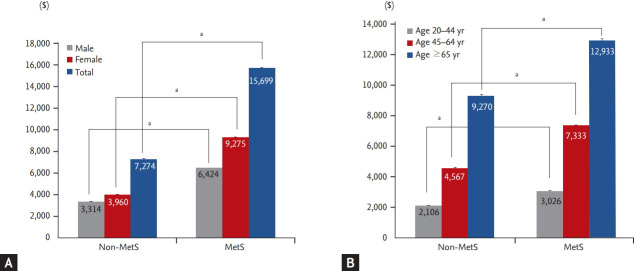
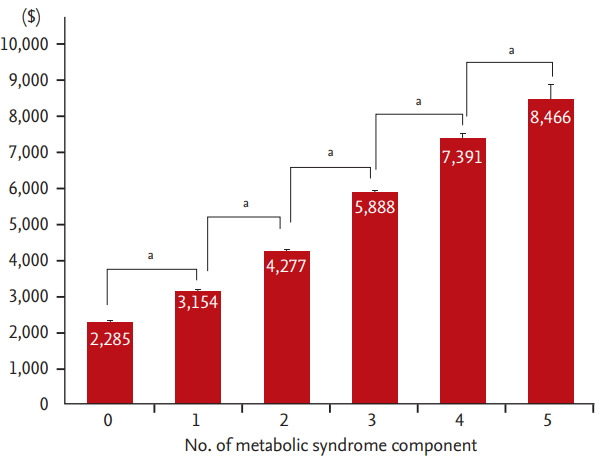
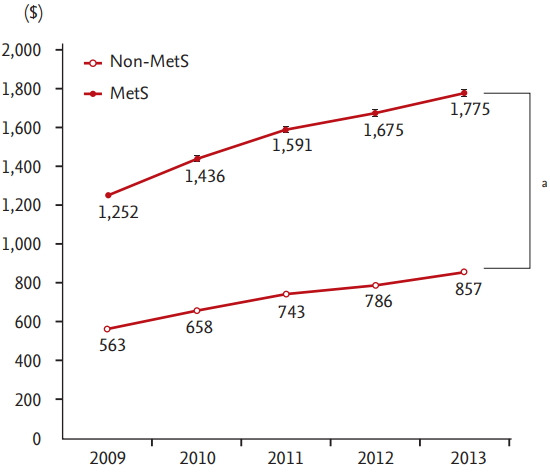
The proportion of subjects with metabolic syndrome was 27.2%. Direct medical costs for 5 years differed by a magnitude of 2.16 between subjects with and without metabolic syndrome. The costs increased by approximately 41.8% in the metabolic syndrome group in 5 years. Direct medical costs increased with every additional risk factor, even if a subject had less than three risk factors of metabolic syndrome. Metabolic syndrome per se and all of its components, except low serum high-density lipoprotein cholesterol level, resulted in a significant increase in medical costs.
The medical costs of subjects with metabolic syndrome were higher than that of those without metabolic syndrome and it increased with the number of risk factors. Further research using cumulative data of more than 10 years, including unsubsidized and indirect costs, is needed in the future.
背景/目的:尽管代谢综合征在全球范围内与医疗成本增加相关,但尚无使用韩国全国性纵向数据集的研究。我们调查了韩国患有代谢综合征的成年人的补贴医疗费用趋势。
本研究基于韩国国家样本队列数据库。我们使用了2009年全国健康检查数据以及2007年至2008年索赔中的补贴处方药数据和韩国疾病分类诊断代码来确定潜在疾病。我们计算了2009年至2013年期间204,768名20岁以上个体中由韩国国民健康保险补贴的直接医疗费用。
代谢综合征患者的比例为27.2%。有和没有代谢综合征的受试者5年的直接医疗费用相差2.16倍。代谢综合征组的费用在5年内增加了约41.8%。即使受试者的代谢综合征风险因素少于三个,直接医疗费用也会随着每增加一个风险因素而增加。代谢综合征本身及其所有组成部分,除了低血清高密度脂蛋白胆固醇水平外,都会导致医疗费用显著增加。
代谢综合征患者的医疗费用高于无代谢综合征患者,且随风险因素数量增加而增加。未来需要使用超过10年的累积数据进行进一步研究,包括未补贴和间接成本。