Kim Jung-Soo, Heo Sung Jae
Department of Otorhinolaryngology-Head and Neck Surgery, Kyungpook National University Hospital, School of Medicine, Kyungpook National University, Daegu, Korea.
Department of Otorhinolaryngology-Head and Neck Surgery, Kyungpook National University Chilgok Hospital, School of Medicine, Kyungpook National University, Daegu, Korea.
Clin Exp Otorhinolaryngol. 2020 Feb;13(1):47-51. doi: 10.21053/ceo.2019.00206. Epub 2019 Aug 17.
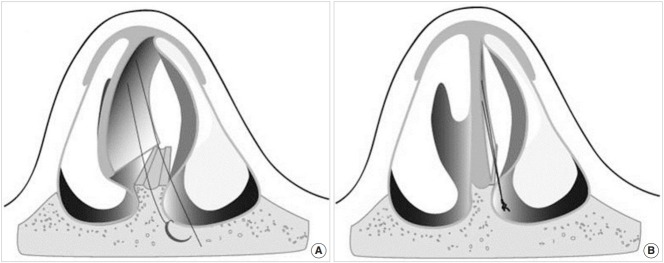
Crosshatching incision has been considered a useful method for correcting cartilaginous septal deviation. The aim of this study was to determine the utility and limitations of this approach.
This retrospective case-control study included 353 patients who underwent septoplasty performed by a senior surgeon between January 2004 and December 2010. Patients were classified into two groups according to whether crosshatching incision was performed (n=151) during septoplasty or not (n=202). All other techniques performed during septoplasty were identical. The parameters of surgical success (improvement of nasal obstruction, correction of deviation, and acoustic rhinometry results and adverse effects were compared between the groups.
There were no significant differences in the parameters of surgical success between the groups (improvement of nasal obstruction, P=0.333; correction of deviation, P=0.608; acoustic rhinometry results P=0.322 for the difference in the minimal cross-sectional area; P=0.919 for difference in volume). Relative to patients who did not undergo the cross-hatching incision, patients with whom the technique was performed showed a significantly higher incidence of saddle nose (0/202 vs. 4/151 cases, P=0.033) and overcorrection (0/202 vs. 5/151 cases, P=0.014).
Crosshatching incision during septoplasty did not produce better surgical outcomes; however, it caused adverse effects such as saddle nose and overcorrection. Therefore, the use of crosshatching incision should be re-evaluated.
交叉切口一直被认为是矫正鼻中隔软骨偏曲的一种有效方法。本研究的目的是确定该方法的实用性和局限性。
这项回顾性病例对照研究纳入了2004年1月至2010年12月期间由一位资深外科医生进行鼻中隔成形术的353例患者。根据鼻中隔成形术中是否进行交叉切口(n = 151),将患者分为两组,另一组未进行交叉切口(n = 202)。鼻中隔成形术中采用的所有其他技术均相同。比较两组之间手术成功的参数(鼻塞改善情况、偏曲矫正情况、鼻声反射测量结果)及不良反应。
两组之间手术成功的参数无显著差异(鼻塞改善情况,P = 0.333;偏曲矫正情况,P = 0.608;鼻声反射测量结果,最小横截面积差异P = 0.322;体积差异P = 0.919)。与未进行交叉切口的患者相比,采用该技术的患者鞍鼻发生率显著更高(0/202例与4/151例,P = 0.033),以及过度矫正发生率显著更高(0/202例与5/151例,P = 0.014)。
鼻中隔成形术中的交叉切口并未产生更好的手术效果;然而,它会引起鞍鼻和过度矫正等不良反应。因此,应重新评估交叉切口的使用。