Department of Immunization, Vaccines and Biologicals, World Health Organization, Avenue Appia 20, CH-1211, Geneva 27, Switzerland.
Centre for Mathematical Modelling of Infectious Disease, London School of Hygiene and Tropical Medicine, London, UK.
BMC Med. 2019 Aug 19;17(1):163. doi: 10.1186/s12916-019-1403-9.
Despite the increasing popularity of multi-model comparison studies and their ability to inform policy recommendations, clear guidance on how to conduct multi-model comparisons is not available. Herein, we present guidelines to provide a structured approach to comparisons of multiple models of interventions against infectious diseases. The primary target audience for these guidelines are researchers carrying out model comparison studies and policy-makers using model comparison studies to inform policy decisions.
The consensus process used for the development of the guidelines included a systematic review of existing model comparison studies on effectiveness and cost-effectiveness of vaccination, a 2-day meeting and guideline development workshop during which mathematical modellers from different disease areas critically discussed and debated the guideline content and wording, and several rounds of comments on sequential versions of the guidelines by all authors.
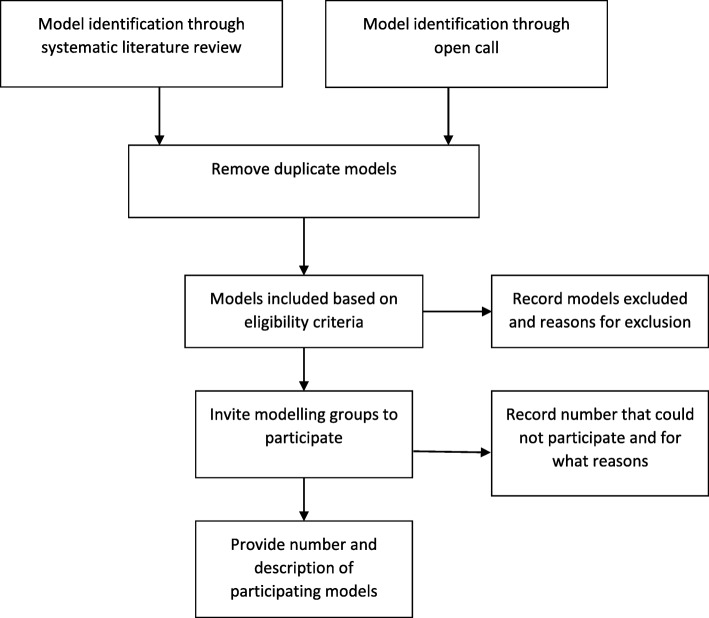
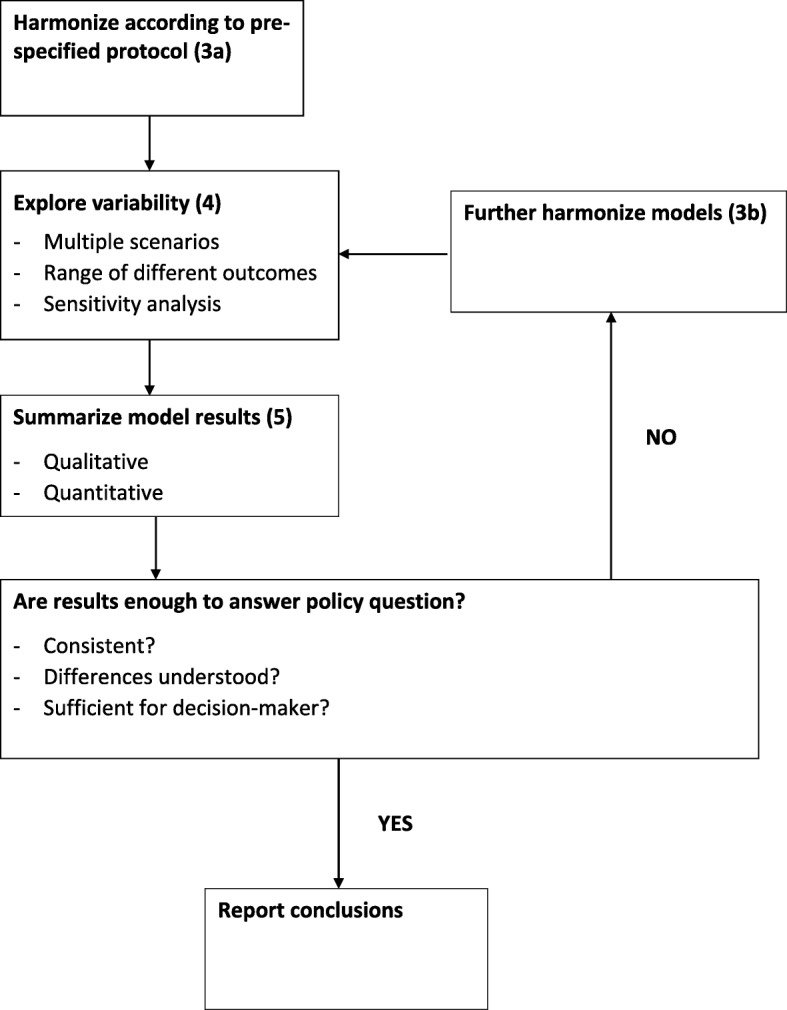
The guidelines provide principles for multi-model comparisons, with specific practice statements on what modellers should do for six domains. The guidelines provide explanation and elaboration of the principles and practice statements as well as some examples to illustrate these. The principles are (1) the policy and research question - the model comparison should address a relevant, clearly defined policy question; (2) model identification and selection - the identification and selection of models for inclusion in the model comparison should be transparent and minimise selection bias; (3) harmonisation - standardisation of input data and outputs should be determined by the research question and value of the effort needed for this step; (4) exploring variability - between- and within-model variability and uncertainty should be explored; (5) presenting and pooling results - results should be presented in an appropriate way to support decision-making; and (6) interpretation - results should be interpreted to inform the policy question.
These guidelines should help researchers plan, conduct and report model comparisons of infectious diseases and related interventions in a systematic and structured manner for the purpose of supporting health policy decisions. Adherence to these guidelines will contribute to greater consistency and objectivity in the approach and methods used in multi-model comparisons, and as such improve the quality of modelled evidence for policy.
尽管多模型比较研究越来越受欢迎,并且能够为政策建议提供信息,但目前尚无关于如何进行多模型比较的明确指南。本文提出了一套指导方针,为干预传染病的多种模型比较提供了一种结构化的方法。这些指南的主要目标受众是开展模型比较研究的研究人员和使用模型比较研究为政策决策提供信息的决策者。
指南制定过程中使用了共识方法,包括对疫苗有效性和成本效益的现有模型比较研究进行系统回顾、为期两天的会议和指南制定研讨会,在此期间,来自不同疾病领域的数学建模人员对指南内容和措辞进行了批判性讨论和辩论,以及所有作者对指南的连续版本进行了几轮评论。
这些指南提供了多模型比较的原则,并针对六个领域的具体实践陈述提出了建模者应该做什么的建议。这些指南对原则和实践陈述进行了解释和阐述,并提供了一些示例来说明这些原则和陈述。这些原则包括:(1)政策和研究问题——模型比较应针对一个相关的、明确界定的政策问题;(2)模型识别和选择——纳入模型比较的模型的识别和选择应透明,并最大限度地减少选择偏差;(3)协调——应根据研究问题和这一步骤所需的努力程度确定输入数据和输出的标准化;(4)探索变异性——应探索模型内和模型间的变异性和不确定性;(5)呈现和汇总结果——应采用适当的方式呈现结果,以支持决策;(6)解释——应解释结果,以回答政策问题。
这些指南应有助于研究人员以系统和结构化的方式规划、进行和报告传染病及其相关干预措施的模型比较,以支持卫生政策决策。遵守这些指南将有助于提高多模型比较中使用的方法和方法的一致性和客观性,并提高模型证据在政策方面的质量。