Chang Angela Y, Gómez-Olivé Francesc Xavier, Payne Collin, Rohr Julia K, Manne-Goehler Jennifer, Wade Alisha N, Wagner Ryan G, Montana Livia, Tollman Stephen, Salomon Joshua A
Department of Global Health and Population, Harvard T H Chan School of Public Health, Boston, Massachusetts, USA.
MRC/Wits Rural Public Health and Health Transitions Research Unit (Agincourt), School of Public Health, Faculty of Health Sciences, University of the Witwatersrand, Johannesburg, South Africa.
BMJ Glob Health. 2019 Aug 5;4(4):e001386. doi: 10.1136/bmjgh-2018-001386. eCollection 2019.
The rapid ageing of populations around the world is accompanied by increasing prevalence of multimorbidity. This study is one of the first to present the prevalence of multimorbidity that includes HIV in the complex epidemiological setting of South Africa, thus filling a gap in the multimorbidity literature that is dominated by studies in high-income or low-HIV prevalence settings.
Out of the full sample of 5059 people aged 40+, we analysed cross-sectional data on 10 conditions from 3889 people enrolled in the Health and Ageing in Africa: A longitudinal study of an INDEPTH Community in South Africa (HAALSI) Programme. Two definitions of multimorbidity were applied: the presence of more than one condition and the presence of conditions from more than one of the following categories: cardiometabolic conditions, mental disorders, HIV and anaemia. We conducted descriptive and regression analyses to assess the relationship between prevalence of multimorbidity and sociodemographic factors. We examined the frequencies of the most prevalent combinations of conditions and assessed relationships between multimorbidity and physical and psychological functioning.
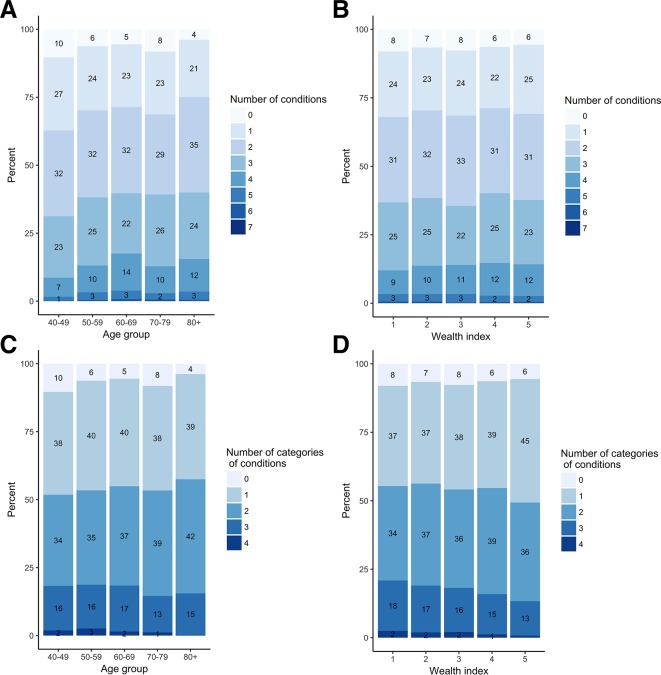
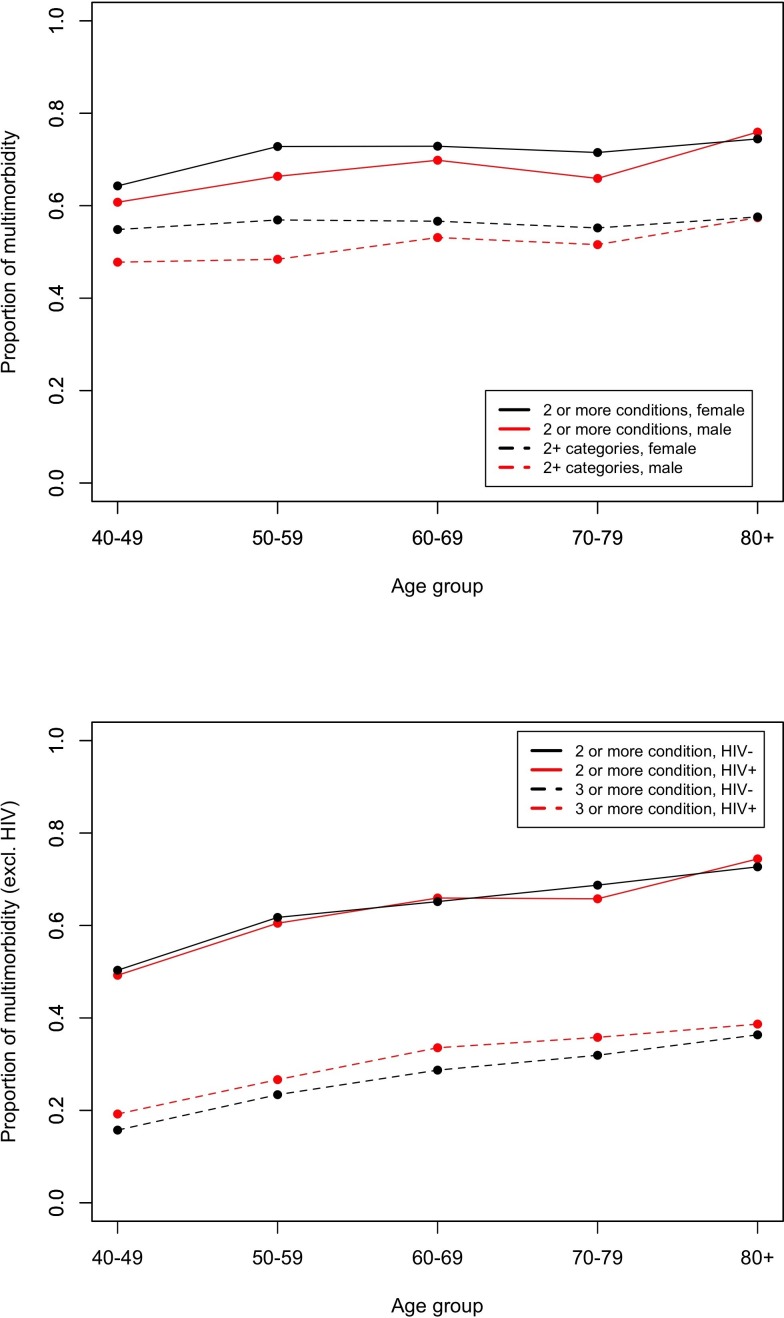
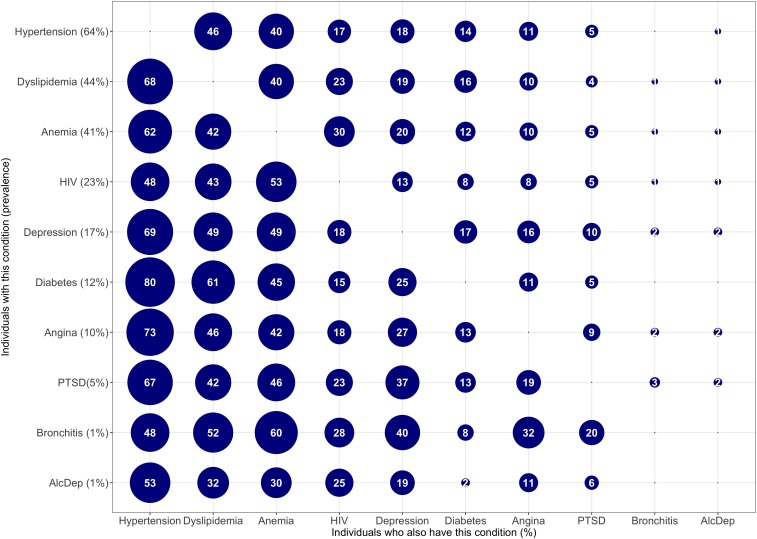
69.4 per cent (95% CI 68.0 to 70.9) of the respondents had at least two conditions and 53.9% (52.4-55.5) of the sample had at least two categories of conditions. The most common condition groups and multimorbid profiles were combinations of cardiometabolic conditions, cardiometabolic conditions and depression, HIV and anaemia and combinations of mental disorders. The commonly observed positive relationships between multimorbidity and age and decreasing wealth were not observed in this population, namelydue to different epidemiological profiles in the subgroups, with higher prevalence of HIV and anaemia in the poorer and younger groups, and higher prevalence of cardiometabolic conditions in the richer and older groups. Both physical functioning and well-being negatively associated with multimorbidity.
More coordinated, long-term integrated care management across multiple chronic conditions should be provided in rural South Africa.
全球人口的快速老龄化伴随着多重疾病发病率的上升。本研究是首批呈现南非复杂流行病学背景下包括艾滋病毒在内的多重疾病发病率的研究之一,从而填补了以高收入或低艾滋病毒流行率环境研究为主导的多重疾病文献中的空白。
在5059名40岁及以上的全部样本中,我们分析了参与“非洲健康与老龄化:南非一个深入社区的纵向研究”(HAALSI)项目的3889人的10种疾病的横断面数据。应用了两种多重疾病的定义:存在一种以上疾病以及存在以下多个类别中的疾病:心脏代谢疾病、精神障碍、艾滋病毒和贫血。我们进行了描述性和回归分析,以评估多重疾病患病率与社会人口学因素之间的关系。我们检查了最常见疾病组合的频率,并评估了多重疾病与身体和心理功能之间的关系。
69.4%(95%置信区间68.0至70.9)的受访者至少患有两种疾病,53.9%(52.4 - 55.5)的样本至少患有两类疾病。最常见的疾病组和多重疾病概况是心脏代谢疾病的组合、心脏代谢疾病和抑郁症、艾滋病毒和贫血以及精神障碍的组合。在该人群中未观察到多重疾病与年龄和财富减少之间通常观察到的正相关关系,这是由于亚组中的不同流行病学特征,较贫穷和较年轻群体中艾滋病毒和贫血的患病率较高,而较富裕和较年长群体中心脏代谢疾病的患病率较高。身体功能和幸福感均与多重疾病呈负相关。
南非农村地区应提供更协调、长期的多种慢性病综合护理管理。