Neuroscience, Janssen Research & Development, LLC, Titusville, NJ, USA.
Clinical Statistics, GlaxoSmithKline R&D, Stevenage, UK.
Mol Psychiatry. 2020 Jun;25(6):1275-1285. doi: 10.1038/s41380-019-0471-8. Epub 2019 Aug 19.
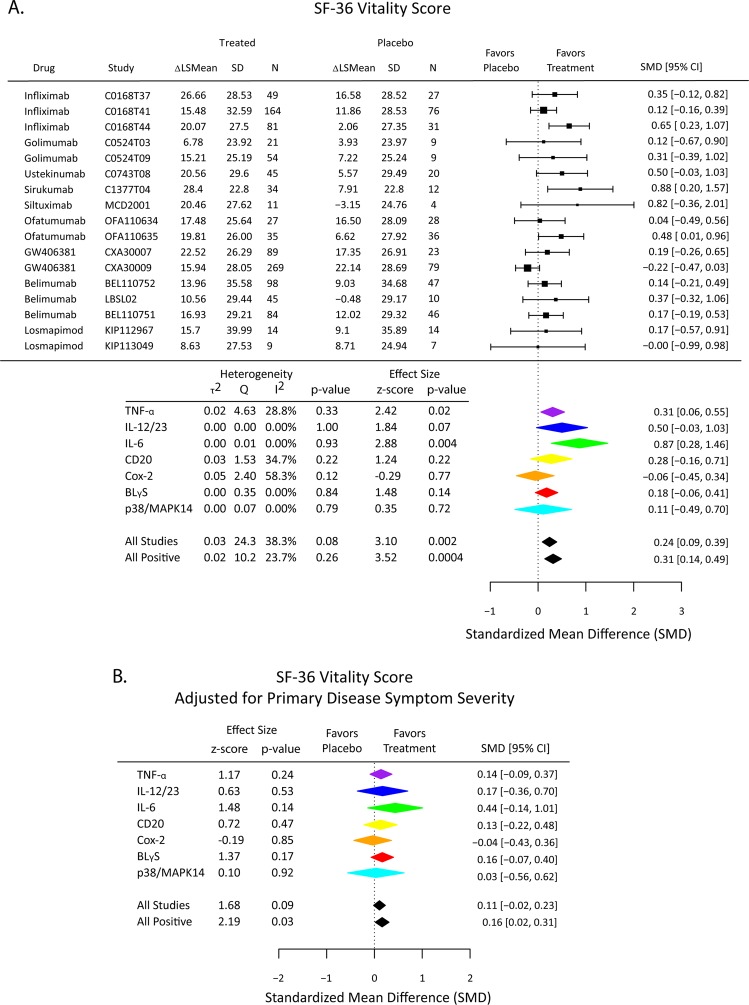
Activation of the innate immune system is commonly associated with depression. Immunomodulatory drugs may have efficacy for depressive symptoms that are co-morbidly associated with inflammatory disorders. We report a large-scale re-analysis by standardized procedures (mega-analysis) of patient-level data combined from 18 randomized clinical trials conducted by Janssen or GlaxoSmithKline for one of nine disorders (N = 10,743 participants). Core depressive symptoms (low mood, anhedonia) were measured by the Short Form Survey (SF-36) or the Hospital Anxiety and Depression Scale (HADS), and participants were stratified into high (N = 1921) versus low-depressive strata based on baseline ratings. Placebo-controlled change from baseline after 4-16 weeks of treatment was estimated by the standardized mean difference (SMD) over all trials and for each subgroup of trials targeting one of 7 mechanisms (IL-6, TNF-α, IL-12/23, CD20, COX2, BLγS, p38/MAPK14). Patients in the high depressive stratum showed modest but significant effects on core depressive symptoms (SMD = 0.29, 95% CI [0.12-0.45]) and related SF-36 measures of mental health and vitality. Anti-IL-6 antibodies (SMD = 0.8, 95% CI [0.20-1.41]) and an anti-IL-12/23 antibody (SMD = 0.48, 95% CI [0.26-0.70]) had larger effects on depressive symptoms than other drug classes. Adjustments for physical health outcome marginally attenuated the average treatment effect on depressive symptoms (SMD = 0.20, 95% CI: 0.06-0.35), but more strongly attenuated effects on mental health and vitality. Effects of anti-IL-12/23 remained significant and anti-IL-6 antibodies became a trend after controlling for physical response to treatment. Novel immune-therapeutics can produce antidepressant effects in depressed patients with primary inflammatory disorders that are not entirely explained by treatment-related changes in physical health.
先天免疫系统的激活通常与抑郁症有关。免疫调节药物可能对伴有炎症性疾病的抑郁症状有效。我们通过标准化程序(荟萃分析)对 Janssen 或 GlaxoSmithKline 进行的 18 项随机临床试验的患者水平数据进行了大规模重新分析,这些临床试验涉及 9 种疾病中的 1 种(N=10743 名参与者)。核心抑郁症状(情绪低落、快感缺失)通过短表单调查(SF-36)或医院焦虑和抑郁量表(HADS)进行测量,参与者根据基线评分分为高(N=1921)和低抑郁分层。通过所有试验和针对 7 种机制之一(IL-6、TNF-α、IL-12/23、CD20、COX2、BLγS、p38/MAPK14)的每个试验亚组的基线后 4-16 周的安慰剂对照治疗变化,采用标准化均数差(SMD)进行估计。高抑郁分层患者的核心抑郁症状(SMD=0.29,95%置信区间 [0.12-0.45])和相关的 SF-36 心理健康和活力测量显示出适度但显著的影响。抗 IL-6 抗体(SMD=0.8,95%置信区间 [0.20-1.41])和抗 IL-12/23 抗体(SMD=0.48,95%置信区间 [0.26-0.70])对抑郁症状的影响大于其他药物类别。对身体健康结果的调整略微减弱了抗抑郁症状的平均治疗效果(SMD=0.20,95%置信区间:0.06-0.35),但对心理健康和活力的影响更强。抗 IL-12/23 的作用仍然显著,在控制对治疗的身体反应后,抗 IL-6 抗体成为一种趋势。新型免疫疗法可以在患有原发性炎症性疾病的抑郁患者中产生抗抑郁作用,这些作用不能完全用与身体健康相关的治疗变化来解释。