Department of Paediatric Immunology and Leukocyte Biology, National Institute of Immunohaematology (ICMR), Mumbai, India.
Bai Jerbai Wadia Hospital for Children, Mumbai, India.
Front Immunol. 2019 Jul 31;10:1739. doi: 10.3389/fimmu.2019.01739. eCollection 2019.
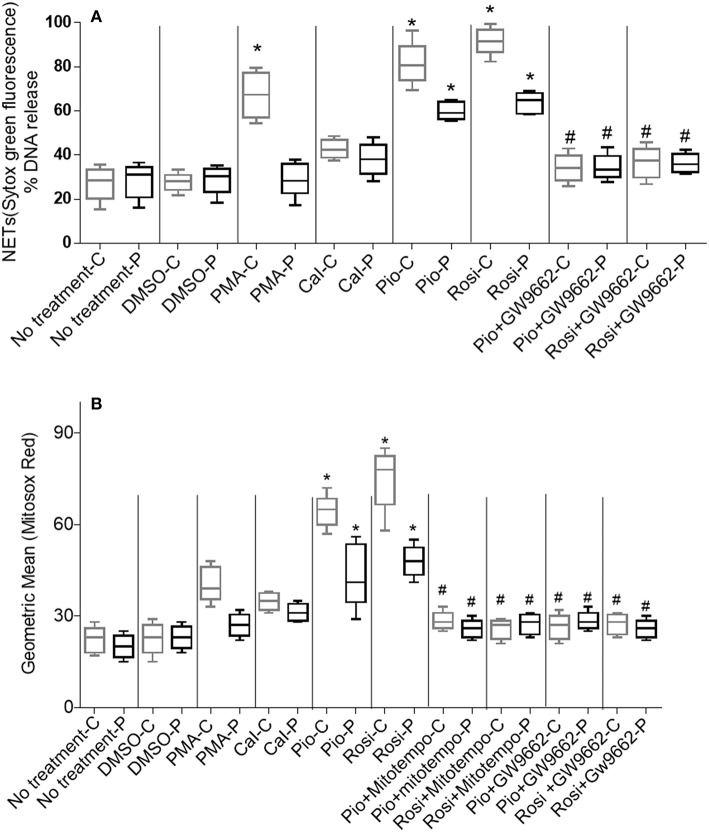
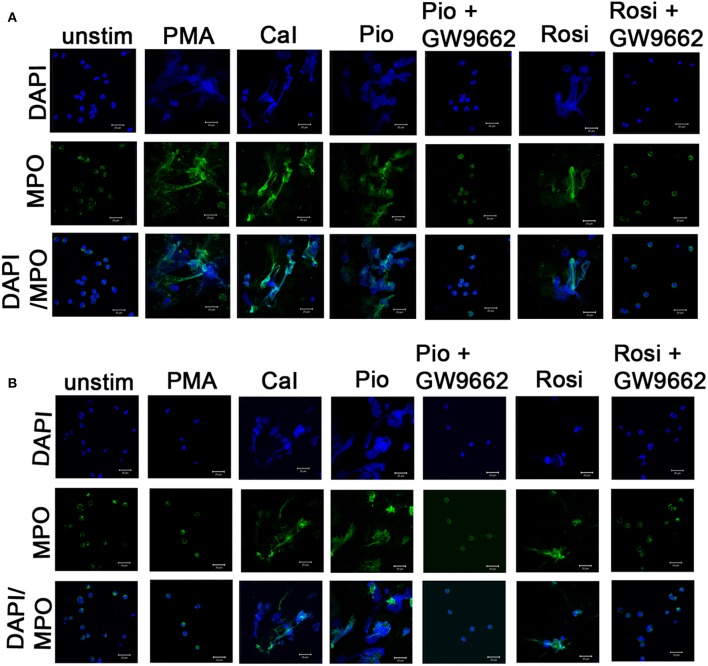
Nicotinamide adenine dinucleotide phosphate (NADPH) oxidase, the enzyme complex responsible for reactive oxygen species (ROS) production, is defective in chronic granulomatous disease (CGD) patients. This enzyme helps in antimicrobial host defense by phagocytes. CGD patients are unable to form neutrophil extracellular traps (NETs), which are composed of granule-derived proteins from neutrophils decorated with decondensed chromatin. Mitochondria have gained attention, being a rich source of flavochrome enzymes due to the presence of several sites for superoxide production. Recently, PPARγ agonists, a mitochondrial ROS inducer, induce mitochondrial ROS formation post-treatment in murine NADPH oxidase knockout models. Mitochondrial ROS is also essential for NOX-independent NETosis. Our study for the first time detects induction of NETosis independent of NADPH oxidase post-treatment with agonists such as pioglitazone and rosiglitazone in CGD subjects. Neutrophils isolated from CGD subjects were treated with pioglitazone and rosiglitazone. After treatment, qualitative analysis of NET formation was done using confocal microscopy after staining with DAPI. Quantitative estimation of extracellular DNA was performed using Sytox green. Mitochondrial ROS production with PPARγ agonist-treated/untreated neutrophils was detected using MitoSOX red. Pioglitazone and rosiglitazone induce significant NET formation in CGD patients. Our data clearly signify the effect of PPARγ agonists in induction of NET formation in CGD cases. Apart from the proposed experimental studies regarding the detailed mechanism of action, controlled trials could provide valuable information regarding the clinical use of pioglitazone in CGD patients as curative HSCT remains challenging in developing countries.
烟酰胺腺嘌呤二核苷酸磷酸(NADPH)氧化酶是负责活性氧(ROS)产生的酶复合物,在慢性肉芽肿病(CGD)患者中存在缺陷。这种酶有助于吞噬细胞的抗菌宿主防御。CGD 患者无法形成中性粒细胞胞外陷阱(NETs),NETs 是由中性粒细胞来源的颗粒蛋白与去凝聚的染色质组成的。线粒体由于存在几个产生超氧化物的部位,作为黄素氧化酶的丰富来源而受到关注。最近,过氧化物酶体增殖物激活受体γ(PPARγ)激动剂,一种线粒体 ROS 诱导剂,在 NADPH 氧化酶敲除的小鼠模型中诱导 ROS 形成。线粒体 ROS 对于非 NADPH 氧化酶依赖性 NETosis 也是必需的。我们的研究首次检测到,在 CGD 患者中,激动剂(如吡格列酮和罗格列酮)治疗后,即使没有 NADPH 氧化酶也能诱导 NETosis。从 CGD 患者中分离出中性粒细胞,用吡格列酮和罗格列酮处理。处理后,使用 DAPI 染色通过共聚焦显微镜对 NET 形成进行定性分析。使用 Sytox green 对细胞外 DNA 进行定量估计。用 MitoSOX red 检测经 PPARγ 激动剂处理/未处理的中性粒细胞中的线粒体 ROS 产生。吡格列酮和罗格列酮在 CGD 患者中诱导显著的 NET 形成。我们的数据清楚地表明了 PPARγ 激动剂在 CGD 病例中诱导 NET 形成的作用。除了关于作用机制的拟议实验研究外,对照试验可以为 CGD 患者使用吡格列酮的临床应用提供有价值的信息,因为在发展中国家,HSCT 作为一种有治愈希望的方法仍然具有挑战性。