Srinivasan Shylaja, Jablonski Kathleen A, Knowler William C, Dagogo-Jack Samuel, E Kahn Steven, Boyko Edward J, Bray George A, Horton Edward S, Hivert Marie-France, Goldberg Ronald, Chen Ling, Mercader Josep, Harden Maegan, Florez Jose C
Division of Pediatric Endocrinology and Diabetes, Department of Pediatrics, University of California at San Francisco, San Francisco, California.
Department of Epidemiology and Biostatistics, Milken Institute School of Public Health, George Washington University, Washington, DC.
J Endocr Soc. 2019 Jun 24;3(9):1663-1677. doi: 10.1210/js.2019-00069. eCollection 2019 Sep 1.
There is substantial heterogeneity in insulin sensitivity, and genetics may suggest possible mechanisms by which common variants influence this trait.
We aimed to evaluate an 11-variant polygenic lipodystrophy genetic risk score (GRS) for association with anthropometric, glycemic and metabolic traits in the Diabetes Prevention Program (DPP). In secondary analyses, we tested the association of the GRS with cardiovascular risk factors in the DPP.
In 2713 DPP participants, we evaluated a validated GRS of 11 common variants associated with fasting insulin-based measures of insulin sensitivity discovered through genome-wide association studies that cluster with a metabolic profile of lipodystrophy, conferring high metabolic risk despite low body mass index (BMI).
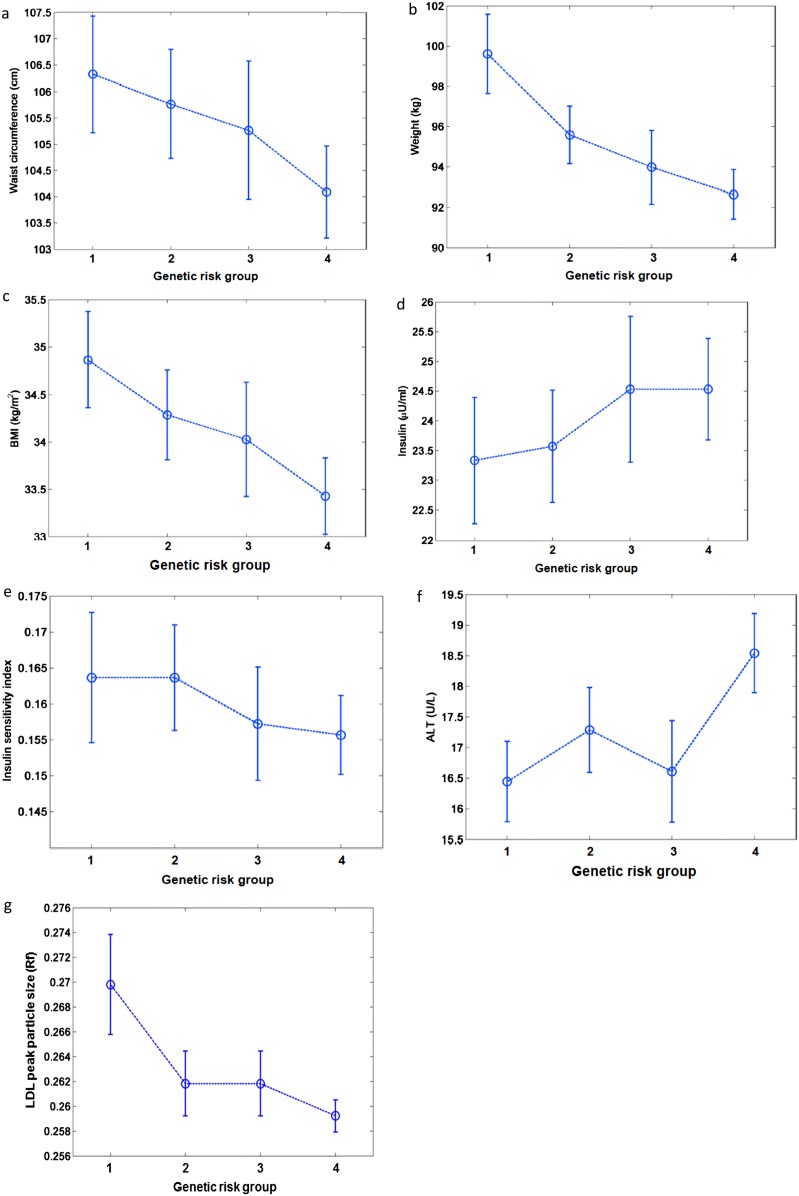
At baseline, a higher polygenic lipodystrophy GRS was associated with lower weight, BMI, and waist circumference measurements, but with worse insulin sensitivity index (ISI) values. Despite starting at a lower weight and BMI, a higher GRS was associated with less weight and BMI reduction at one year and less improvement in ISI after adjusting for baseline values but was not associated with diabetes incidence. A higher GRS was also associated with more atherogenic low-density lipoprotein peak-particle-density at baseline but was not associated with coronary artery calcium scores in the Diabetes Prevention Program Outcomes Study.
In the DPP, a higher polygenic lipodystrophy GRS for insulin resistance with lower BMI was associated with diminished improvement in insulin sensitivity and potential higher cardiovascular disease risk. This GRS helps characterize insulin resistance in a cohort of individuals at high risk for diabetes, independent of adiposity.
胰岛素敏感性存在显著异质性,遗传学可能提示常见变异影响该性状的潜在机制。
我们旨在评估一个包含11个变异的多基因脂肪营养不良遗传风险评分(GRS),以确定其与糖尿病预防计划(DPP)中人体测量学、血糖和代谢性状的关联。在二次分析中,我们测试了该GRS与DPP中心血管危险因素的关联。
在2713名DPP参与者中,我们评估了一个经过验证的GRS,该GRS由11个常见变异组成,这些变异与通过全基因组关联研究发现的基于空腹胰岛素的胰岛素敏感性测量指标相关,这些指标与脂肪营养不良的代谢特征聚集在一起,尽管体重指数(BMI)较低,但代谢风险较高。
在基线时,较高的多基因脂肪营养不良GRS与较低的体重、BMI和腰围测量值相关,但与较差的胰岛素敏感性指数(ISI)值相关。尽管起始体重和BMI较低,但较高的GRS与一年时体重和BMI降低较少以及调整基线值后ISI改善较少相关,但与糖尿病发病率无关。较高的GRS在基线时也与更多致动脉粥样硬化的低密度脂蛋白峰值颗粒密度相关,但在糖尿病预防计划结局研究中与冠状动脉钙化评分无关。
在DPP中,较高的多基因脂肪营养不良GRS与较低BMI的胰岛素抵抗相关,与胰岛素敏感性改善减弱和潜在较高的心血管疾病风险相关。该GRS有助于在一组糖尿病高危个体中表征胰岛素抵抗,独立于肥胖情况。