Department of Infectious Disease, Tongji Hospital, Tongji Medical College, Huazhong University of Science and Technology, Wuhan, 430030, China.
Institute of Pathology, Tongji Hospital, Tongji Medical College, Huazhong University of Science and Technology, Wuhan, 430030, China.
Cancer Chemother Pharmacol. 2019 Oct;84(4):861-872. doi: 10.1007/s00280-019-03923-1. Epub 2019 Aug 19.
FK506-binding protein 12 (FKBP12) is abundant, ubiquitously expressed cytoplasmic protein with multiple functions in cell signaling transduction. Recently, we reported a novel function for FKBP12 in oncoprotein mouse double minute 2 (MDM2) self-ubiquitination and degradation, which greatly enhanced the sensitivity of cancer cells to chemotherapy. However, the clinical relevance remains unclear.
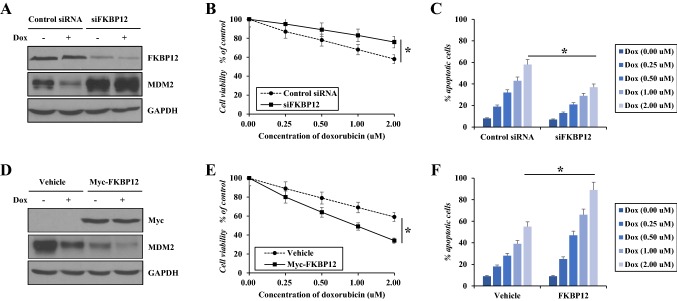
An immunohistochemical analysis of FKBP12 expression was performed in a cohort of 524 patients with invasive breast cancer. The correlations of FKBP12 expression with patient survival and chemoresponse were statistically analyzed. MDA-MB-468 cells were transfected with FKBP12 siRNA or Myc-tagged FKBP12, and then, the tumor cells were treated with doxorubicin followed by western blot, cell viability, and apoptosis assay.
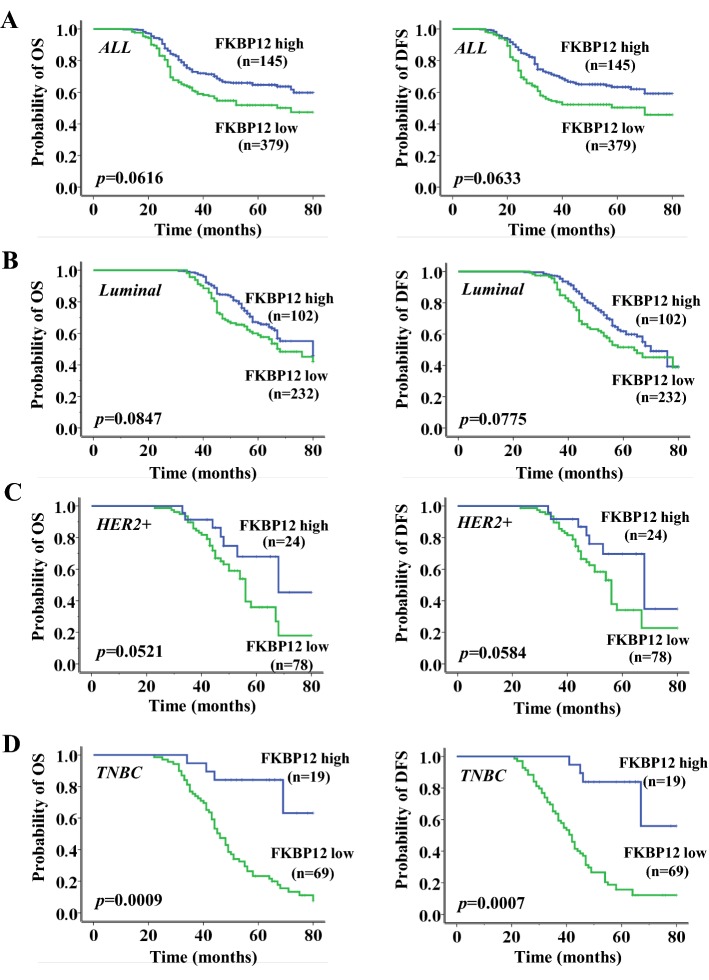
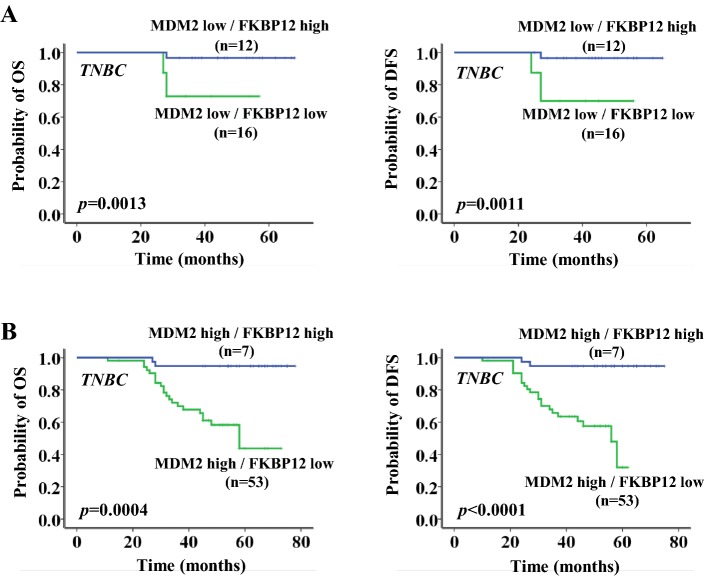
The expression of FKBP12 was decreased in breast cancer tissues, and there was a significant correlation between FKBP12 loss and MDM2 overexpression. Furthermore, FKBP12 loss was specifically correlated with poor prognosis and increased resistance to anthracycline-based chemotherapy. Kaplan-Meier survival analysis showed that overall survival (OS) and disease-free survival (DFS) were both significantly lower in the low FKBP12 expression group than those in the high FKBP12 expression group. In patients treated with anthracycline-based preoperative chemotherapy, low FKBP12 expression patients had a significant lower rate of pathologic complete response (pCR). Importantly, these results seemed to be driven mainly by MDM2. These observations were especially prominent in the MDM2-positive subgroup. Univariate and multivariate analyses revealed that FKBP12 loss was an independent factor for predicting prognosis and pCR. In in vitro assay, FKBP12 silence led to significant upregulation of MDM2. Accordingly, MDA-MB-468 cells with FKBP12 silence were less responsive to doxorubicin-induced cytotoxic and apoptotic effect. In contrast, in FKBP12-transfected MDA-MB-468 cells, MDM2 was more greatly inhibited by doxorubicin, resulting in greater cytotoxic and apoptotic effect.
We propose that FKBP12 loss, which can be enhanced by MDM2 overexpression, predicts poor prognosis and chemoresistance. Increasing the expression of FKBP12 may be a valuable strategy to add to anthracycline-based chemotherapy, especially in MDM2-overexpressed patients.
FK506 结合蛋白 12(FKBP12)是一种丰富的、广泛表达的细胞质蛋白,在细胞信号转导中有多种功能。最近,我们报道了 FKBP12 在癌蛋白鼠双微体 2(MDM2)自我泛素化和降解中的新功能,这极大地增强了癌细胞对化疗的敏感性。然而,其临床相关性尚不清楚。
对 524 例浸润性乳腺癌患者进行 FKBP12 表达的免疫组织化学分析。统计分析 FKBP12 表达与患者生存和化疗反应的相关性。用 FKBP12 siRNA 或 Myc 标记的 FKBP12 转染 MDA-MB-468 细胞,然后用阿霉素处理肿瘤细胞,进行 Western blot、细胞活力和细胞凋亡检测。
乳腺癌组织中 FKBP12 的表达降低,FKBP12 缺失与 MDM2 过表达之间存在显著相关性。此外,FKBP12 缺失与不良预后和增加对蒽环类化疗药物的耐药性密切相关。Kaplan-Meier 生存分析显示,低 FKBP12 表达组的总生存期(OS)和无病生存期(DFS)均显著低于高 FKBP12 表达组。在接受蒽环类术前化疗的患者中,低 FKBP12 表达患者的病理完全缓解(pCR)率显著较低。重要的是,这些结果似乎主要由 MDM2 驱动。这些观察结果在 MDM2 阳性亚组中尤为明显。单因素和多因素分析表明,FKBP12 缺失是预测预后和 pCR 的独立因素。在体外实验中,FKBP12 沉默导致 MDM2 显著上调。因此,FKBP12 沉默的 MDA-MB-468 细胞对阿霉素诱导的细胞毒性和凋亡作用的反应性降低。相反,在 FKBP12 转染的 MDA-MB-468 细胞中,阿霉素更能抑制 MDM2,导致更大的细胞毒性和凋亡作用。
我们提出,FKBP12 缺失(可由 MDM2 过表达增强)预示着不良预后和化疗耐药性。增加 FKBP12 的表达可能是一种有价值的策略,可以添加到蒽环类化疗中,特别是在 MDM2 过表达的患者中。