Division of Pediatrics, Shimane Prefectural Central Hospital, 4-1-1 Himebara, Izumo, Shimane, 693-8555, Japan.
Division of Neonatology, Shimane Prefectural Central Hospital, Izumo, Japan.
Clin Exp Nephrol. 2019 Nov;23(11):1306-1314. doi: 10.1007/s10157-019-01775-w. Epub 2019 Aug 19.
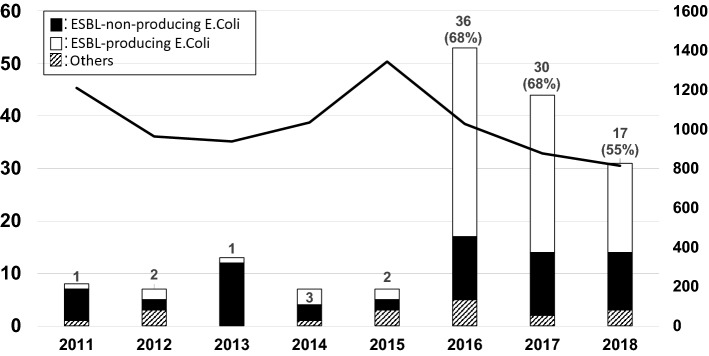
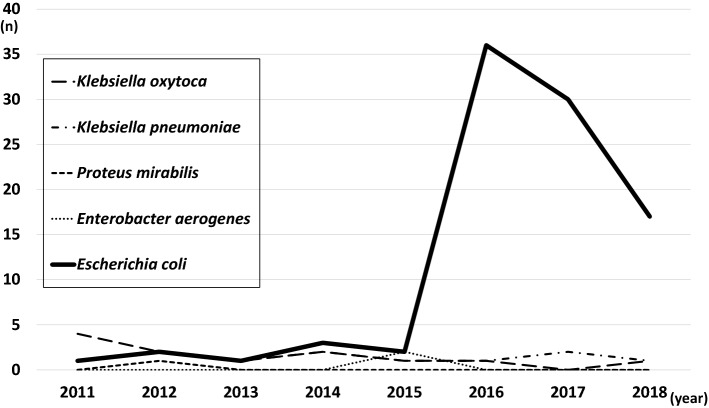
Urinary tract infections caused by extended-spectrum beta-lactamase-producing bacteria are increasing worldwide. At our hospital, the number of pediatric patients hospitalized because of an upper urinary tract infection has dramatically increased since 2016. In total, 60.5% of urinary tract infections are caused by extended-spectrum beta-lactamase-producing Escherichia coli. Such a high prevalence of extended-spectrum beta-lactamase-producing E. coli has not been detected previously in Japan. Therefore, we evaluated the clinical and bacteriologic characteristics and efficacy of antibiotics against upper urinary tract infections caused by E. coli in children.
This retrospective study surveyed 152 patients who were hospitalized in the pediatric department of Shimane Prefectural Central Hospital because of upper urinary tract infections caused by E. coli. Medical records were reviewed to examine patient characteristics. O antigens, antibiotic susceptibility, gene typing, and pulse-field gel electrophoresis were studied at the Shimane Prefectural Institute of Public Health and Environmental Science.
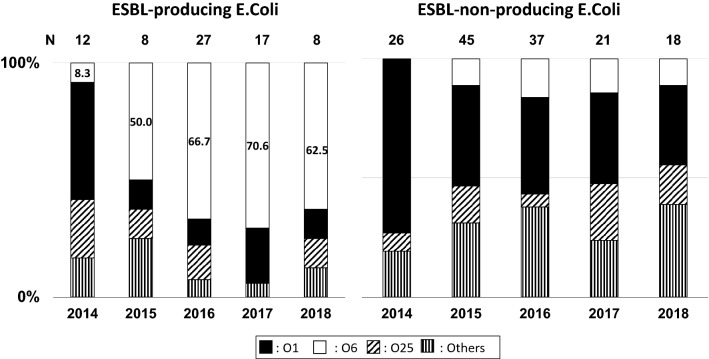
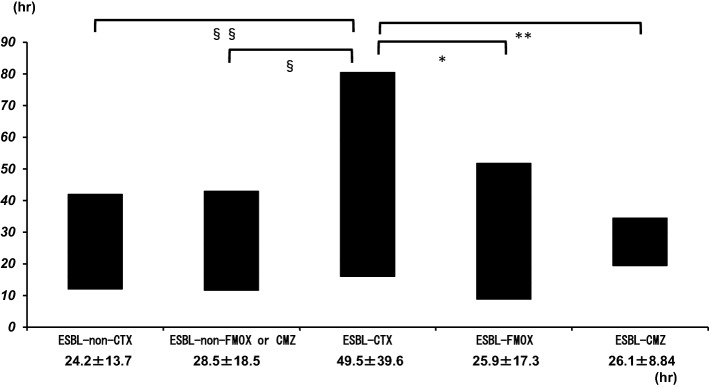
Urine sample analyses showed extended-spectrum beta-lactamase types such as CTX-M-9 and plural virulence genes. We changed the primary antibiotic treatment to flomoxef or cefmetazole to treat upper urinary tract infections caused by Gram-negative bacilli. After changing treatment, the time to fever alleviation was significantly shortened.
Extended-spectrum beta-lactamase-producing E. coli should be suspected in community-acquired upper urinary tract infections. Therefore, when treating patients, it is necessary to focus on antibiotic susceptibility and the prevalence of extended-spectrum beta-lactamase-producing bacteria found in each area. Flomoxef and cefmetazole are useful primary treatments for upper urinary tract infections caused by extended-spectrum beta-lactamase-producing E. coli.
全球范围内,由产超广谱β-内酰胺酶的细菌引起的尿路感染正在增加。在我们医院,自 2016 年以来,因上尿路感染住院的儿科患者数量急剧增加。在所有尿路感染中,有 60.5%是由产超广谱β-内酰胺酶的大肠埃希菌引起的。在日本,此前从未检测到如此高比例的产超广谱β-内酰胺酶的大肠埃希菌。因此,我们评估了儿童大肠埃希菌引起上尿路感染的临床和细菌学特征以及抗生素的疗效。
本回顾性研究调查了因大肠埃希菌引起上尿路感染而在岛根县立中央医院儿科住院的 152 名患者。查阅病历以检查患者特征。岛根县立公共卫生与环境科学研究所对 O 抗原、抗生素敏感性、基因分型和脉冲场凝胶电泳进行了研究。
尿液样本分析显示存在 CTX-M-9 等超广谱β-内酰胺酶类型和多种毒力基因。我们将初始抗生素治疗改为头孢噻肟或头孢美唑,以治疗革兰氏阴性杆菌引起的上尿路感染。改变治疗后,发热缓解时间明显缩短。
在社区获得性上尿路感染中应怀疑产超广谱β-内酰胺酶的大肠埃希菌。因此,在治疗患者时,有必要关注每个地区的抗生素敏感性和产超广谱β-内酰胺酶细菌的流行情况。头孢噻肟和头孢美唑是治疗产超广谱β-内酰胺酶大肠埃希菌引起上尿路感染的有效初始治疗方法。