Pereva Stiliyana, Nikolova Valya, Angelova Silvia, Spassov Tony, Dudev Todor
Faculty of Chemistry and Pharmacy, Sofia University "St. Kl. Ohridski", 1164 Sofia, Bulgaria.
Institute of Organic Chemistry with Centre of Phytochemistry, Bulgarian Academy of Sciences, 1113 Sofia, Bulgaria.
Beilstein J Org Chem. 2019 Jul 17;15:1592-1600. doi: 10.3762/bjoc.15.163. eCollection 2019.
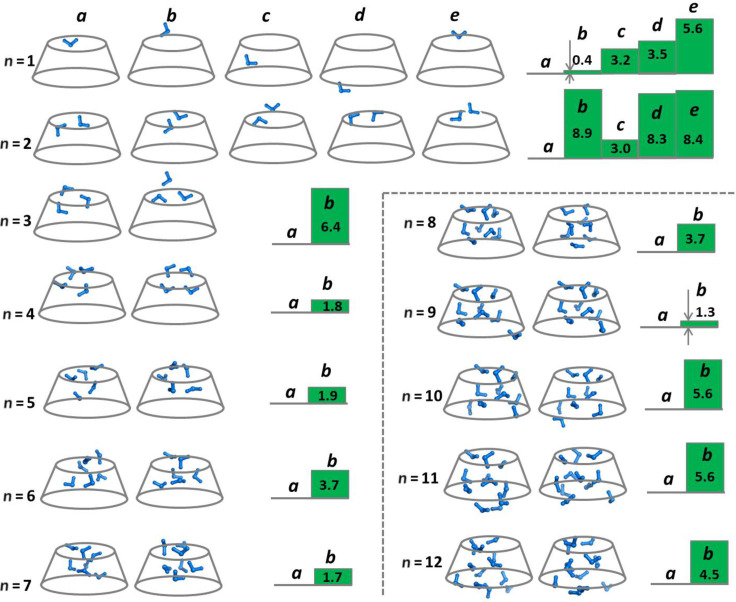
Cyclodextrins (CDs) are native host systems with inherent ability to form inclusion complexes with various molecular entities, mostly hydrophobic substances. Host cyclodextrins are accommodative to water molecules as well and contain water in the native state. For β-cyclodextrin (β-CD), there is no consensus regarding the number of bound water molecules and the location of their coordination. A number of intriguing questions remain: (1) Which localities of the host's macrocycle are the strongest attractors for the guest water molecules? (2) What are the stabilizing factors for the water clusters in the interior of β-CD and what type of interactions between water molecules and cavity walls or between the water molecules themselves are dominating the energetics of the β-CD hydration? (3) What is the maximum number of water molecules inside the cavity of β-CD? (4) How do the thermodynamic characteristics of β-CD hydration compare with those of its smaller α-cyclodextrin (α-CD) counterpart? In this study, we address these questions by employing a combination of experimental (DSC/TG) and theoretical (DFT) approaches.
环糊精(CDs)是天然的主体系统,具有与各种分子实体(主要是疏水性物质)形成包合物的固有能力。主体环糊精也能容纳水分子,并且在天然状态下含有水。对于β-环糊精(β-CD),关于结合水分子的数量及其配位位置尚无共识。仍有许多有趣的问题:(1)主体大环的哪些位置对客体水分子具有最强的吸引力?(2)β-CD内部水簇的稳定因素是什么,水分子与腔壁之间或水分子自身之间的哪种相互作用主导了β-CD水合作用的能量学?(3)β-CD腔内水分子的最大数量是多少?(4)β-CD水合作用的热力学特征与其较小的α-环糊精(α-CD)对应物的热力学特征相比如何?在本研究中,我们通过结合实验(DSC/TG)和理论(DFT)方法来解决这些问题。