Duggal Pallavi, Mehan Sidharth
Neuropharmacology Division, ISF College of Pharmacy, Moga, Punjab, India.
J Alzheimers Dis Rep. 2019 Jul 2;3(1):179-218. doi: 10.3233/ADR-190125.
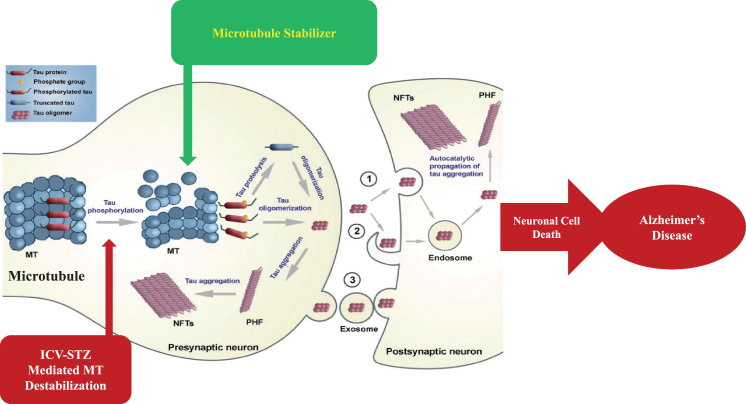
Neuronal microtubule (MT) tau protein provides cytoskeleton to neuronal cells and plays a vital role including maintenance of cell shape, intracellular transport, and cell division. Tau hyperphosphorylation mediates MT destabilization resulting in axonopathy and neurotransmitter deficit, and ultimately causing Alzheimer's disease (AD), a dementing disorder affecting vast geriatric populations worldwide, characterized by the existence of extracellular amyloid plaques and intracellular neurofibrillary tangles in a hyperphosphorylated state. Pre-clinically, streptozotocin stereotaxically mimics the behavioral and biochemical alterations similar to AD associated with tau pathology resulting in MT assembly defects, which proceed neuropathological cascades. Accessible interventions like cholinesterase inhibitors and NMDA antagonist clinically provides only symptomatic relief. Involvement of microtubule stabilizers (MTS) prevents tauopathy particularly by targeting MT oriented cytoskeleton and promotes polymerization of tubulin protein. Multiple and research studies have shown that MTS can hold substantial potential for the treatment of AD-related tauopathy dementias through restoration of tau function and axonal transport. Moreover, anti-cancer taxane derivatives and epothiolones may have potential to ameliorate MT destabilization and prevent the neuronal structural and functional alterations associated with tauopathies. Therefore, this current review strictly focuses on exploration of various clinical and pre-clinical features available for AD to understand the neuropathological mechanisms as well as introduce pharmacological interventions associated with MT stabilization. MTS from diverse natural sources continue to be of value in the treatment of cancer, suggesting that these agents have potential to be of interest in the treatment of AD-related tauopathy dementia in the future.
神经元微管(MT)tau蛋白为神经元细胞提供细胞骨架,并发挥着至关重要的作用,包括维持细胞形态、细胞内运输和细胞分裂。tau蛋白的过度磷酸化介导微管不稳定,导致轴突病变和神经递质缺乏,最终引发阿尔茨海默病(AD),这是一种影响全球大量老年人群的痴呆症,其特征是存在细胞外淀粉样斑块和处于过度磷酸化状态的细胞内神经原纤维缠结。在临床前,链脲佐菌素通过立体定位模拟与tau病理相关的类似于AD的行为和生化改变,导致微管组装缺陷,进而引发神经病理级联反应。临床上可采用的干预措施,如胆碱酯酶抑制剂和NMDA拮抗剂,仅能提供症状缓解。微管稳定剂(MTS)的参与尤其通过靶向微管导向的细胞骨架来预防tau病变,并促进微管蛋白的聚合。多项研究表明,MTS通过恢复tau蛋白功能和轴突运输,在治疗与AD相关的tau病变痴呆方面具有巨大潜力。此外,抗癌紫杉烷衍生物和埃坡霉素可能有潜力改善微管不稳定,并预防与tau病变相关的神经元结构和功能改变。因此,本综述严格聚焦于探索AD可用的各种临床和临床前特征,以了解神经病理机制,并介绍与微管稳定相关的药物干预措施。来自不同天然来源的MTS在癌症治疗中仍然具有价值,这表明这些药物未来有可能在治疗与AD相关的tau病变痴呆方面受到关注。