Universidad de Valladolid, Departamento de Física Teórica, Atómica y Óptica, Valladolid, España; Universidad de Valladolid, Instituto Universitario de Oftalmobiología Aplicada (IOBA), Valladolid, España; Optometry Research Group, IOBA Eye Institute, School of Optometry, University of Valladolid, Valladolid, Spain.
Optometry Research Group, IOBA Eye Institute, School of Optometry, University of Valladolid, Valladolid; Department of Ophthalmology, Ramón y Cajal University Hospital, Madrid, Spain.
Indian J Ophthalmol. 2019 Sep;67(9):1410-1416. doi: 10.4103/ijo.IJO_1538_18.
Compare the agreement between the finally fitted back optic zone radius (BOZR) of a spherical gas permeable (GP) contact lense (CL) with those proposed by different guidelines currently available to fit GP CLs in keratoconus.
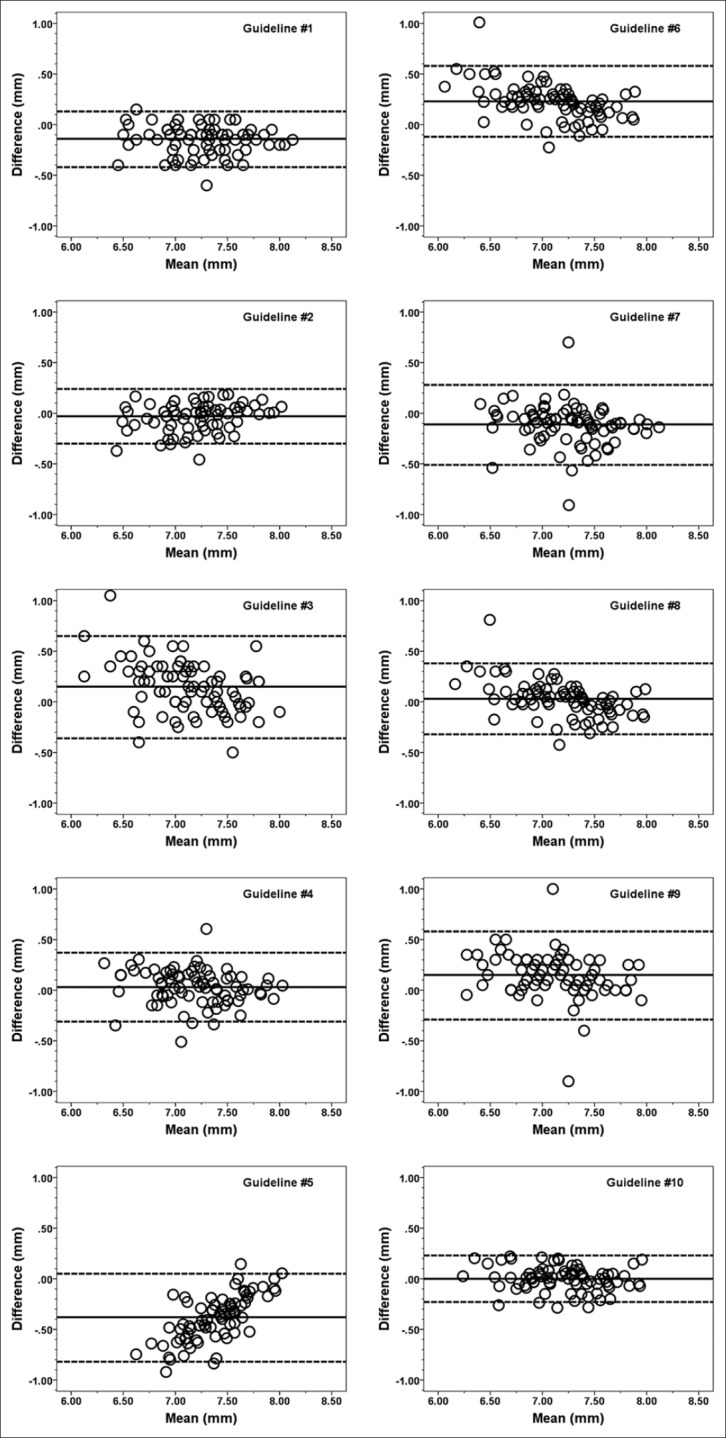
The BOZR fitted in 81 keratoconus eyes (46 patients) were recorded and compared with the BOZR calculated with ten different guidelines (identified after a literature review) proposed to calculate the first diagnostic lens BOZR to be fitted in keratoconus. Arithmetic and absolute mean difference between both BOZR were calculated (paired t-test). The success rate of each guideline (difference between both BOZR ≤0.05 mm) was calculated for different keratoconus stages (Amsler-Krumeich classification). Agreement between BOZR was evaluated using Bland-Altman analysis.
The BOZR proposed by all guidelines correlated with the final BOZR that was fitted (R > 0.71; P < 0.01). A statistically significant difference was found between the BOZR suggested by all guidelines and the BOZR that was prescribed (P < 0.05), except for three Guidelines (P ≥ 0.11). CALCULENS.com presented the best agreement (mean difference of 0.00 ± 0.12 mm), and 50.6% of cases showed ≤0.05 mm of difference with the BOZR that was fitted. However, the worst guideline showed an agreement of -0.38 ± 0.22 mm, and just 3.8% of cases had ≤0.05 mm of difference with the final fitted BOZR.
BOZR calculated with most of the analyzed guidelines shows statistical differences with final fitted BOZR, suggesting a lack of clinical validation of these guidelines. The selection of the BOZR with CALCULENS.com could provide a better starting point for spherical GP CL fitting in keratoconus eyes.
比较角膜塑形术(GP)接触镜(CL)最终拟合的后光学区半径(BOZR)与目前用于拟合圆锥角膜 GP CL 的不同指南中建议的 BOZR 的一致性。
记录 81 例(46 例患者)圆锥角膜患者的 BOZR,并与文献回顾后确定的 10 种不同指南中计算第一个诊断性镜片 BOZR 的计算值进行比较,以拟合圆锥角膜。计算两种 BOZR 的算术和绝对平均值差异(配对 t 检验)。对于不同的圆锥角膜阶段(Amsler-Krumeich 分类),计算每种指南的成功率(两种 BOZR 的差异≤0.05mm)。使用 Bland-Altman 分析评估 BOZR 之间的一致性。
所有指南建议的 BOZR 与最终拟合的 BOZR 相关(R>0.71;P<0.01)。除了三种指南(P≥0.11),所有指南建议的 BOZR 与处方 BOZR 之间存在统计学差异(P<0.05)。CALCULENS.com 表现出最佳的一致性(平均差异为 0.00±0.12mm),50.6%的病例与最终拟合的 BOZR 的差异≤0.05mm。然而,最差的指南显示出-0.38±0.22mm 的一致性,只有 3.8%的病例与最终拟合的 BOZR 的差异≤0.05mm。
大多数分析指南中计算的 BOZR 与最终拟合的 BOZR 存在统计学差异,表明这些指南缺乏临床验证。选择 CALCULENS.com 的 BOZR 可以为圆锥角膜患者的球形 GP CL 拟合提供更好的起点。