Department of Food, Environmental and Nutritional Sciences, University of Milan, Milan, Italy.
Departement of Biochemistry and Microbiology, University of Chemistry and Technology Prague, Prague, Czech Republic.
PLoS One. 2019 Aug 22;14(8):e0221253. doi: 10.1371/journal.pone.0221253. eCollection 2019.
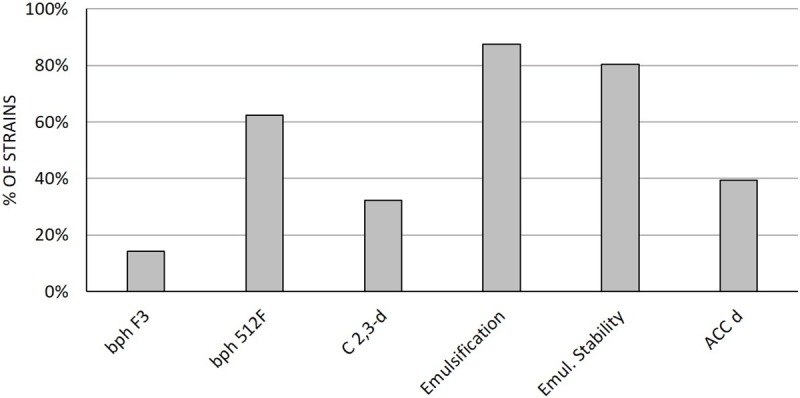
Extended soil contamination by polychlorinated biphenyls (PCBs) represents a global environmental issue that can hardly be addressed with the conventional remediation treatments. Rhizoremediation is a sustainable alternative, exploiting plants to stimulate in situ the degradative bacterial communities naturally occurring in historically polluted areas. This approach can be enhanced by the use of bacterial strains that combine PCB degradation potential with the ability to promote plant and root development. With this aim, we established a collection of aerobic bacteria isolated from the soil of the highly PCB-polluted site "SIN Brescia-Caffaro" (Italy) biostimulated by the plant Phalaris arundinacea. The strains, selected on biphenyl and plant secondary metabolites provided as unique carbon source, were largely dominated by Actinobacteria and a significant number showed traits of interest for remediation, harbouring genes homologous to bphA, involved in the PCB oxidation pathway, and displaying 2,3-catechol dioxygenase activity and emulsification properties. Several strains also showed the potential to alleviate plant stress through 1-aminocyclopropane-1-carboxylate deaminase activity. In particular, we identified three Rhodococcus strains able to degrade in vitro several PCB congeners and to promote lateral root emergence in the model plant Arabidopsis thaliana in vivo. In addition, these strains showed the capacity to colonize the root system and to increase the plant biomass in PCB contaminated soil, making them ideal candidates to sustain microbial-assisted PCB rhizoremediation through a bioaugmentation approach.
多氯联苯(PCBs)的土壤污染延伸是一个全球性的环境问题,传统的修复处理方法很难解决。根际修复是一种可持续的替代方法,利用植物刺激原位存在于历史污染地区的降解细菌群落。通过使用具有 PCB 降解潜力和促进植物和根系发育能力的细菌菌株,可以增强这种方法。为此,我们从高度 PCB 污染的“SIN Brescia-Caffaro”(意大利)土壤中分离出了一组好氧细菌,这些细菌是由植物菘蓝刺激的。这些菌株以联苯和植物次生代谢物为唯一碳源进行选择,主要由放线菌组成,并且有大量菌株具有修复的相关特性,携带参与 PCB 氧化途径的 bphA 同源基因,并表现出 2,3-儿茶酚双加氧酶活性和乳化特性。一些菌株还通过 1-氨基环丙烷-1-羧酸脱氨酶活性表现出缓解植物胁迫的潜力。特别是,我们鉴定了三株能够在体外降解几种 PCB 同系物并在体内促进模式植物拟南芥侧根出现的红球菌株。此外,这些菌株还表现出在 PCB 污染土壤中定殖根系和增加植物生物量的能力,使它们成为通过生物增强方法支持微生物辅助 PCB 根际修复的理想候选菌株。