Shanghai Ji Ai Genetics & IVF Institute, Obstetrics and Gynecology Hospital, Fudan University, Shanghai, China.
Collaborative Innovation Center for Genetics and Development, State Key Laboratory of Genetic Engineering, School of Life Science, Fudan University, Shanghai, China.
J Med Genet. 2019 Nov;56(11):741-749. doi: 10.1136/jmedgenet-2018-105976. Epub 2019 Aug 22.
Preimplantation genetic testing (PGT) has already been applied in patients known to carry chromosomal structural variants to improve the clinical outcome of assisted reproduction. However, conventional molecular techniques are not capable of reliably distinguishing embryos that carry balanced inversion from those with a normal karyotype. We aim to evaluate the use of long-read sequencing in combination with haplotype linkage analysis to address this challenge.
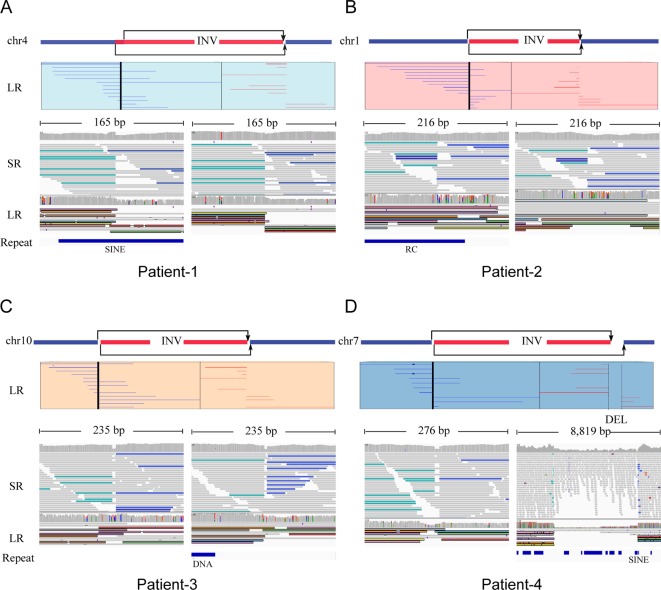
Long-read sequencing on Oxford Nanopore platform was employed to identify the precise positions of inversion break points in four patients. Comprehensive chromosomal screening and genome-wide haplotype linkage analysis were performed based on SNP microarray. The haplotypes, including the break point regions, the whole chromosomes involved in the inversion and the corresponding homologous chromosomes, were established using informative SNPs.
All the inversion break points were successfully identified by long-read sequencing and validated by Sanger sequencing, and on average only 13 bp differences were observed between break points inferred by long-read sequencing and Sanger sequencing. Eighteen blastocysts were biopsied and tested, in which 10 were aneuploid or unbalanced and eight were diploid with normal or balanced inversion karyotypes. Diploid embryos were transferred back to patients, the predictive results of the current methodology were consistent with fetal karyotypes of amniotic fluid or cord blood.
Nanopore long-read sequencing is a powerful method to assay chromosomal inversions and identify exact break points. Identification of inversion break points combined with haplotype linkage analysis is an efficient strategy to distinguish embryos with normal or balanced inversion karyotypes, facilitating PGT applications.
胚胎植入前遗传学检测(PGT)已应用于携带染色体结构变异的患者,以提高辅助生殖的临床结局。然而,传统的分子技术无法可靠地区分携带平衡倒位的胚胎与具有正常核型的胚胎。我们旨在评估长读长测序结合单倍型连锁分析在解决这一挑战中的应用。
采用 Oxford Nanopore 平台进行长读长测序,以确定四名患者中倒位断点的精确位置。基于 SNP 微阵列进行全面染色体筛查和全基因组单倍型连锁分析。利用信息 SNP 建立包括断点区域、涉及倒位的整条染色体和相应同源染色体的单倍型。
所有的倒位断点均通过长读长测序成功识别,并通过 Sanger 测序验证,平均观察到长读长测序和 Sanger 测序推断的断点之间仅存在 13bp 的差异。对 18 个囊胚进行活检和检测,其中 10 个为非整倍体或不平衡,8 个为二倍体,具有正常或平衡的倒位核型。将二倍体胚胎移植回患者体内,当前方法的预测结果与羊水或脐带血的胎儿核型一致。
Nanopore 长读长测序是一种检测染色体倒位和确定精确断点的强大方法。与单倍型连锁分析相结合的倒位断点鉴定是区分具有正常或平衡倒位核型的胚胎的有效策略,有助于 PGT 的应用。