
单纯疱疹病毒 1 编码的 miR-H2-3p 通过靶向 DDX41 调控细胞质 DNA 刺激的抗病毒固有免疫反应。
Herpes Simplex Virus Type 1-Encoded miR-H2-3p Manipulates Cytosolic DNA-Stimulated Antiviral Innate Immune Response by Targeting DDX41.
机构信息
Department of Viral Immunology, Institute of Medical Biology, Chinese Academy of Medical Sciences & Peking Union Medical College, Kunming 650118, China.
Experimental Center for Medical Research, Kunming Medical University, Kunming 650500, China.
出版信息
Viruses. 2019 Aug 15;11(8):756. doi: 10.3390/v11080756.
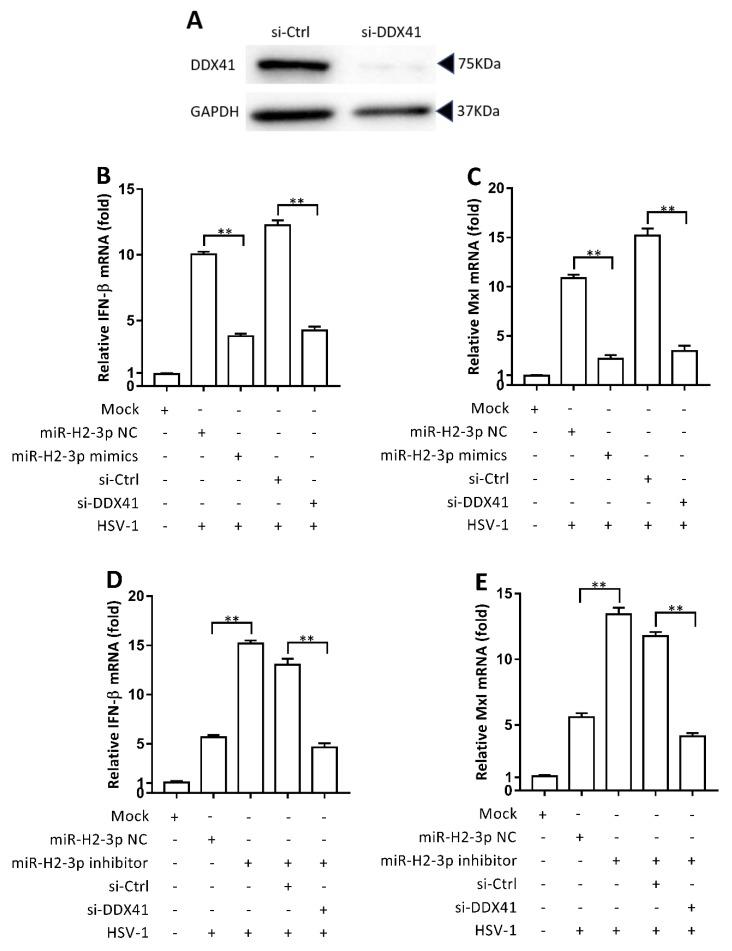
Herpes simplex virus type 1 (HSV-1), one of the human pathogens widely epidemic and transmitted among various groups of people in the world, often causes symptoms known as oral herpes or lifelong asymptomatic infection. HSV-1 employs many sophisticated strategies to escape host antiviral immune response based on its multiple coding proteins. However, the functions involved in the immune evasion of miRNAs encoded by HSV-1 during lytic (productive) infection remain poorly studied. Dual-luciferase reporter gene assay and bioinformatics revealed that Asp-Glu-Ala-Asp (DEAD)-box helicase 41 (DDX41), a cytosolic DNA sensor of the DNA-sensing pathway, was a putative direct target gene of HSV-1-encoded miR-H2-3p. The transfection of miR-H2-3p mimics inhibited the expression of DDX41 at the level of mRNA and protein, as well as the expression of interferon beta (IFN-β) and myxoma resistance protein I (MxI) induced by HSV-1 infection in THP-1 cells, and promoted the viral replication and its gene transcription. However, the transfection of miR-H2-3p inhibitor showed opposite effects. This finding indicated that HSV-1-encoded miR-H2-3p attenuated cytosolic DNA-stimulated antiviral immune response by manipulating host DNA sensor molecular DDX41 to enhance virus replication in cultured cells.
单纯疱疹病毒 1 型(HSV-1)是一种在世界范围内广泛流行并在不同人群中传播的人类病原体,常引起口腔疱疹或终生无症状感染等症状。HSV-1 利用其多种编码蛋白,采用许多复杂的策略来逃避宿主抗病毒免疫反应。然而,在裂解(有活力)感染过程中,HSV-1 编码的 miRNAs 所涉及的免疫逃逸功能仍研究甚少。双荧光素酶报告基因检测和生物信息学分析表明,解旋酶 41(DDX41)是 DNA 感应途径的细胞质 DNA 传感器,是 HSV-1 编码的 miR-H2-3p 的一个潜在的直接靶基因。miR-H2-3p 模拟物的转染抑制了 THP-1 细胞中 HSV-1 感染诱导的 DDX41 的 mRNA 和蛋白表达,以及干扰素β(IFN-β)和兔粘液瘤抵抗蛋白 I(MxI)的表达,并促进了病毒复制及其基因转录。然而,miR-H2-3p 抑制剂的转染则表现出相反的效果。这一发现表明,HSV-1 编码的 miR-H2-3p 通过操纵宿主 DNA 传感器分子 DDX41 来削弱细胞质 DNA 刺激的抗病毒免疫反应,从而增强病毒在培养细胞中的复制。



 Zotero 插件