State Key Laboratory of Hydrology-Water Resources and Hydraulic Engineering, Hohai University, Nanjing 210098, China.
Business School, Hohai University, Nanjing 211100, China.
Int J Environ Res Public Health. 2019 Aug 22;16(17):3051. doi: 10.3390/ijerph16173051.
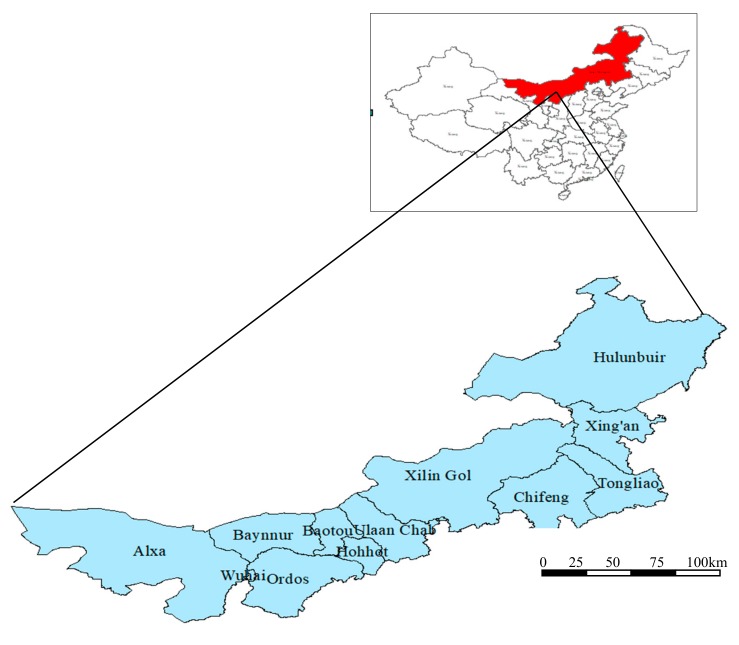
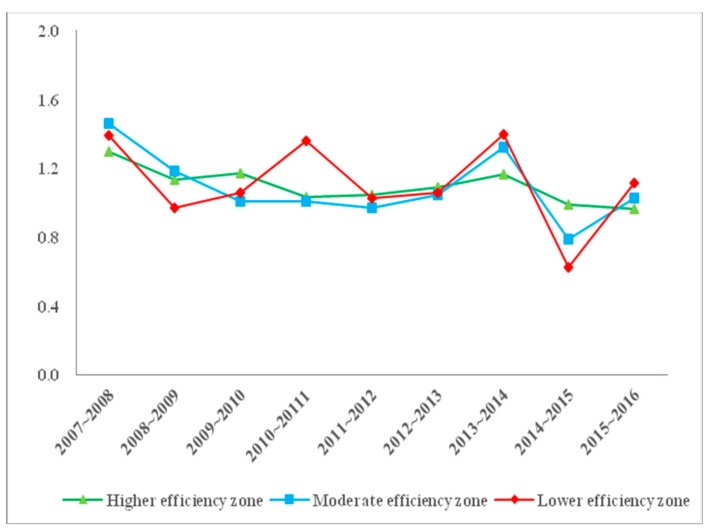
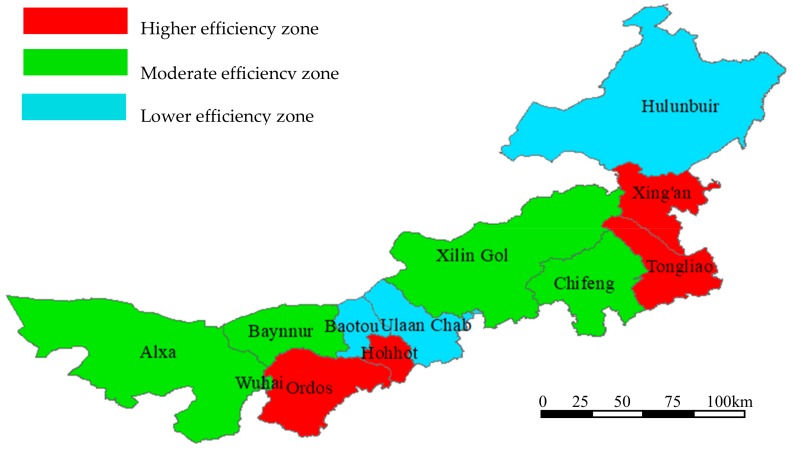
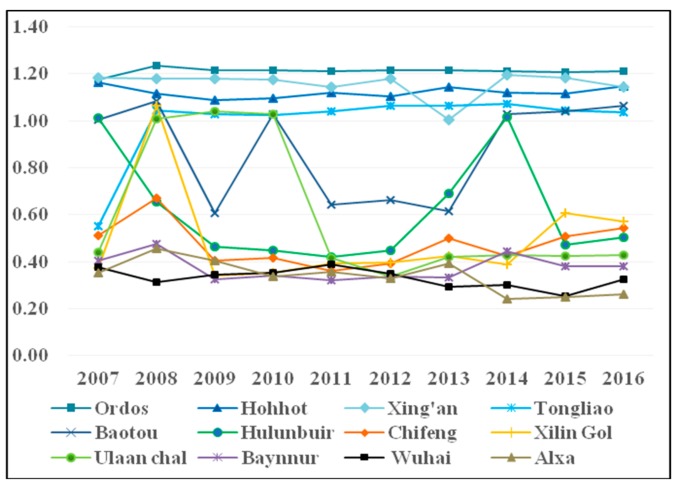
With the supply of water, energy and food facing severe challenges, there has been an increased recognition of the importance of studying the regional water-energy-food nexus. In this paper, Inner Mongolia, including 12 cities in China, was selected as a research case. A super-efficiency slack based measure (SBM) model that considered the undesirable outputs was adopted to calculate the regional total factor productivity (TFP) and the Malmquist-Luenberger index was used to investigate the change trend of the TFP from 2007 to 2016 based on understanding the water-energy-food nexus. Finally, influential factors of the TFP were explored by Tobit regression. The results show that the 12 Inner Mongolia cities are divided into higher, moderate and lower efficiency zones. The higher efficiency zone includes Ordos, Hohhot, Xing'an, and Tongliao, and the lower efficiency zone includes Chifeng, Xilin Gol, Baynnur, Wuhai and Alxa. There is a serious difference in TFP between Inner Mongolia cities. During the study period, the TFP of the water-energy-food nexus in Inner Mongolia cities shows a rising trend, which is mainly driven by the growth of technical progress change. However, the average ML values of the lower and moderate efficiency zones were inferior to the higher efficiency zone in six of the ten years, so the difference between Inner Mongolia cities is growing. According to the Tobit regression, the mechanization level and degree of opening up have positive effects on the TFP, while enterprise scale and the output of the third industry have negative effects on the TFP. Government support does not have any significant impact on the TFP. Finally, suggestions were put forward to improve the TFP of the water-energy-food nexus in Inner Mongolia cities.
在水、能源和粮食供应面临严峻挑战的情况下,人们越来越认识到研究区域水-能源-粮食关系的重要性。本文以中国内蒙古 12 个城市为研究案例,采用考虑非期望产出的超效率松弛测度(SBM)模型计算了区域全要素生产率(TFP),并利用 Malmquist-Luenberger 指数探讨了 2007—2016 年 TFP 的变化趋势,在此基础上,从水-能源-粮食关系的角度理解了内蒙古各城市 TFP 的变化情况。最后,利用 Tobit 回归模型探讨了影响 TFP 的因素。结果表明:12 个内蒙古城市可分为高、中、低效率区,其中,高效率区包括鄂尔多斯市、呼和浩特市、兴安盟和通辽市,低效率区包括赤峰市、锡林郭勒盟、巴彦淖尔市、乌海市和阿拉善盟;内蒙古城市 TFP 差异明显,研究期间,内蒙古城市水-能源-粮食关系的 TFP 呈上升趋势,主要得益于技术进步变化的推动;但在 10 年中有 6 年,低效率区和中效率区的平均 ML 值均低于高效率区,说明内蒙古城市间的差距在扩大。Tobit 回归结果显示,机械化水平和对外开放程度对 TFP 具有正向影响,而企业规模和第三产业产值对 TFP 具有负向影响,政府支持对 TFP 没有显著影响。最后,为提高内蒙古城市水-能源-粮食关系的 TFP 提出了相关建议。