van Luenen Sanne, Kraaij Vivian, Spinhoven Philip, Wilderjans Tom F, Garnefski Nadia
Section of Clinical Psychology, Institute of Psychology, Faculty of Social and Behavioural Sciences, Leiden University, Leiden, Netherlands.
Department of Psychiatry, Leiden University Medical Center, Leiden, Netherlands.
JMIR Ment Health. 2019 Aug 23;6(8):e12711. doi: 10.2196/12711.
Cognitive behavioral therapy (CBT) is frequently used to treat depressive symptoms in people living with HIV. We developed an internet-based cognitive behavioral intervention for people with HIV and depressive symptoms, which was based on an effective self-help booklet. The Web-based intervention was previously found to be effective.
The objective of this study was to investigate potential mediators of the Web-based intervention.
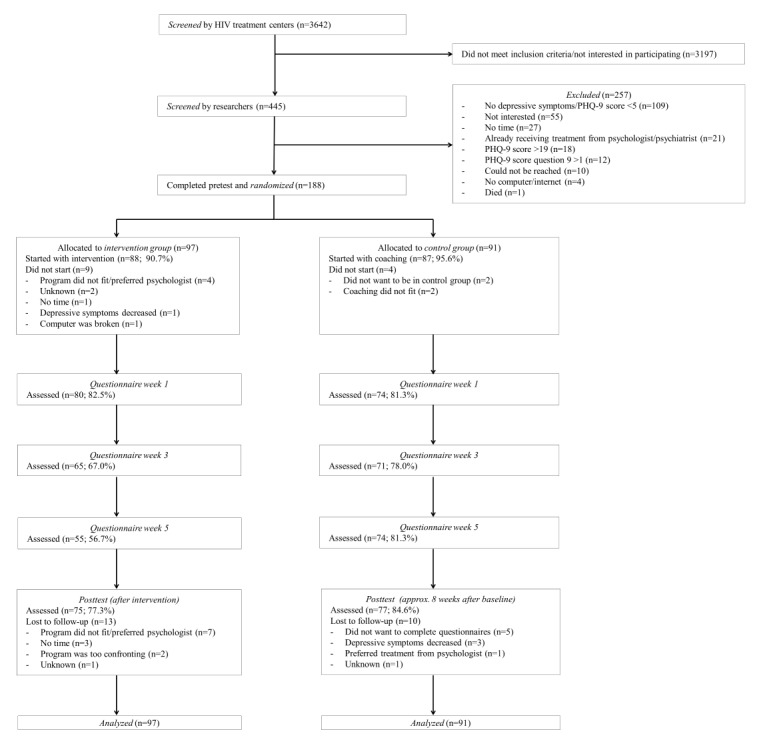
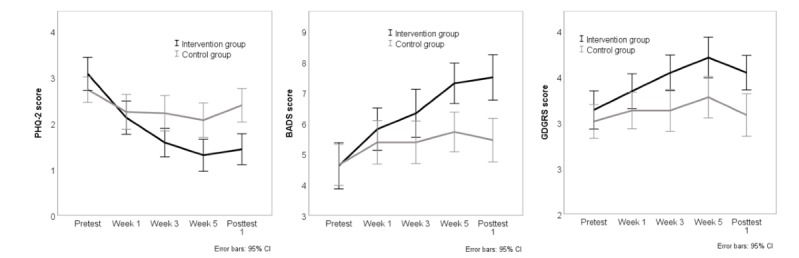
This study was part of a randomized controlled trial, in which the intervention was compared with an attention-only waiting list control condition. Participants were 188 (97 in intervention group and 91 in control group) people with HIV and mild to moderate depressive symptoms recruited in HIV treatment centers in the Netherlands. A total of 22 participants (22/188, 11.7%) in the study were female and 166 (166/188, 88.3%) were male. The average age of the participants was 46.30 years (SD 10.63). The intervention comprised Web-based self-help CBT for 8 weeks, 1 to 2 hours a week, including minimal telephone support from a coach. The participants received Web-based questionnaires at pretest, 3 times during the intervention/or waiting period, and post intervention. The outcome was depressive symptoms. Factors tested as potential mediators were changes in behavioral activation, relaxation, the cognitive coping strategies catastrophizing and positive refocusing, goal re-engagement, and coping self-efficacy.
Using multilevel structural equation modeling, changes in behavioral activation (P=.006) and goal re-engagement (P=.009) were found to be significant mediators of the intervention effect. The mediation effect seemed to occur between weeks 3 and 5 for behavioral activation and weeks 1 and 3 for goal re-engagement. Using (bivariate) autoregressive latent trajectory analysis, we found a return effect (from the dependent variable to the mediator) for goal re-engagement but not for behavioral activation, which suggested that the mediation effect of changes in behavioral activation was stronger than that in goal re-engagement.
The results suggest that changes in behavioral activation and goal re-engagement may mediate the effect of the Web-based intervention for people with HIV and depressive symptoms. The results may lead to possible mechanisms of change of the intervention and improvement of therapy outcomes.
Netherlands Trial Register NTR5407; https://www.trialregister.nl/trial/5298.
认知行为疗法(CBT)常用于治疗HIV感染者的抑郁症状。我们基于一本有效的自助手册,为患有HIV和抑郁症状的人群开发了一种基于互联网的认知行为干预措施。此前发现该基于网络的干预措施是有效的。
本研究的目的是调查基于网络的干预措施的潜在中介因素。
本研究是一项随机对照试验的一部分,其中将干预措施与仅接受关注的等待列表对照条件进行比较。参与者为188名(干预组97名,对照组91名)在荷兰HIV治疗中心招募的患有HIV且有轻度至中度抑郁症状的人。研究中共有22名参与者(22/188,11.7%)为女性,166名(166/188,88.3%)为男性。参与者的平均年龄为46.30岁(标准差10.63)。干预包括为期8周、每周1至2小时的基于网络的自助CBT,包括来自一名指导者的最少电话支持。参与者在预测试、干预/等待期间的3次以及干预后接受基于网络的问卷调查。结果指标为抑郁症状。作为潜在中介因素进行测试的因素包括行为激活、放松、认知应对策略灾难化和积极重新聚焦、目标重新参与以及应对自我效能的变化。
使用多层次结构方程模型,发现行为激活的变化(P = 0.006)和目标重新参与的变化(P = 0.009)是干预效果的显著中介因素。行为激活的中介效应似乎发生在第3周和第5周之间,目标重新参与的中介效应发生在第1周和第3周之间。使用(双变量)自回归潜在轨迹分析,我们发现目标重新参与存在回归效应(从因变量到中介因素),但行为激活不存在,这表明行为激活变化的中介效应比目标重新参与的中介效应更强。
结果表明,行为激活和目标重新参与的变化可能介导基于网络的干预措施对患有HIV和抑郁症状人群的效果。这些结果可能会引出干预措施可能的变化机制以及治疗效果的改善。
荷兰试验注册NTR5407;https://www.trialregister.nl/trial/5298 。