Wang Ying, Lei Jianxun, Jha Ritu K, Kiven Stacy, Gupta Kalpna
Vascular Biology Center, Division of Hematology, Oncology and Transplantation, Department of Medicine, University of Minnesota, Minneapolis, MN, USA.
J Pain Res. 2019 Aug 1;12:2419-2426. doi: 10.2147/JPR.S210196. eCollection 2019.
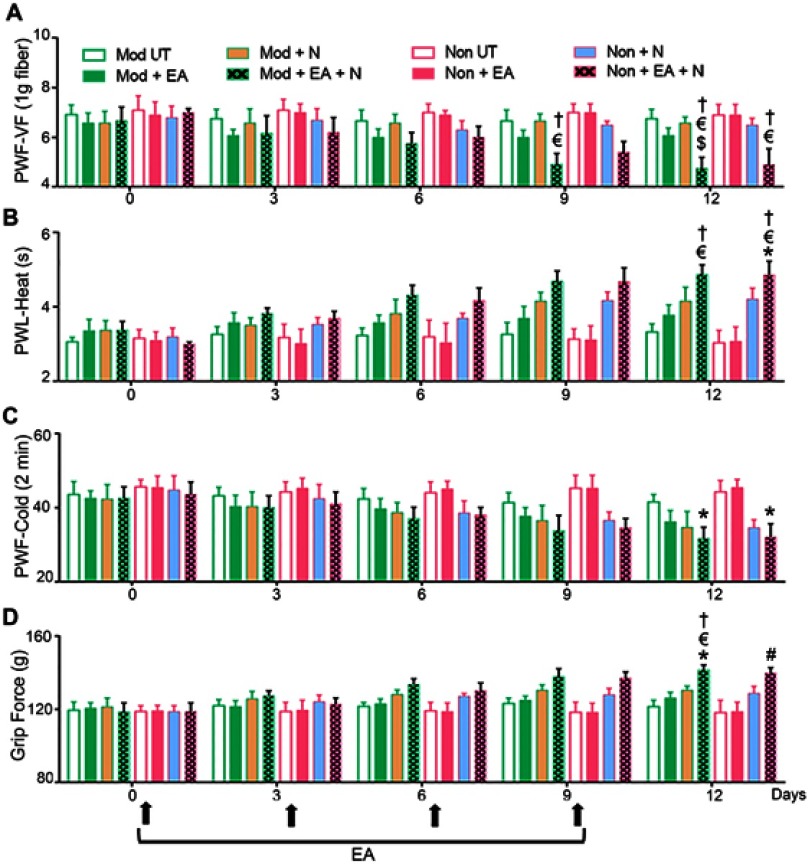
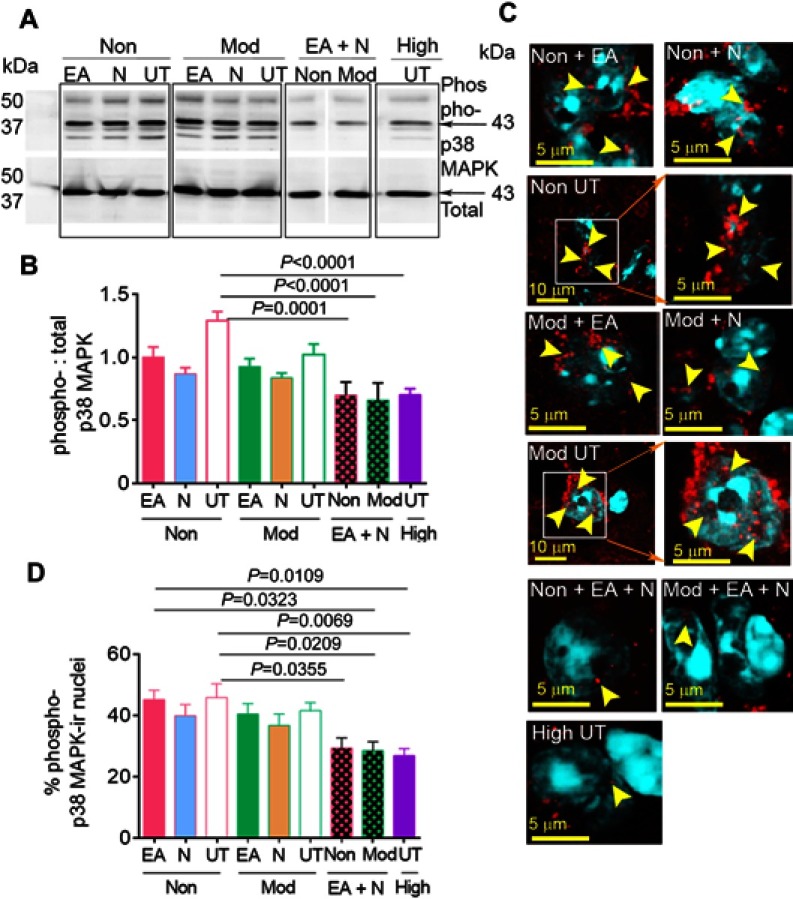
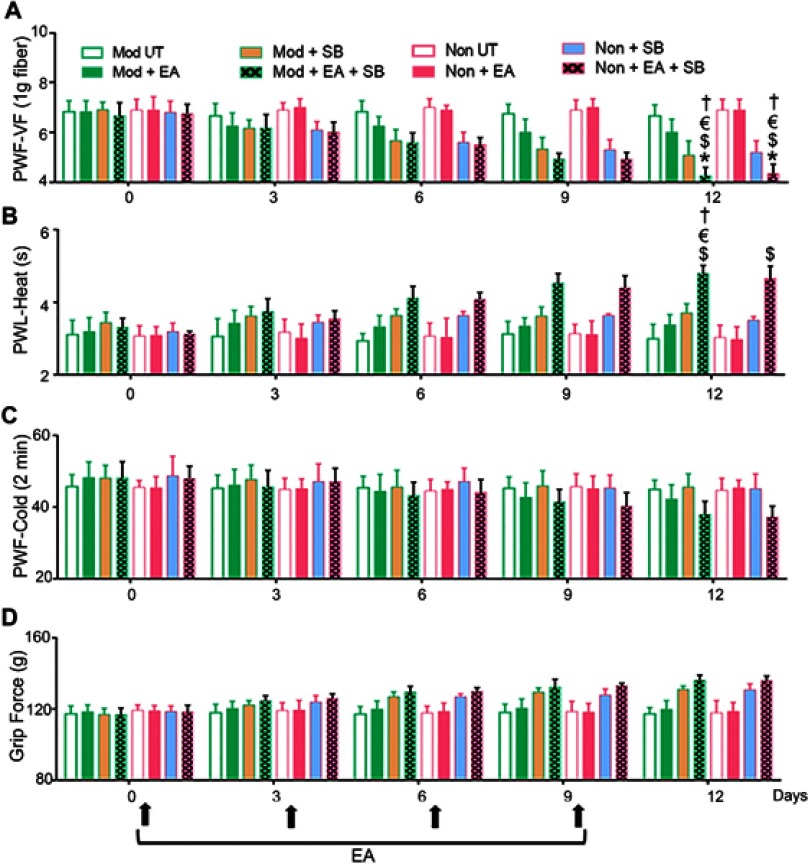
Chronic pain is a major comorbidity of sickle cell disease (SCD). Acupuncture, a non-opioid and non-addictive therapy to treat pain, was found to reduce pain in the majority (80%) of SCD patients in an earlier retrospective review. We observed that electroacupuncture (EA) decreased hyperalgesia in transgenic mice with SCD with varied analgesia from high to moderate to no response. Interestingly, poor responders exhibited high levels of substance P (SP), a mediator of chronic pain, as well as active p38 MAPK in spinal cords. The present study aimed to investigate the roles of inhibition of SP and SP-activated p38 MAPK in chronic pain in sickle mice that are poorly responsive to EA intervention (moderate/non-responders). Humanized mouse model with SCD defined as moderate- and non-responders to EA were intraperitoneally administered with antagonist of SP receptor NK1R (netupitant, 10 mg/kg/day, i.p.) or p38 MAPK inhibitor (SB203580, 10 mg/kg/day, i.p.) alone or in combination with EA (acupoint GB30, every 3rd day until day 12). Hyperalgesia to mechanical, thermal and cold stimuli, as well as deep tissue were measured. Phosphorylated p38 MAPK (phospho-p38 MAPK) in the lumbar spinal cord was quantified using western blotting. Phospho-p38 MAPK nuclear translocation in spinal dorsal horn was examined using immunohistochemical staining and confocal microscopy. In EA poor-responders, combined treatment with EA and netupitant significantly enhanced the analgesic effects of EA in poor-responders on mechanical, heat, cold, and deep tissue pain, and decreased phosphorylation of p38 MAPK in lumbar spinal cords and its nuclear translocation in the spinal dorsal horn. Furthermore, combined treatment with EA and SB203580 significantly improved analgesic effects of EA on mechanical and heat hyperalgesia, but not cold or deep tissue hyperalgesia. However, additional EA treatment only, or administration of either netupitant or SB203580 alone did not lead to analgesic effects. These results suggest a pivotal role of SP in maintaining the chronic pain in SCD via spinal phospho-p38 MAPK signaling, which may hinder the effect of EA in poor responders. Inhibition of SP signaling pathway or activity of p38 MAPK significantly improved the EA analgesia In EA poor-responders with SCD, which provides a promising way to treat the chronic pain in patients with SCD.
慢性疼痛是镰状细胞病(SCD)的一种主要合并症。针灸是一种治疗疼痛的非阿片类且无成瘾性的疗法,在早期一项回顾性研究中发现,它能减轻大多数(80%)SCD患者的疼痛。我们观察到,电针(EA)可减轻SCD转基因小鼠的痛觉过敏,镇痛效果从高到中再到无反应各不相同。有趣的是,反应较差的小鼠脊髓中显示出高水平的P物质(SP),这是一种慢性疼痛介质,同时还有活性p38丝裂原活化蛋白激酶(MAPK)。本研究旨在探究抑制SP以及SP激活的p38 MAPK在对EA干预反应较差(中度/无反应)的镰状小鼠慢性疼痛中的作用。将被定义为对EA中度和无反应的SCD人源化小鼠模型腹腔注射SP受体NK1R拮抗剂(奈妥吡坦,10毫克/千克/天,腹腔注射)或p38 MAPK抑制剂(SB203580,10毫克/千克/天,腹腔注射),单独使用或与EA联合使用(针刺穴位GB30,每3天一次,直至第12天)。测量对机械、热和冷刺激以及深部组织的痛觉过敏情况。使用蛋白质印迹法对腰脊髓中磷酸化的p38 MAPK(磷酸化p38 MAPK)进行定量分析。使用免疫组织化学染色和共聚焦显微镜检查脊髓背角中磷酸化p38 MAPK的核转位情况。在对EA反应较差的小鼠中,EA与奈妥吡坦联合治疗显著增强了EA对反应较差小鼠在机械、热痛、冷痛和深部组织疼痛方面的镇痛效果,并降低了腰脊髓中p38 MAPK的磷酸化及其在脊髓背角的核转位。此外,EA与SB203580联合治疗显著改善了EA对机械性和热痛觉过敏的镇痛效果,但对冷痛或深部组织痛觉过敏无效。然而,仅额外进行EA治疗,或单独给予奈妥吡坦或SB203580均未产生镇痛效果。这些结果表明,SP通过脊髓磷酸化p38 MAPK信号通路在维持SCD慢性疼痛中起关键作用,这可能会阻碍EA在反应较差小鼠中的效果。抑制SP信号通路或p38 MAPK的活性可显著改善SCD中对EA反应较差小鼠的EA镇痛效果,这为治疗SCD患者的慢性疼痛提供了一种有前景的方法。