Fang Jennifer, Hirschi Karen
Department of Molecular Biology and Biochemistry, School of Biological Sciences, University of California, Irvine, Irvine, CA, 92697, USA.
2Departments of Medicine, Genetics, and Biomedical Engineering, Yale Cardiovascular Research Center, Yale Stem Cell Center, Yale University School of Medicine, 333 Cedar Street, New Haven, CT, 06520, USA.
F1000Res. 2019 Jul 29;8. doi: 10.12688/f1000research.16701.1. eCollection 2019.
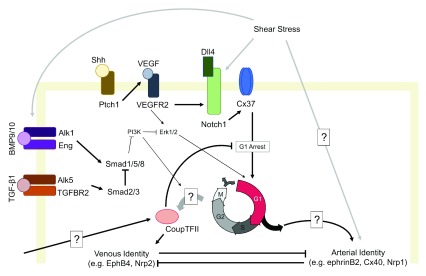
The systemic circulation depends upon a highly organized, hierarchal blood vascular network that requires the successful specification of arterial and venous endothelial cells during development. This process is driven by a cascade of signaling events (including Hedgehog, vascular endothelial growth factor (VEGF), Notch, connexin (Cx), transforming growth factor-beta (TGF- β), and COUP transcription factor 2 (COUP-TFII)) to influence endothelial cell cycle status and expression of arterial or venous genes and is further regulated by hemodynamic flow. Failure of endothelial cells to properly undergo arteriovenous specification may contribute to vascular malformation and dysfunction, such as in hereditary hemorrhagic telangiectasia (HHT) and capillary malformation-arteriovenous malformation (CM-AVM) where abnormal vessel structures, such as large shunts lacking clear arteriovenous identity and function, thereby compromising peripheral blood flow. This review provides an overview of recent findings in the field of arteriovenous specification and highlights key regulators of this process.
体循环依赖于一个高度组织化的层级式血管网络,该网络在发育过程中需要成功确定动脉和静脉内皮细胞。这个过程由一系列信号事件驱动(包括刺猬信号通路、血管内皮生长因子(VEGF)、Notch信号通路、连接蛋白(Cx)、转化生长因子-β(TGF-β)和COUP转录因子2(COUP-TFII)),以影响内皮细胞周期状态以及动脉或静脉基因的表达,并且进一步受到血流动力学的调节。内皮细胞未能正确进行动静脉分化可能会导致血管畸形和功能障碍,例如在遗传性出血性毛细血管扩张症(HHT)和毛细血管畸形-动静脉畸形(CM-AVM)中,存在异常的血管结构,如缺乏明确动静脉特征和功能的大分流,从而损害外周血流。本综述概述了动静脉分化领域的最新发现,并强调了这一过程的关键调节因子。