Department of Non-Communicable Disease Epidemiology, London School of Hygiene and Tropical Medicine, London, UK.
Saw Swee Hock School of Public Health, National University of Singapore, Singapore.
J Glob Health. 2019 Dec;9(2):020409. doi: 10.7189/jogh.09.020409.
Non-communicable diseases (NCDs) cause a large and growing burden of morbidity and mortality in sub-Saharan Africa. Prospective cohort studies are key to study multiple risk factors and chronic diseases and are crucial to our understanding of the burden, aetiology and prognosis of NCDs in SSA. We aimed to identify the level of research output on NCDs and their risk factors collected by cohorts in SSA.
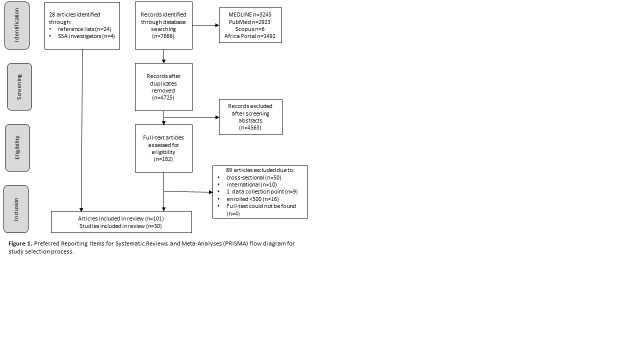
We conducted a scoping review to map the extent of current NCDs research in SSA by identifying studies published after the year 2000 using prospectively collected cohort data on any of the six NCDs (cardiovascular diseases, diabetes, obesity, chronic kidney disease, chronic respiratory diseases, and cancers), ≥1 major risk factor (other than age and sex), set only within SSA, enrolled ≥500 participants, and ≥12 months of follow-up with ≥2 data collection points (or with plans to). We performed a systematic search of databases, a manual search of references lists from included articles and the INDEPTH network website, and study investigators from SSA were contacted for further articles.
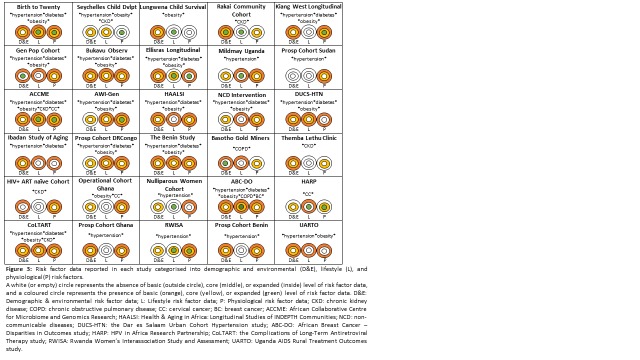
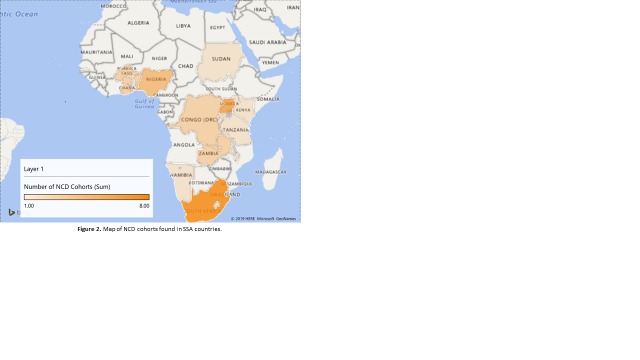
We identified 30 cohort studies from the 101 included articles. Eighteen countries distributed in West, Central, East and Southern Africa, were represented. The majority (27%) set in South Africa. There were three studies including children, twenty with adults, and seven with both. 53% of cohorts were sampled in general populations, 47% in clinical populations, and 1 occupational cohort study. Hypertension (n = 23) was most commonly reported, followed by obesity (n = 16), diabetes (n = 15), CKD (n = 6), COPD (n = 2), cervical cancer (n = 3), and breast cancer (n = 1). The majority (n = 22) reported data on at least one demographic/environmental, lifestyle, or physiological risk factor but these data varied greatly.
Most studies collected data on a combination of hypertension, diabetes, and obesity and few studies collected data on respiratory diseases and cancer. Although most collected data on different risk factors the methodologies varied greatly. Several methodological limitations were found including low recruitment rate, low retention rate, and lack of validated and standardized data collection. Our results could guide potential collaborations and maximize impact to improve our global understanding of NCDs (and their risk factors) in SSA and also to inform future research, as well as policies.
非传染性疾病(NCDs)在撒哈拉以南非洲地区导致了大量且不断增长的发病率和死亡率。前瞻性队列研究是研究多种危险因素和慢性病的关键,对于我们了解 NCDs 在 SSA 的负担、病因和预后至关重要。我们旨在确定 SSA 队列研究中收集的 NCDs 及其危险因素的研究产出水平。
我们进行了范围界定审查,以确定 2000 年后使用前瞻性收集的队列数据在 SSA 进行的任何六种 NCD(心血管疾病、糖尿病、肥胖症、慢性肾脏病、慢性呼吸道疾病和癌症)之一、≥1 个主要危险因素(除年龄和性别外)、仅在 SSA 内进行、纳入≥500 名参与者且≥12 个月随访时间≥2 个数据收集点(或有计划进行)的 NCDs 研究的当前 NCDs 研究的程度。我们对数据库进行了系统搜索,对纳入文章的参考文献列表和 INDEPTH 网络网站进行了手动搜索,并联系了 SSA 的研究人员以获取更多文章。
我们从 101 篇文章中确定了 30 项队列研究。代表了分布在西非、中非、东非和南非的 18 个国家。其中南非的研究最多(27%)。有三项研究包括儿童,二十项研究包括成年人,七项研究包括儿童和成年人。53%的队列研究在普通人群中进行,47%在临床人群中进行,1 项为职业队列研究。高血压(n=23)报告最多,其次是肥胖症(n=16)、糖尿病(n=15)、慢性肾脏病(n=6)、慢性阻塞性肺疾病(n=2)、宫颈癌(n=3)和乳腺癌(n=1)。大多数研究(n=22)报告了至少一个人口统计学/环境、生活方式或生理危险因素的数据,但这些数据差异很大。
大多数研究都收集了高血压、糖尿病和肥胖症的数据,而很少有研究收集了呼吸道疾病和癌症的数据。尽管大多数研究都收集了不同的危险因素,但方法差异很大。研究发现了几个方法学局限性,包括低招募率、低保留率以及缺乏经过验证和标准化的数据收集。我们的研究结果可以指导潜在的合作,并最大限度地提高对撒哈拉以南非洲地区 NCDs(及其危险因素)的全球理解,还可以为未来的研究以及政策提供信息。