Song Yali, Ye Wenting, Ye Huiyun, Xie Tingting, Shen Weiwei, Zhou Lili
Center for Reproductive Medicine, Department of Obstetrics and Gynecology, Nanfang Hospital, Southern Medical University, Guangzhou, China.
State Key Laboratory of Organ Failure Research, National Clinical Research Center of Kidney Disease, Division of Nephrology, Nanfang Hospital, Southern Medical University, Guangzhou, China.
Physiol Rep. 2019 Aug;7(16):e14219. doi: 10.14814/phy2.14219.
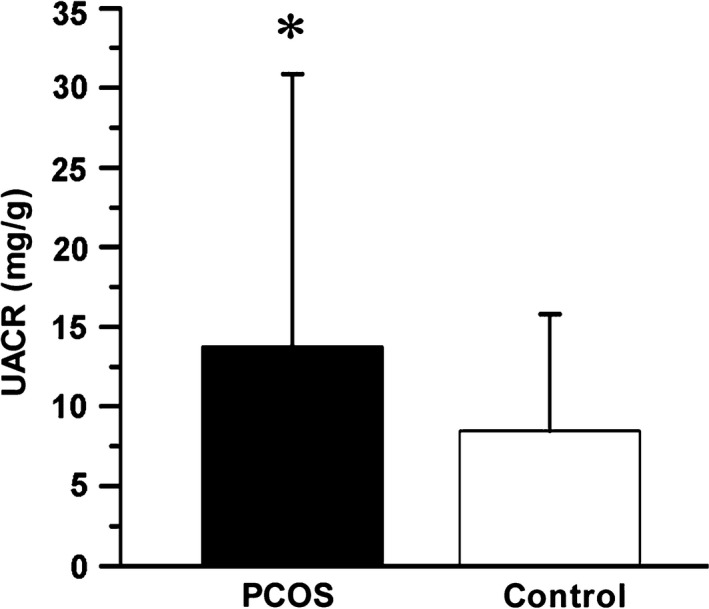
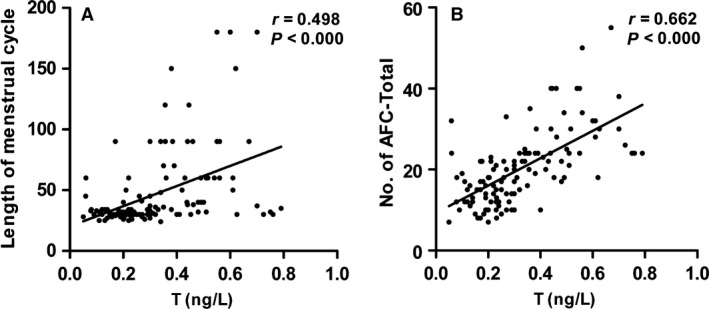
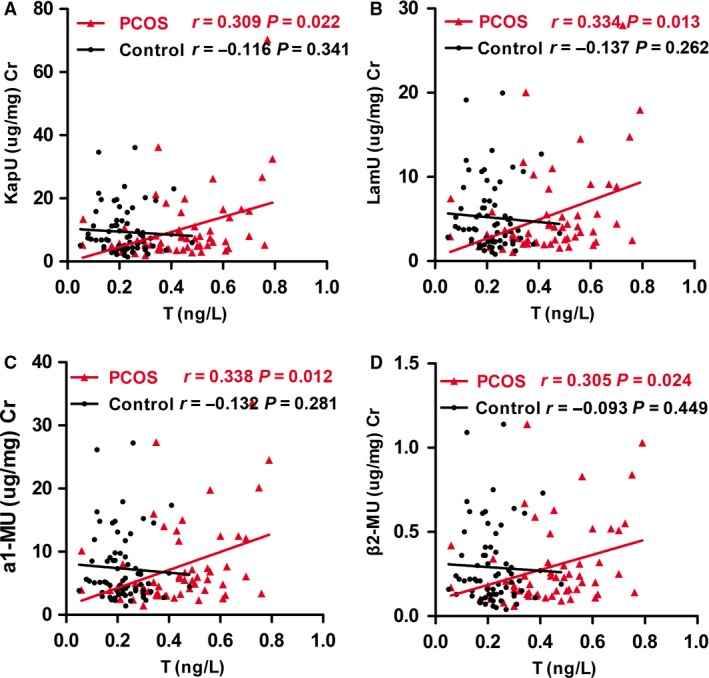
Polycystic ovary syndrome (PCOS) is closely related with the onset and development of metabolic abnormalities. However, the correlation between PCOS and kidney injury has not been clarified, and the underlying mechanism remains unknown. Herein, we performed a prospective survey in 55 PCOS and 69 healthy participants. Furthermore, the correlation analyses between serum testosterone and renal functional manifestations of patients and healthy subjects, including urinary albumin to creatinine ratio (UACR), urinary κ-light chains (KapU), urinary λ-light chains (LamU), urinary α1-microglobulin (α1-MU), and urinary β2-microglobulin (β2-MU), were analyzed. Compared with that in normal subjects, the levels of serum testosterone and UACR were significantly higher in PCOS patients. Serum testosterone is significantly correlated with the disease severity of PCOS. Although urinary excretions of KapU, LamU, α1-MU, and β2-MU did not increase in PCOS patients, they had a significantly positive correlation with the extent of serum testosterone in PCOS patients. IN vitro, primary cultured human ovary granulosa cells (GCs) were isolated from the follicular fluid (FF) extracting from PCOS patients and controls. FF, especially which extracted from PCOS patients with a high expression of serum testosterone, significantly induced cell apoptosis and inflammation in human GCs. To examine the communication between PCOS and kidney injury, a human proximal tubular epithelial cell line (HKC-8) was cultured and administered FF. Interestingly, FF from PCOS patients with a higher level of serum testosterone induced fibrotic lesions in HKC-8 cells. These data suggest serum testosterone plays a critical role in PCOS and PCOS-associated kidney injury. Serum testosterone may serve as a promising indicator for kidney fibrotic injury outcomes in PCOS patients.
多囊卵巢综合征(PCOS)与代谢异常的发生和发展密切相关。然而,PCOS与肾损伤之间的相关性尚未明确,其潜在机制仍不清楚。在此,我们对55例PCOS患者和69名健康参与者进行了一项前瞻性调查。此外,还分析了患者和健康受试者血清睾酮与肾功能表现之间的相关性,包括尿白蛋白与肌酐比值(UACR)、尿κ轻链(KapU)、尿λ轻链(LamU)、尿α1微球蛋白(α1-MU)和尿β2微球蛋白(β2-MU)。与正常受试者相比,PCOS患者的血清睾酮水平和UACR显著更高。血清睾酮与PCOS的疾病严重程度显著相关。虽然PCOS患者的KapU、LamU、α1-MU和β2-MU的尿排泄量没有增加,但它们与PCOS患者血清睾酮的程度呈显著正相关。在体外,从PCOS患者和对照组的卵泡液(FF)中分离出原代培养的人卵巢颗粒细胞(GCs)。FF,尤其是从血清睾酮高表达的PCOS患者中提取的FF,显著诱导人GCs细胞凋亡和炎症。为了研究PCOS与肾损伤之间的联系,培养了人近端肾小管上皮细胞系(HKC-8)并给予FF。有趣的是,血清睾酮水平较高的PCOS患者的FF在HKC-8细胞中诱导了纤维化病变。这些数据表明血清睾酮在PCOS和PCOS相关的肾损伤中起关键作用。血清睾酮可能是PCOS患者肾纤维化损伤结局的一个有前景的指标。