Fante Júlia Ferreira, Silva Thais Daniel, Mateus-Vasconcelos Elaine Cristine Lemes, Ferreira Cristine Homsi Jorge, Brito Luiz Gustavo Oliveira
Faculdade de Ciências Médicas, Universidade Estadual de Campinas, Campinas, SP, Brazil.
Faculdade de Medicina, Universidade de São Paulo, Ribeirão Preto, SP, Brazil.
Rev Bras Ginecol Obstet. 2019 Aug;41(8):508-519. doi: 10.1055/s-0039-1695002. Epub 2019 Aug 26.
We sought to investigate whether women present adequate knowledge of the main pelvic floor disorders (PFDs) (urinary incontinence - UI, fecal incontinence - FI, and pelvic organ prolapse - POP).
A systematic review was performed in the MEDLINE, PEDro, CENTRAL, and Cochrane databases for publications from inception to April 2018.
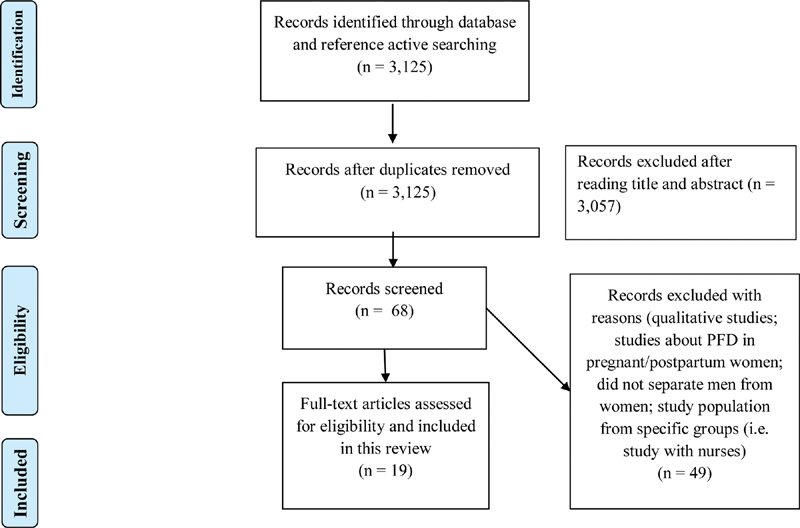
A total of 3,125 studies were reviewed. Meta-analysis was not possible due to the heterogeneity of primary outcomes and the diversity of instruments for measuring knowledge. The quality of the articles included in the analysis was evaluated with the Newcastle-Ottawa Scale (NOS) adapted for cross-sectional studies.
Two authors performed data extraction into a standardized spreadsheet.
Nineteen studies were included, comprising 11,512 women. About the methodological quality (NOS), most of the studies (n = 11) presented a total score of 6 out of 10. Validated questionnaires and designed pilot-tested forms were the most frequently used ways of assessing knowledge. Some studies were stratified by race, age, or group minorities. The most used questionnaire was the prolapse and incontinence knowledge questionnaire (PIKQ) (n = 5). Knowledge and/or awareness regarding PFD was low to moderate among the studies. Urinary incontinence was the most prevalent PFD investigated, and the most important risk factors associated with the lack of knowledge of the pelvic floor were: African-American ethnicity (n = 3), low educational level (n = 4), low access to information (n = 5) and socioeconomic status (n = 3).
Most women have a gap in the knowledge of pelvic floor muscle dysfunctions, do not understand their treatment options, and are not able to identify risk factors for these disorders.
我们试图调查女性是否对主要的盆底功能障碍(PFDs)(尿失禁 - UI、粪失禁 - FI和盆腔器官脱垂 - POP)有足够的了解。
在MEDLINE、PEDro、CENTRAL和Cochrane数据库中进行了一项系统综述,涵盖从数据库建立到2018年4月的出版物。
共审查了3125项研究。由于主要结局的异质性和测量知识的工具的多样性,无法进行荟萃分析。采用适用于横断面研究的纽卡斯尔 - 渥太华量表(NOS)评估纳入分析的文章的质量。
两位作者将数据提取到一个标准化的电子表格中。
纳入了19项研究,包括11512名女性。关于方法学质量(NOS),大多数研究(n = 11)的总分是10分中的6分。经过验证的问卷和经过预试验设计的表格是评估知识最常用的方法。一些研究按种族、年龄或少数群体进行了分层。使用最多的问卷是脱垂和失禁知识问卷(PIKQ)(n = 5)。在这些研究中,对PFD的知识和/或认识水平低至中等。尿失禁是所研究的最常见的PFD,与盆底知识缺乏相关的最重要风险因素是:非裔美国人种族(n = 3)、低教育水平(n = 4)、信息获取机会少(n = 5)和社会经济地位(n = 3)。
大多数女性在盆底肌肉功能障碍的知识方面存在差距,不了解其治疗选择,也无法识别这些疾病的风险因素。