Department of Family Medicine Seoul National University Hospital Seoul Republic of Korea.
Office of Hospital Information Seoul National University Hospital Seoul Republic of Korea.
J Am Heart Assoc. 2019 Sep 3;8(17):e011825. doi: 10.1161/JAHA.118.011825. Epub 2019 Aug 27.
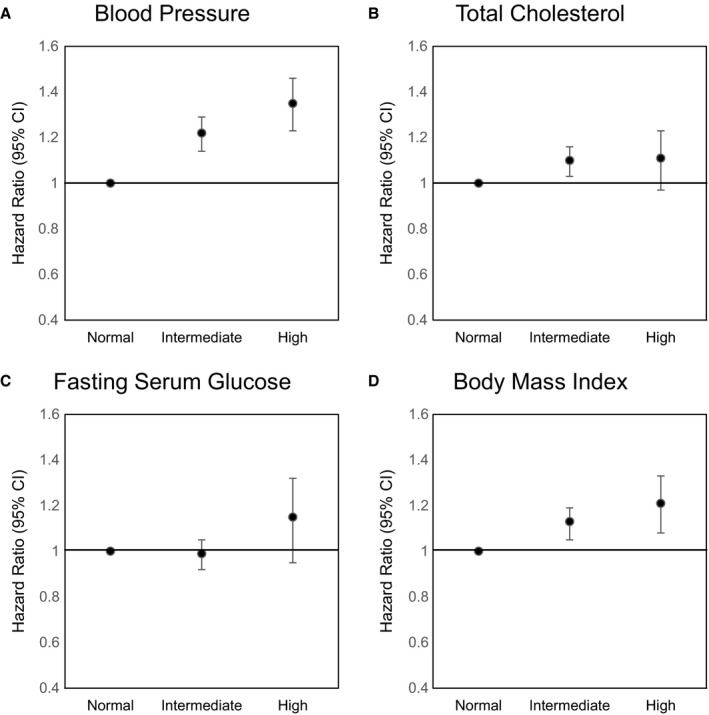
Background The combined effect of transitions of metabolic health and weight on cardiovascular disease (CVD) remains unclear. We aimed to examine the association of concurrent changes of metabolic health and weight on CVD over time. Methods and Results The study population consisted of 205 394 from the Korean National Health Insurance Service. Metabolic health was determined by fasting serum glucose, total cholesterol, and blood pressure levels, while obesity was determined by body mass index. All participants were divided into either metabolically healthy nonobese (MHNO), metabolically healthy obese, metabolically unhealthy nonobese, or metabolically unhealthy obese for each of the first (2002-2003) and second (2004-2005) health screening periods, after which participants were followed-up for CVD from 2006 to 2015. Cox proportional hazards regression was used to determine adjusted hazard ratios (aHRs) and 95% CIs. Among initial MHNO participants, those who became metabolically healthy obese (aHR, 1.25; 95% CI, 1.10-1.41), metabolically unhealthy nonobese (aHR, 1.23; 95% CI, 1.15-1.31), and metabolically unhealthy obese (aHR, 1.34; 95% CI, 1.12-1.61) had elevated risk for CVD compared with those who remained MHNO. Conversely, improving metabolic health and obesity were associated with reduced CVD risk among initially metabolically unhealthy nonobese to secondary MHNO (aHR, 0.79; 95% CI, 0.73-0.84), metabolically unhealthy obese to MHNO (aHR, 0.68; 95% CI, 0.58-0.81), and metabolically unhealthy obese to metabolically healthy obese (aHR, 0.73; 95% CI, 0.66-0.80) participants. Conclusions Changes toward metabolically unhealthy or obese states resulted in increased CVD risk. Improving metabolic health along with reducing weight may lead to decreased risk of CVD.
代谢健康和体重的转变对心血管疾病(CVD)的综合影响尚不清楚。本研究旨在探讨代谢健康和体重的同时变化与随时间推移发生的 CVD 之间的关联。
研究人群来自韩国国民健康保险服务,共 205394 人。代谢健康通过空腹血糖、总胆固醇和血压水平来确定,而肥胖则通过体重指数来确定。所有参与者根据第一次(2002-2003 年)和第二次(2004-2005 年)健康筛查期的情况,分为代谢健康非肥胖(MHNO)、代谢健康肥胖、代谢不健康非肥胖和代谢不健康肥胖。随后,从 2006 年至 2015 年对参与者进行 CVD 随访。采用 Cox 比例风险回归确定调整后的危险比(aHR)和 95%置信区间(CI)。在初始 MHNO 参与者中,与那些仍为 MHNO 的参与者相比,那些转变为代谢健康肥胖(aHR,1.25;95%CI,1.10-1.41)、代谢不健康非肥胖(aHR,1.23;95%CI,1.15-1.31)和代谢不健康肥胖(aHR,1.34;95%CI,1.12-1.61)的 CVD 风险升高。相反,在最初代谢不健康非肥胖转为二次 MHNO(aHR,0.79;95%CI,0.73-0.84)、代谢不健康肥胖转为 MHNO(aHR,0.68;95%CI,0.58-0.81)和代谢不健康肥胖转为代谢健康肥胖(aHR,0.73;95%CI,0.66-0.80)的参与者中,改善代谢健康和肥胖与 CVD 风险降低相关。
向代谢不健康或肥胖状态的转变导致 CVD 风险增加。改善代谢健康同时减轻体重可能会降低 CVD 的风险。