McComsey Grace A, Emond Bruno, Shah Aditi, Bookhart Brahim K, Rossi Carmine, Milbers Katherine, Lafeuille Marie-Hélène, Donga Prina
Case Western Reserve University and University Hospitals of Cleveland, Cleveland, OH, USA.
Analysis Group, Inc., Montréal, QC, Canada.
Infect Dis Ther. 2022 Oct;11(5):1883-1899. doi: 10.1007/s40121-022-00673-1. Epub 2022 Aug 2.
Antiretroviral therapy (ART) has been associated with weight gain in people living with HIV-1 (PLWH); however, limited research has assessed whether early weight gain post-ART initiation is associated with metabolic or cardiovascular outcomes among PLWH at high risk of weight gain (i.e., female, Black or Hispanic). This study aimed to evaluate the incidence of metabolic and cardiovascular outcomes between PLWH at high risk of weight gain following an observed ≥ 5% or < 5% weight/body mass index (BMI) gain within 6 months following ART initiation.
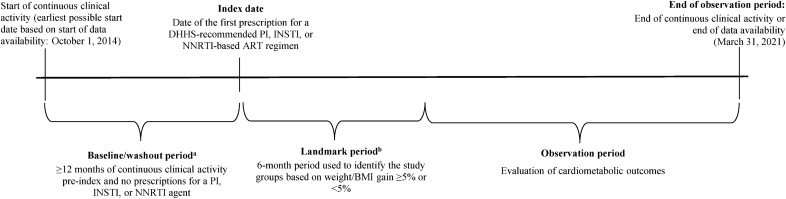
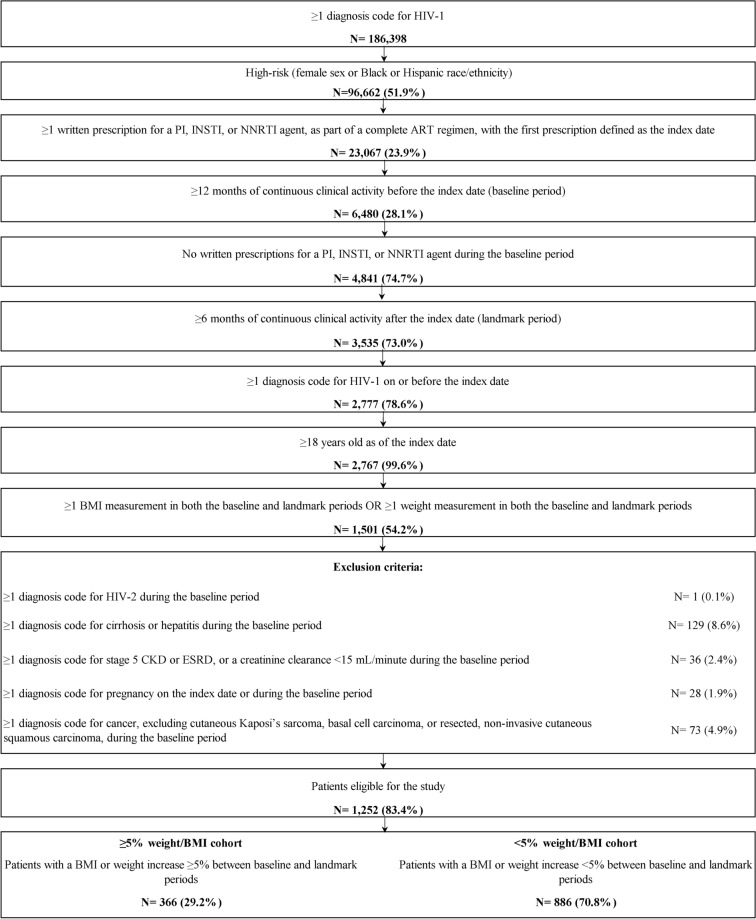
A retrospective longitudinal study using Symphony Health, an ICON plc Company, IDV® electronic medical records (October 1, 2014-March 31, 2021) identified adult female, Black, or Hispanic treatment-naïve PLWH who initiated ART and who had ≥ 1 weight or BMI measurement pre- and within 6 months post-treatment (landmark period). Inverse probability of treatment weighting was used to account for differences between PLWH who experienced ≥ 5% and < 5% weight/BMI gain. The time to each outcome was compared between cohorts using weighted hazard ratios (HRs) after the landmark period.
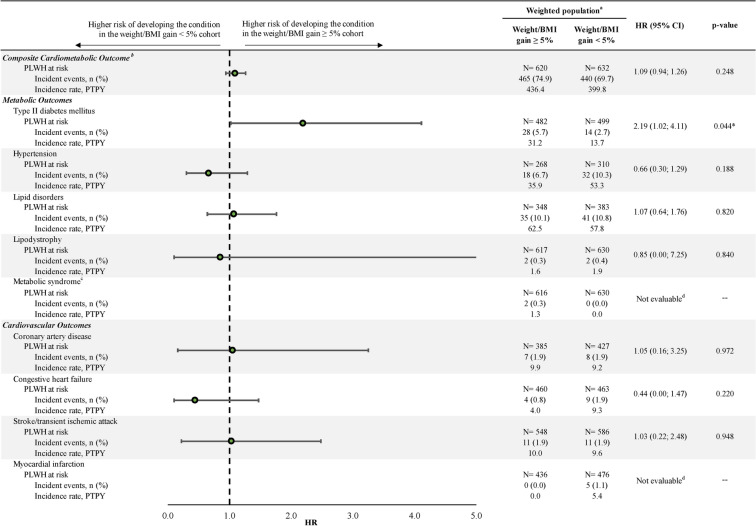
Weighted ≥ 5% and < 5% cohorts included 620 and 632 patients, respectively; baseline characteristics were similar between the two cohorts (mean age: ~ 48 years, ~ 59% female, ~ 49% Black, ~ 17% Hispanic). During a mean 2-year follow-up, PLWH with ≥ 5% weight/BMI gain were significantly more likely to be diagnosed with type 2 diabetes mellitus (T2DM; HR = 2.19; p = 0.044). There were no significant differences in the incidence of any other outcomes between the study cohorts.
Despite a short 2-year follow-up, female, Black or Hispanic PLWH experiencing ≥ 5% weight/BMI increase within 6 months following ART initiation had an increased risk of T2DM, but not other metabolic or cardiovascular outcomes, likely due to the short follow-up period. Further research with longer follow-up and specific ART regimens is warranted to examine the impact of ART-related weight gain on long-term clinical outcomes.
抗逆转录病毒疗法(ART)与HIV-1感染者(PLWH)体重增加有关;然而,有限的研究评估了ART开始后早期体重增加是否与体重增加风险较高的PLWH(即女性、黑人或西班牙裔)的代谢或心血管结局相关。本研究旨在评估在ART开始后6个月内观察到体重/体重指数(BMI)增加≥5%或<5%的高体重增加风险PLWH之间代谢和心血管结局的发生率。
一项回顾性纵向研究使用了ICON plc公司的Symphony Health的IDV®电子病历(2014年10月1日至2021年3月31日),确定了开始接受ART且在治疗前和治疗后6个月内有≥1次体重或BMI测量值的成年女性、黑人或西班牙裔初治PLWH(标志性时期)。使用治疗权重的逆概率来解释体重/BMI增加≥5%和<5%的PLWH之间的差异。在标志性时期后,使用加权风险比(HR)比较队列之间每个结局的发生时间。
体重增加≥5%和<5%的加权队列分别包括620例和632例患者;两个队列的基线特征相似(平均年龄:约48岁,约59%为女性,约49%为黑人,约17%为西班牙裔)。在平均2年的随访期间,体重/BMI增加≥5%的PLWH被诊断为2型糖尿病(T2DM)的可能性显著更高(HR = 2.19;p = 0.044)。研究队列之间任何其他结局的发生率没有显著差异。
尽管随访期仅2年,但在ART开始后6个月内体重/BMI增加≥5%的女性、黑人或西班牙裔PLWH患T2DM的风险增加,但其他代谢或心血管结局未增加,这可能是由于随访期较短。有必要进行更长随访期和特定ART方案的进一步研究,以检查ART相关体重增加对长期临床结局的影响。