Department of Human Evolution, Max Planck Institute for Evolutionary Anthropology, Leipzig, Germany.
University of Bologna, Department of Cultural Heritage, Ravenna, Italy.
Sci Rep. 2019 Aug 26;9(1):12350. doi: 10.1038/s41598-019-48706-z.
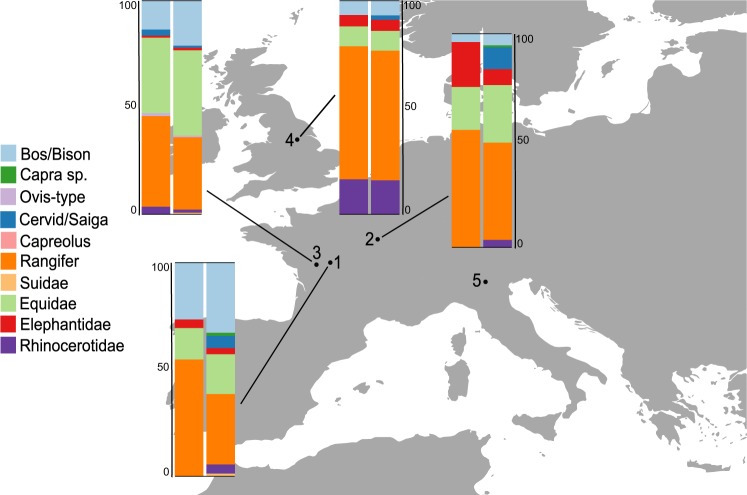
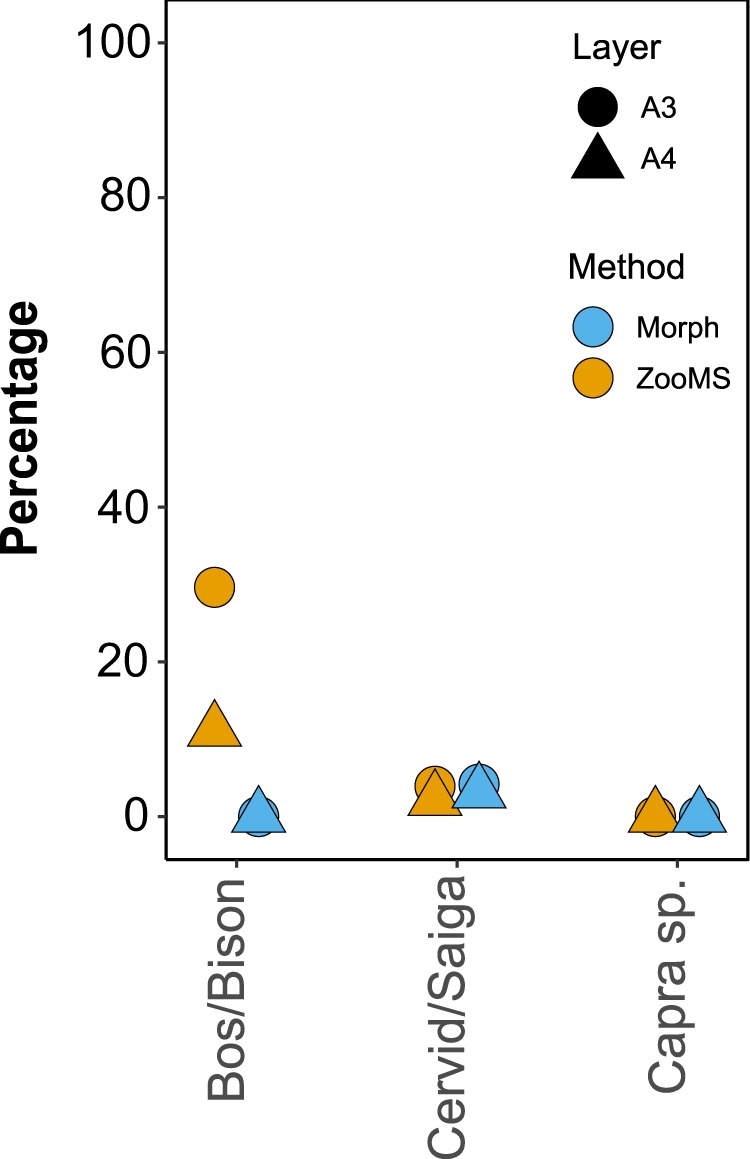
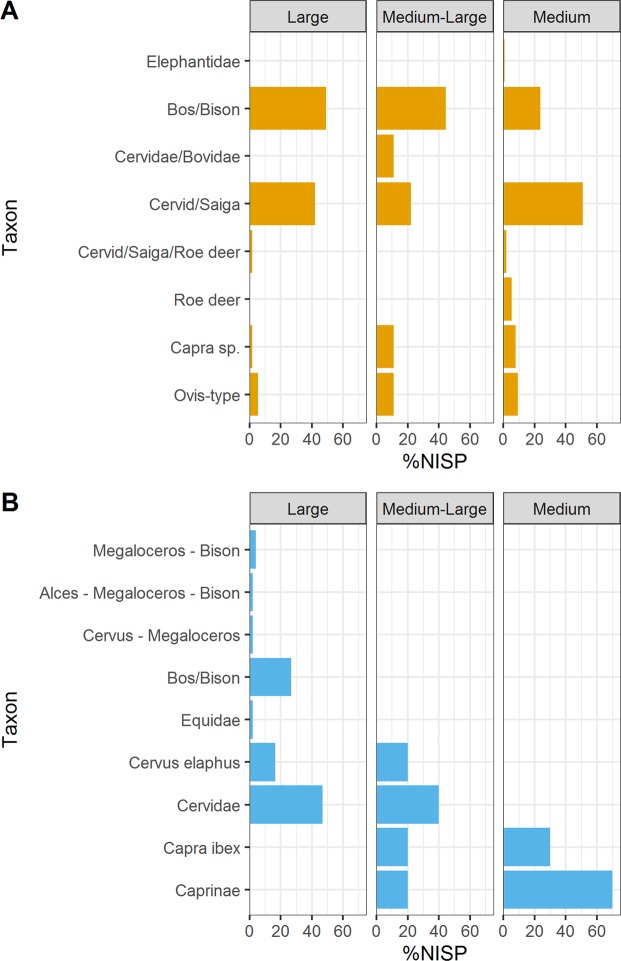
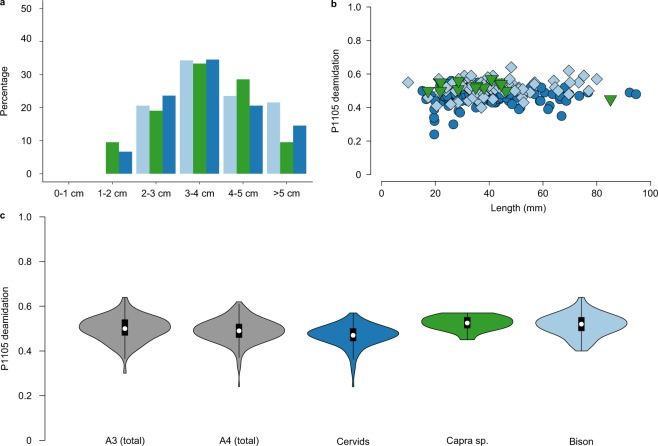
Collagen type I fingerprinting (ZooMS) has recently been used to provide either palaeoenvironmental data or to identify additional hominin specimens in Pleistocene contexts, where faunal assemblages are normally highly fragmented. However, its potential to elucidate hominin subsistence behaviour has been unexplored. Here, ZooMS and zooarchaeology have been employed in a complementary approach to investigate bone assemblages from Final Mousterian and Uluzzian contexts at Fumane cave (Italy). Both approaches produced analogous species composition, but differ significantly in species abundance, particularly highlighted by a six fold-increase in the quantity of Bos/Bison remains in the molecularly identified component. Traditional zooarchaeological methods would therefore underestimate the proportion of Bos/Bison in these levels to a considerable extent. We suggest that this difference is potentially due to percussion-based carcass fragmentation of large Bos/Bison bone diaphyses. Finally, our data demonstrates high variability in species assignment to body size classes based on bone cortical thickness and fragment size. Thus, combining biomolecular and traditional zooarchaeological methods allows us to refine our understanding of bone assemblage composition associated with hominin occupation at Fumane.
胶原类型 I 指纹图谱(ZooMS)最近被用于提供古环境数据或鉴定更新世背景下的额外人类标本,在这些情况下,动物群通常高度破碎。然而,它在阐明人类生存行为方面的潜力尚未得到探索。在这里,ZooMS 和动物考古学采用互补的方法来研究意大利富马尼洞穴的终莫斯特和乌鲁齐亚时期的骨骼组合。两种方法都产生了类似的物种组成,但在物种丰度上存在显著差异,特别是在分子鉴定成分中,牛/野牛的数量增加了六倍。因此,传统的动物考古学方法会大大低估这些层面上牛/野牛的比例。我们认为,这种差异可能是由于基于冲击的大型牛/野牛骨骼骨干的碎骨。最后,我们的数据表明,基于骨皮质厚度和碎片大小,物种在体型类别中的分配具有高度的可变性。因此,结合生物分子和传统动物考古学方法,使我们能够更准确地了解与富马尼人类居住相关的骨骼组合组成。