Department of Clinical Medicine, Faculty of Medicine, University of Bergen, Bergen.
Department of Orthopaedic Surgery, Haukeland University Hospital, Bergen.
Acta Orthop. 2019 Dec;90(6):582-589. doi: 10.1080/17453674.2019.1657333. Epub 2019 Aug 27.
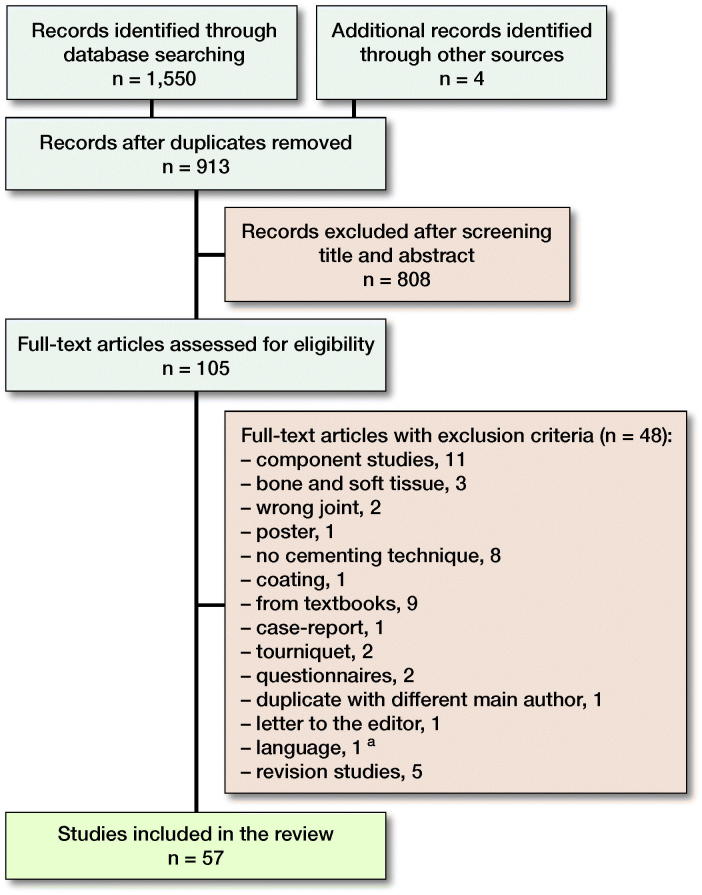
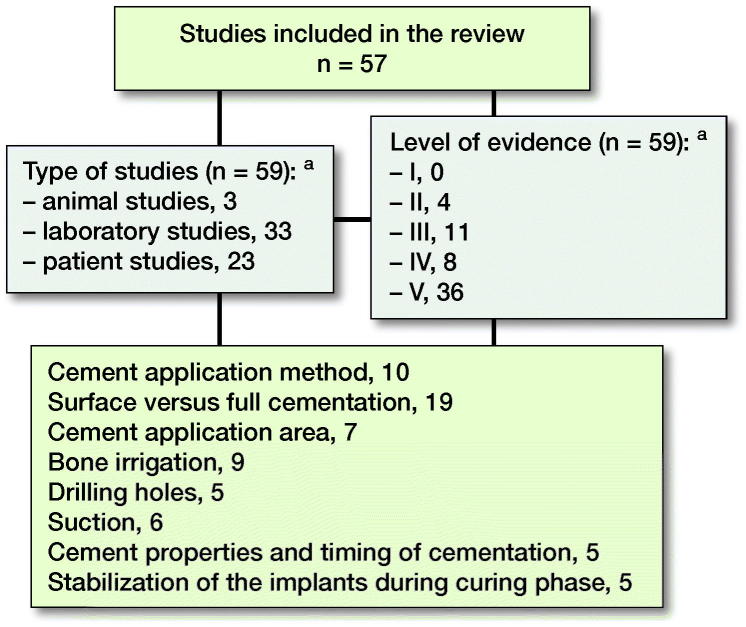
Background and purpose - The optimal cementing technique for primary total knee arthroplasty (TKA) remains unclear. We therefore performed a scoping review based on available studies regarding cementation technique in primary TKA and unicondylar knee arthroplasty (UKA).Patients and methods - A search in 3 databases identified 1,554 studies. The inclusion criteria were literature that studied cementing technique in primary TKA or UKA. This included cement application methods, full or surface cementing, applying cement to the bone and/or prosthesis, stabilization of the implant during curing phase, bone irrigation technique, drilling holes in the bone, use of suction, and the timing of cementation. 57 studies met the inclusion criteria.Results - The evidence was unanimously in favor of pulsatile lavage irrigation, drying the bone, and drilling holes into the tibia during a TKA. All studies concerning suction recommended it during TKA cementation. 7 out of 11 studies favored the use of a cement gun and no studies showed that finger packing was statistically significantly better than using a cement gun. There is evidence that full cementation should be used if metal-backed tibial components are used. Applying the cement to both implant and bone seems to give better cement penetration.Interpretation - There are still many knowledge gaps regarding cementing technique in primary TKA. There seems to be sufficient evidence to recommend pulsatile lavage irrigation of the bone, drilling multiple holes, and drying the bone before cementing and implant insertion, and applying cement to both implant and on the bone.
背景与目的-初次全膝关节置换术(TKA)的最佳粘结技术仍不清楚。因此,我们根据现有的关于初次 TKA 和单髁膝关节置换术(UKA)的粘结技术的研究进行了范围性综述。
患者和方法-在 3 个数据库中进行搜索,共识别出 1554 项研究。纳入标准为研究初次 TKA 或 UKA 粘结技术的文献。其中包括粘结剂应用方法、全或面粘结、向骨和/或假体涂覆粘结剂、在固化阶段稳定植入物、骨冲洗技术、在骨上钻孔、使用抽吸、以及粘结时间。57 项研究符合纳入标准。
结果-所有证据一致支持在 TKA 中使用脉动冲洗灌洗、干燥骨和在胫骨上钻孔。所有关于抽吸的研究都建议在 TKA 粘结时使用。11 项研究中有 7 项赞成使用粘结剂枪,没有研究表明手指填塞在统计学上明显优于使用粘结剂枪。有证据表明,如果使用金属背衬胫骨组件,则应使用全粘结。向植入物和骨涂覆粘结剂似乎可以更好地增加粘结剂渗透。
解释-初次 TKA 的粘结技术仍存在许多知识空白。似乎有足够的证据建议在粘结和植入物插入前对骨进行脉动冲洗灌洗、多钻孔和干燥骨,并向植入物和骨涂覆粘结剂。