Xue Cuiling, Zhang Jialing, Zhang Guiju, Xue Yuyan, Zhang Guiyan, Wu Xia
Department of Hematology, Linyi Central Hospital, Linyi, Shandong 276400, P.R. China.
Department of Orthopedics, Linyi Central Hospital, Linyi, Shandong 276400, P.R. China.
Oncol Lett. 2019 Sep;18(3):2877-2884. doi: 10.3892/ol.2019.10665. Epub 2019 Jul 25.
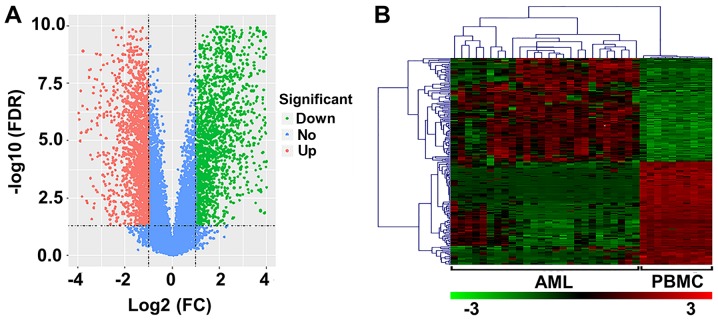
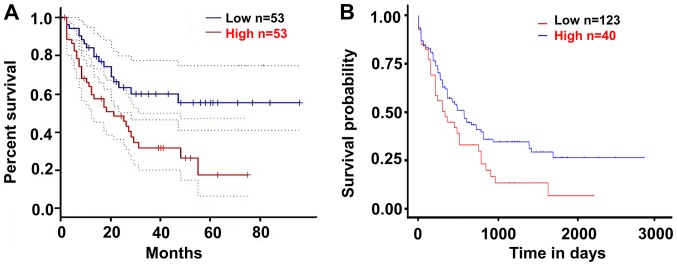
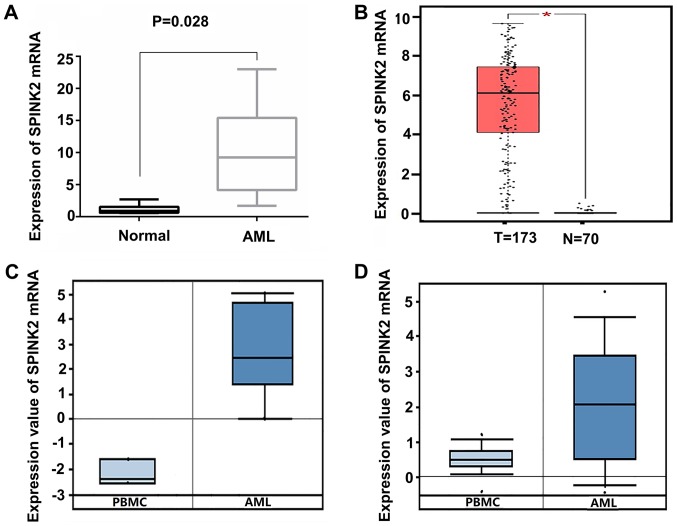
Acute myeloid leukemia (AML) has a high mortality rate and its clinical management remains challenging. The aim of the present study was to identify the hub genes involved in AML. In order to do so, the gene expression data of the GSE9476 database, including 26 AML and 10 normal samples, were downloaded from the Gene Expression Omnibus database. Differentially expressed genes (DEGs) were then identified via bioinformatics analysis. Gene Ontology and Kyoto Encyclopedia of Genes and Genomes pathway analyses were performed on DEGs. Furthermore, the most upregulated genes were selected for further investigation in the Oncomine, gene expression profiling interactive analysis and UALCAN datasets. In total, 1,744 upregulated and 1,956 downregulated genes were detected. The GO and KEGG results revealed that upregulated genes were enriched in metabolic processes, while downregulated genes were associated with the immune response. Serine protease inhibitor Kazal-type 2 (SPINK2) ranked first among all the upregulated genes and was regarded as a hub gene in the development of AML. The overexpression of SPINK2 was validated in 12 patients with AML from the Linyi Central Hospital and in data from the Oncomine and Gene Expression Profiling Interactive Analysis (GEPIA) databases. Furthermore, the UALCAN and GEPIA datasets demonstrated that patients with high SPINK2 levels had shorter survival times. In conclusion, the results from the present study revealed that the SPINK2 gene was upregulated in patients with AML and that elevated SPINK2 expression was associated with poor outcomes in these patients.
急性髓系白血病(AML)死亡率高,其临床管理仍然具有挑战性。本研究的目的是识别参与AML的核心基因。为此,从基因表达综合数据库下载了GSE9476数据库的基因表达数据,包括26例AML样本和10例正常样本。然后通过生物信息学分析鉴定差异表达基因(DEG)。对DEG进行基因本体论和京都基因与基因组百科全书通路分析。此外,选择上调最显著的基因在Oncomine、基因表达谱交互式分析和UALCAN数据集中进行进一步研究。总共检测到1744个上调基因和1956个下调基因。GO和KEGG结果显示,上调基因富集于代谢过程,而下调基因与免疫反应相关。丝氨酸蛋白酶抑制剂Kazal型2(SPINK2)在所有上调基因中排名第一,被视为AML发生发展中的核心基因。SPINK2的过表达在临沂市中心医院的12例AML患者以及Oncomine和基因表达谱交互式分析(GEPIA)数据库的数据中得到验证。此外,UALCAN和GEPIA数据集表明,SPINK2水平高的患者生存时间较短。总之,本研究结果表明,SPINK2基因在AML患者中上调,SPINK2表达升高与这些患者的不良预后相关。