Feng Ye, Gao Shuohui, Gao Yongjian, Song Defeng, Wang Xuefeng, Chen Zhi
Department of Gastrointestinal Colorectal and Anal Surgery, China-Japan Union Hospital of Jilin University, Changchun, Jilin 130033, P.R. China.
Department of Nephropathy, The First Bethune Hospital of Jilin University, Changchun, Jilin 130021, P.R. China.
Oncol Lett. 2019 Sep;18(3):3290-3294. doi: 10.3892/ol.2019.10654. Epub 2019 Jul 23.
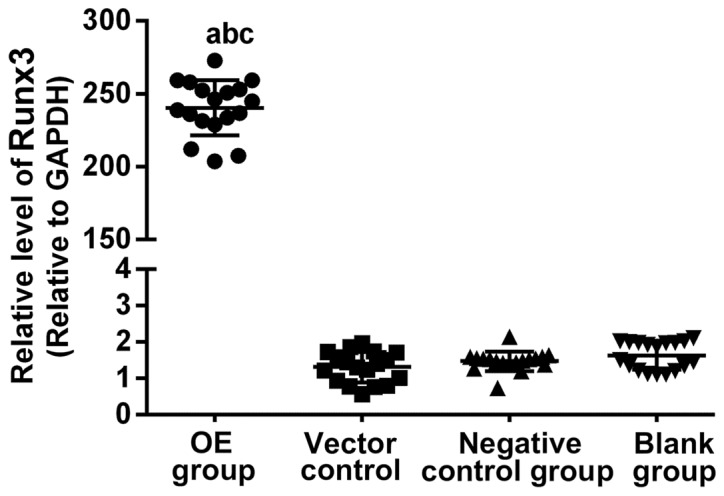
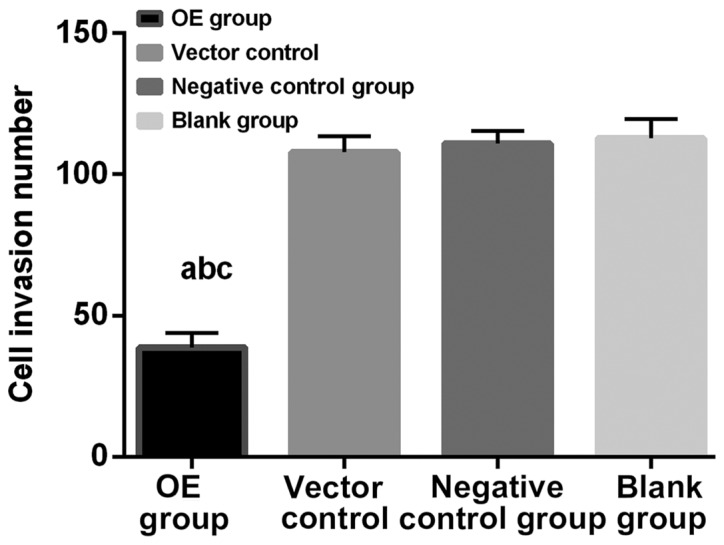
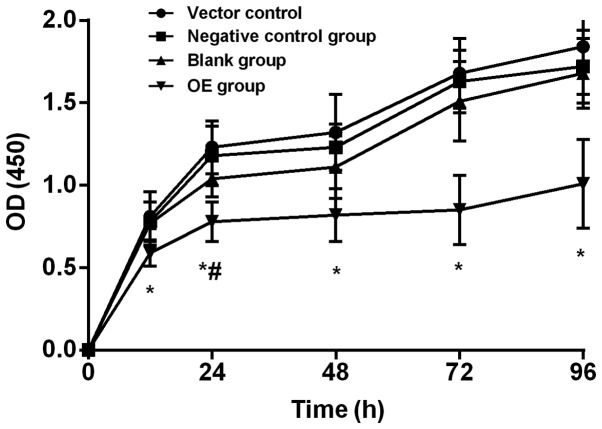
Effect of Runx3 gene on the cell proliferation and invasion of rectal cancer was investigated to explore potential new targets for targeted treatment of rectal cancer. The Runx3 overexpression group (OE group), blank plasmid control group, negative control and blank group of the rectal cancer HRC-9698 cell strain were set. The overexpressed Runx3 plasmid was transfected in OE group; the empty plasmid was transfected in blank plasmid control group; only liposome Lipofectamine was added to negative control group; only 1640 medium was used in blank group. RT-qPCR was used for detection of the mRNA expression of Runx3 in different groups; CCK-8 kit for detection of cell proliferation in different groups; Transwell chamber test for detection of cell strain invasion in different groups. The mRNA expression of Runx3 gene in OE group was the highest, significantly higher than that in blank plasmid control group, negative control and blank group (P<0.01). The OD values of overexpressed Runx3 at 96 h after transfection in OE group was significantly lower than each control group (P<0.01). At the same time-point, pairwise comparison in each group found that OE group was significantly lower than blank plasmid control, negative control and blank groups (all P<0.01). In the invasion experiment, the number of invasion cells in OE, blank plasmid control, negative control and blank groups were 38.63±9.33, 107.87±5.66, 110.93±4.33 and 112.86±6.66, respectively. OE group was significantly lower than each control group (P<0.01). Overexpression of Runx3 gene inhibits the cell proliferation of rectal cancer and blocks the cell invasion and metastasis. This study provides a new idea and a new molecular therapeutic target for molecular targeted therapy of rectal cancer.
研究Runx3基因对直肠癌细胞增殖和侵袭的影响,以探索直肠癌靶向治疗的潜在新靶点。设置直肠癌HRC-9698细胞株的Runx3过表达组(OE组)、空白质粒对照组、阴性对照组和空白组。OE组转染过表达Runx3质粒;空白质粒对照组转染空质粒;阴性对照组仅加入脂质体Lipofectamine;空白组仅使用1640培养基。采用RT-qPCR检测不同组中Runx3的mRNA表达;采用CCK-8试剂盒检测不同组的细胞增殖;采用Transwell小室试验检测不同组的细胞株侵袭。OE组中Runx3基因的mRNA表达最高,显著高于空白质粒对照组、阴性对照组和空白组(P<0.01)。OE组转染后96 h时过表达Runx3的OD值显著低于各对照组(P<0.01)。在同一时间点,各组两两比较发现OE组显著低于空白质粒对照组、阴性对照组和空白组(均P<0.01)。在侵袭实验中,OE组、空白质粒对照组、阴性对照组和空白组的侵袭细胞数分别为38.63±9.33、107.87±5.66、110.93±4.33和112.86±6.66。OE组显著低于各对照组(P<0.01)。Runx3基因过表达抑制直肠癌细胞增殖并阻断细胞侵袭和转移。本研究为直肠癌分子靶向治疗提供了新思路和新的分子治疗靶点。