Gusho Charles A, Jenson Mark
Miscellaneous, Medical College of Wisconsin Green Bay, De Pere, USA.
Family Medicine, Medical College of Wisconsin Green Bay, De Pere, USA.
Cureus. 2019 Jun 22;11(6):e4972. doi: 10.7759/cureus.4972.
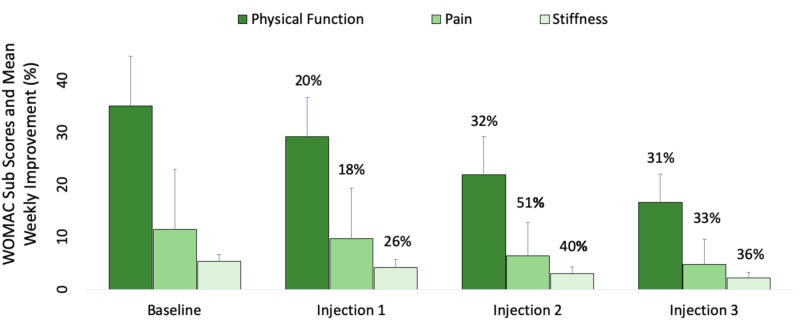
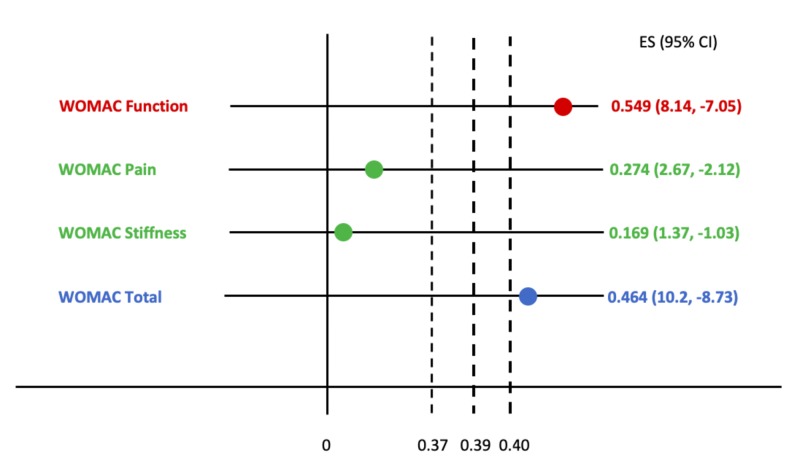
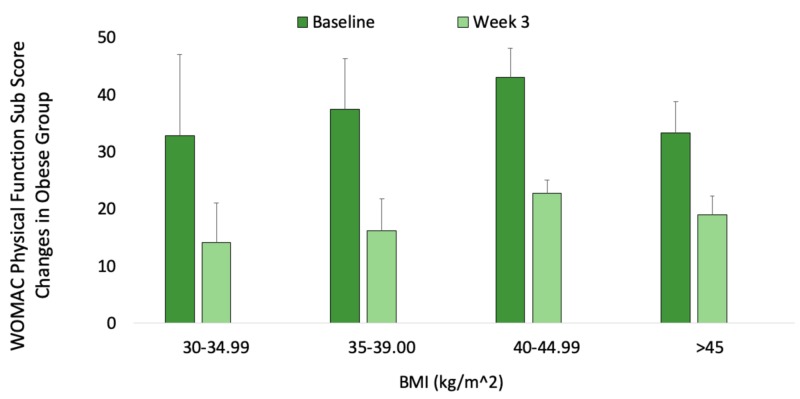
Background Supartz FX (Seikagaku Corp., Tokyo, Japan) has been investigated as a therapeutic for knee osteoarthritis (OA) due to its claimed preservation of viscoelastic joint properties and improvement in pain and physical function. The US prescribing information suggests patients may experience benefit with as few as three of five injections administered once weekly. However, recommended guidelines from the American Academy of Orthopaedic Surgeons (AAOS) do not support injectable hyaluronate due to controversial results of randomized controlled trials. Objective Do patients experience statistically and/or clinically significant improvement in disability scores following three injections? Methods A total of 32 patients with a mean age of 66±14 years receiving Supartz FX were reviewed in a prospective, observational study. Functional outcome data via Western Ontario and McMaster Universities Osteoarthritis Index (WOMAC) scores for pain, stiffness, and physical function were collected at 0, 1, 2 and 3 weeks, and means were analyzed via paired t-test. Results Three injections at one-week intervals resulted in statistically significant improvement across all sub scores (p<0.05). Confidence intervals (CIs) of treatment effects (ES, 95% CI) for pain (0.27, 95% CI 0.99, 1.26), stiffness (0.17, 95% CI 0.50, 0.67), and function (0.55, 95% CI 2.79, 3.35) were recorded and compared to published minimum clinically important improvement (MCII) thresholds. Conclusion Despite manufacturer recommendations, in this study short-term use of Supartz FX for knee OA does not meet clinically significant thresholds as the treatment effects for WOMAC sub scores fail to satisfy published MCII for pain (0.39), stiffness (0.39) and function (0.37). In light of these findings and in concordance with recommendations set forth by the AAOS, this study contributes to a preventative medicine database that encourages exploration of non-surgical and non-opiate modalities for the management of osteoarthritis.
由于宣称能保留关节粘弹性特性并改善疼痛和身体功能,Supartz FX(日本东京Seikagaku公司)已被作为膝骨关节炎(OA)的一种治疗方法进行研究。美国的处方信息表明,患者每周注射一次,五次注射中只需三次就可能获益。然而,美国骨科医师学会(AAOS)的推荐指南并不支持注射透明质酸盐,因为随机对照试验的结果存在争议。目的:三次注射后患者的残疾评分是否有统计学和/或临床显著改善?方法:在一项前瞻性观察研究中,对32例平均年龄为66±14岁且接受Supartz FX治疗的患者进行了回顾。在第0、1、2和3周收集通过西安大略和麦克马斯特大学骨关节炎指数(WOMAC)评分得出的疼痛、僵硬和身体功能的功能结局数据,并通过配对t检验分析均值。结果:每隔一周注射三次在所有子评分上均有统计学显著改善(p<0.05)。记录了疼痛(0.27,95%CI 0.99,1.26)、僵硬(0.17,95%CI 0.50,0.67)和功能(0.55,95%CI 2.79,3.35)的治疗效果(效应大小,95%CI)的置信区间,并与已发表的最小临床重要改善(MCII)阈值进行比较。结论:尽管有制造商的建议,但在本研究中,Supartz FX用于膝OA的短期使用未达到临床显著阈值,因为WOMAC子评分的治疗效果未能满足已发表的疼痛(0.39)、僵硬(0.39)和功能(0.37)的MCII。鉴于这些发现并与AAOS提出的建议一致,本研究为一个预防医学数据库做出了贡献,该数据库鼓励探索用于骨关节炎管理的非手术和非阿片类治疗方法。