Rasmussen Astrid, Stone Donald U, Kaufman C Erick, Hefner Kimberly S, Fram Nicole R, Siatkowski Rhea L, Huang Andrew J W, Chodosh James, Rasmussen Pablo T, Fife Dustin A, Pezant Nathan, Grundahl Kiely, Radfar Lida, Lewis David M, Weisman Michael H, Venuturupalli Swamy, Wallace Daniel J, Rhodus Nelson L, Brennan Michael T, Montgomery Courtney G, Lessard Christopher J, Scofield R Hal, Sivils Kathy L
Astrid Rasmussen, MD, PhD: Oklahoma Medical Research Foundation, Oklahoma City, and Instituto Nacional de Ciencias Médicas y Nutrición Salvador Zubirán, México City, México.
Donald U. Stone, MD: Johns Hopkins University, Baltimore, Maryland (current address: Dean McGee Eye Institute, University of Oklahoma Health Sciences Center, Oklahoma City).
ACR Open Rheumatol. 2019 Jul;1(5):292-302. doi: 10.1002/acr2.1033. Epub 2019 Jun 7.
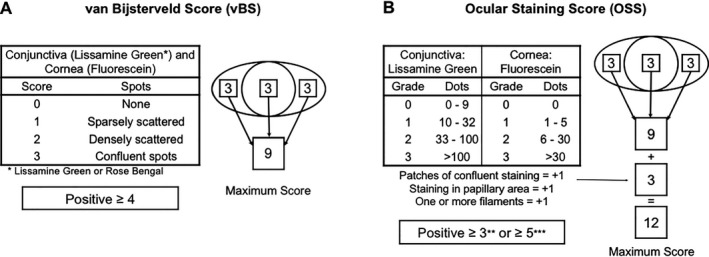
The objective of this study was to assess the performance and reproducibility of the two currently used ocular surface staining scores in the assessment of keratoconjunctivitis sicca in Sjögren syndrome (SS) research classification.
In a multidisciplinary clinic for the evaluation of sicca, we performed all tests for the American European Consensus Group (AECG) and the American College of Rheumatology (ACR)/European League Against Rheumatism (EULAR) classification criteria, including the van Bijsterveld score (vBS) and the Ocular Staining Score (OSS), in 994 participants with SS or with non-SS sicca. We analyzed the concordance between the scores, the diagnostic accuracy and correlation with clinical variables, and interrater and intrasubject reproducibility.
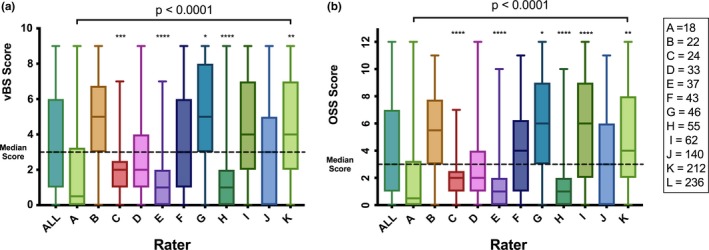
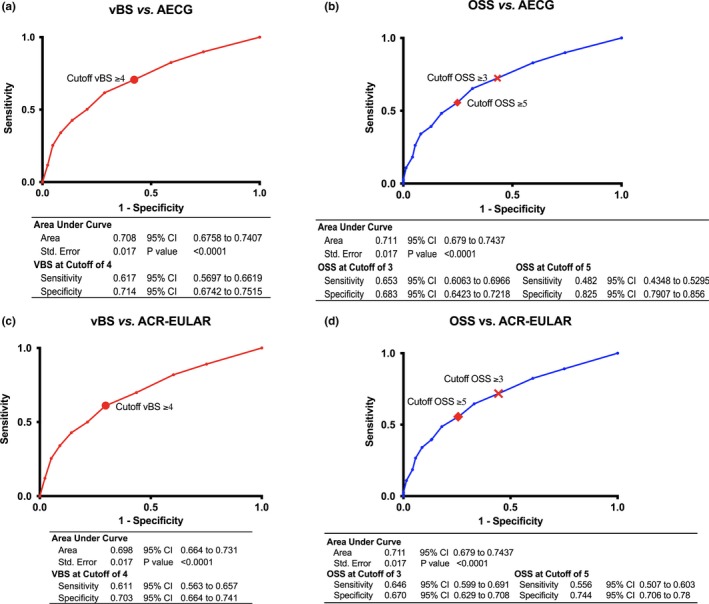
A total of 308 (31.1%) participants had a discordant vBS and OSS that was due to extra corneal staining points in the OSS. The presence of one or more of the additional points was highly predictive of SS classification (odds ratio = 3.66; = 1.65 × 10e-20) and was associated with abnormal results of all measures of autoimmunity and glandular dysfunction. Receiver operating characteristic curves showed optimal cutoff values of four for the vBS (sensitivity = 0.62; specificity = 0.71; Youden's = 0.33) and five for the OSS (sensitivity = 0.56; specificity = 0.75; Youden's = 0.31). Notably, there was very poor consistency in interobserver mean scores and distributions ( < 0.0001) and in intrasubject scores after a median of 5.5 years (35% changed status of the ocular criterion).
Ocular surface staining scores are useful for SS research classification; however, they are subject to significant interrater and intrasubject variability, which could result in changes in classification in 5%-10% of all subjects. These results highlight the need for objective and reproducible markers of disease that have thus far remained elusive for SS.
本研究的目的是评估目前用于干燥综合征(SS)研究分类中评估干燥性角结膜炎的两种眼表染色评分的性能和可重复性。
在一个评估干燥症状的多学科诊所中,我们对994例患有SS或非SS干燥症状的参与者进行了美国欧洲共识小组(AECG)和美国风湿病学会(ACR)/欧洲抗风湿病联盟(EULAR)分类标准的所有测试,包括范·比斯特费尔德评分(vBS)和眼表染色评分(OSS)。我们分析了评分之间的一致性、诊断准确性以及与临床变量的相关性,以及观察者间和受试者内的可重复性。
共有308例(31.1%)参与者的vBS和OSS不一致,这是由于OSS中角膜外染色点所致。存在一个或多个额外的点对SS分类具有高度预测性(比值比 = 3.66; = 1.65×10e - 20),并且与所有自身免疫和腺体功能障碍测量的异常结果相关。受试者工作特征曲线显示vBS的最佳截断值为4(敏感性 = 0.62;特异性 = 0.71;约登指数 = 0.33),OSS的最佳截断值为5(敏感性 = 0.56;特异性 = 0.75;约登指数 = 0.31)。值得注意的是,观察者间平均评分和分布(< 0.0001)以及在中位数为5.5年的受试者内评分方面一致性非常差(35%的眼部标准状态发生了变化)。
眼表染色评分对SS研究分类有用;然而,它们存在显著的观察者间和受试者内变异性,这可能导致所有受试者中5% - 10%的分类发生变化。这些结果凸显了对疾病客观且可重复标记物的需求,而这在SS中迄今仍难以捉摸。