From the Department of Radiology, Division of Interventional Radiology (C.F.G., D.J.E., R.D.A., A.N.H.), Department of Radiation Oncology (P.R.A.), Department of Medical Oncology (M.O., M.T., T.S.), and Division of Biostatistics, Department of Pharmacology and Experimental Therapeutics (M.Y., I.C.), Sidney Kimmel Medical College at Thomas Jefferson University, Thomas Jefferson University Hospital, 132 S 10th St, Main Building, Suite 766, Philadelphia, Pa 19107.
Radiology. 2019 Oct;293(1):223-231. doi: 10.1148/radiol.2019190199. Epub 2019 Aug 27.
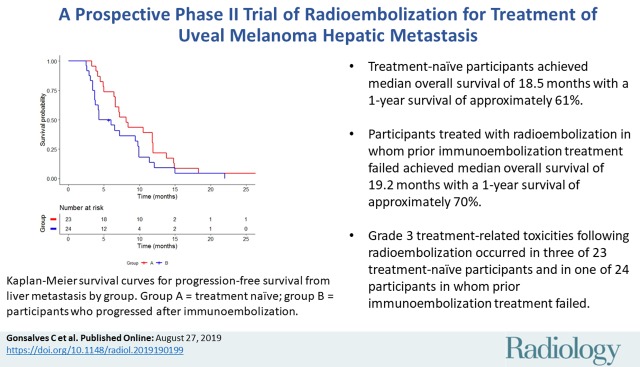
Background Overall survival (OS) for patients with uveal melanoma (UM) hepatic metastases is extremely poor. Therefore, stabilization of hepatic metastases is essential to prolonging OS. Purpose To assess the safety and effectiveness of radioembolization (RE) for treatment of UM hepatic metastases. Materials and Methods Enrollment for this prospective phase II trial began November 2011 and concluded January 2017. Treatment-naïve participants (group A) and participants who progressed after immunoembolization (group B) with hepatic tumor burden less than 50% underwent RE. Participants were followed for 1 month and every 3 months for acute and delayed toxicities, respectively. MRI, CT, and PET were performed every 3 months to evaluate for tumor response and extrahepatic disease. Participants were followed for at least 2 years or until death. Kaplan-Meier method and multivariable Cox proportional hazard models were used for data analysis. Results In group A, 24 participants (mean age ± standard deviation, 59 years ± 13; 13 men and 11 women) underwent unilobar ( = 7), fractionated whole-liver ( = 1), or sequential lobar ( = 16) RE. One participant was excluded from the trial. Complete response ( = 0), partial response ( = 9), or stable disease ( = 11) was achieved in 20 of 23 (87.0%; 95% confidence interval [CI]: 66.4%, 97.2%) participants. Median progression-free survival from liver metastasis was 8.1 months (95% CI: 6.4, 11.8; range, 3.3-33.7 months). Median OS was 18.5 months (95% CI: 11.3, 23.5; range, 6.5-73.7 months). In group B, 24 participants (mean age, 58 years ± 10; nine men and 15 women) underwent unilobar ( = 5) or sequential lobar ( = 19) RE. Complete response ( = 0), partial response ( = 8), or stable disease ( = 6) was achieved in 14 of 24 (58.3%; 95% CI: 36.3%, 77.9%) participants. Median progression-free survival from liver metastasis was 5.2 months (95% CI: 3.7, 9.8; range, 2.9-22.0 months). Median OS was 19.2 months (95% CI: 11.5, 24.0; range, 4.8-76.6 months). Grade 3 treatment-related toxicities included transient lymphopenia (group A, = 1; group B, = 1), pain (group A, = 2) and nausea or vomiting (group A, = 1). Conclusion Radioembolization is a promising treatment for patients with uveal melanoma hepatic metastases. © RSNA, 2019
背景 葡萄膜黑色素瘤(UM)肝转移患者的总生存期(OS)极差。因此,稳定肝转移对于延长 OS 至关重要。目的 评估放射性栓塞(RE)治疗 UM 肝转移的安全性和有效性。材料与方法 本前瞻性 II 期试验于 2011 年 11 月开始招募患者,2017 年 1 月结束。未经治疗的患者(A 组)和接受免疫栓塞后进展的患者(B 组),肝肿瘤负荷<50%,行 RE。分别在治疗后 1 个月和每 3 个月评估急性和迟发性毒性。每 3 个月行 MRI、CT 和 PET 以评估肿瘤反应和肝外疾病。至少随访 2 年或直至死亡。Kaplan-Meier 方法和多变量 Cox 比例风险模型用于数据分析。结果 A 组 24 例患者(平均年龄±标准差,59 岁±13;13 例男性,11 例女性)行单叶( = 7)、分叶全肝( = 1)或序贯叶( = 16)RE。1 例患者被排除在试验之外。23 例(87.0%;95%CI:66.4%,97.2%)患者完全缓解( = 0)、部分缓解( = 9)或稳定疾病( = 11)。肝转移无进展生存期的中位时间为 8.1 个月(95%CI:6.4,11.8;范围,3.3-33.7 个月)。中位 OS 为 18.5 个月(95%CI:11.3,23.5;范围,6.5-73.7 个月)。B 组 24 例患者(平均年龄,58 岁±10;9 例男性,15 例女性)行单叶( = 5)或序贯叶( = 19)RE。24 例患者中有 14 例(58.3%;95%CI:36.3%,77.9%)达到完全缓解( = 0)、部分缓解( = 8)或稳定疾病( = 6)。肝转移无进展生存期的中位时间为 5.2 个月(95%CI:3.7,9.8;范围,2.9-22.0 个月)。中位 OS 为 19.2 个月(95%CI:11.5,24.0;范围,4.8-76.6 个月)。3 级治疗相关毒性包括短暂性淋巴细胞减少症(A 组, = 1;B 组, = 1)、疼痛(A 组, = 2)和恶心或呕吐(A 组, = 1)。结论 RE 是治疗 UM 肝转移的一种很有前途的方法。