Lin Wendong, Sun Jiehao, Fu Shuying
Department of Anesthesiology, The First Affiliated Hospital of Wenzhou Medical University, Wenzhou, 325000, China.
Department of Anesthesiology, The Second Affiliated Hospital and Yuying Children's Hospital of Wenzhou Medical University, Wenzhou, 325000, China.
BMC Anesthesiol. 2019 Aug 28;19(1):164. doi: 10.1186/s12871-019-0836-1.
Intravenous use of sufentanil can elicit cough. This study aimed to evaluate the inhibitory effect of pre-injection of a mall dose of remifentanil on sufentanil-induced cough during the induction of general anesthesia.
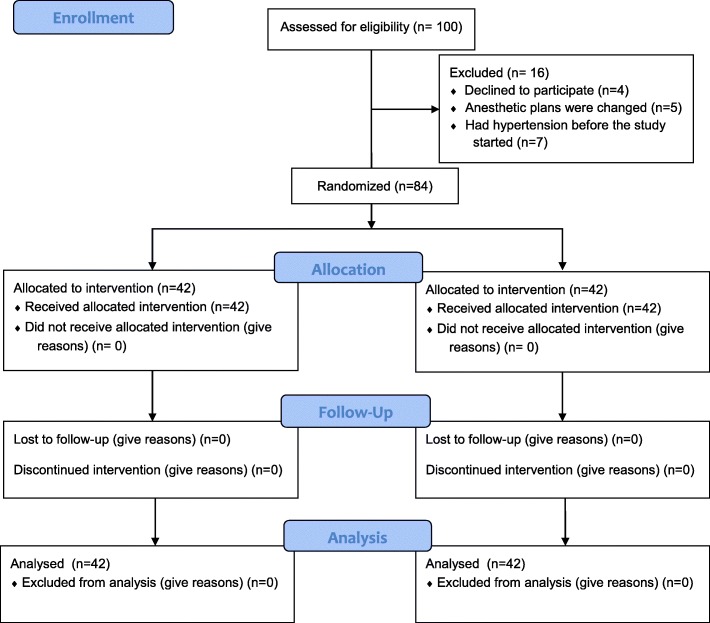
This prospective, randomized, controlled trial was conducted from January 10, 2019 to March 01, 2019. A total of 100 patients undergoing elective surgery under general anesthesia were enrolled, and at last 84 patients were included and randomly allocated into two equal size groups (n = 42): Patients in the Remifentanil group (R group) received an intravenous infusion of remifentanil 0.3 μg/kg (diluted to 2 ml) 1 min before sufentanil injection; patients in the Control group (C group) received 2 ml of normal saline (NS) at the same time point. Injections of patients in both groups were completed within 5 s. Then, sufentanil 0.5 μg/kg was injected within 5 s and the number of coughs that occurred within 1 min after sufentanil injection were recorded. One minute after sufentanil injection, etomidate 0.3 mg/kg and cisatracurium 0.15 mg/kg were given for general anesthesia induction irrespective of the presence or absence of cough. The mean arterial pressure (MAP) and heart rate (HR) at time points just before remifentanil pretreatment administration (T0), 3 min after administration (T1), 1 min after intubation (T2), and 3 min after intubation (T3) were recorded.
The incidence of cough in patients in the R group and C group was 4.8 and 31%, respectively. Compared with group C, the incidence and severity of cough in group R was significantly lower (P < 0.01). No significant differences were observed in MAP and HR at the time of general anesthesia induction between the two groups (P > 0.05).
Pretreatment with a small dose of remifentanil effectively and safely reduced the incidence and severity of cough induced by sufentanil during anesthesia induction and can be used as an alternative treatment to inhibit coughing caused by sufentanil.
Chinese Clinical Trial Registry (ChiCTR1900020587, registered date: January 9, 2019), http://www.chictr.org.cn.
静脉注射舒芬太尼可引发咳嗽。本研究旨在评估麻醉诱导期预先注射小剂量瑞芬太尼对舒芬太尼诱发咳嗽的抑制作用。
本前瞻性、随机、对照试验于2019年1月10日至2019年3月1日进行。共纳入100例行全身麻醉择期手术的患者,最终84例患者被纳入并随机分为两组,每组42例:瑞芬太尼组(R组)患者在注射舒芬太尼前1分钟静脉输注0.3μg/kg瑞芬太尼(稀释至2ml);对照组(C组)患者在同一时间点接受2ml生理盐水(NS)。两组患者的注射均在5秒内完成。然后,在5秒内注射0.5μg/kg舒芬太尼,并记录舒芬太尼注射后1分钟内发生的咳嗽次数。无论是否咳嗽,舒芬太尼注射1分钟后,给予依托咪酯0.3mg/kg和顺式阿曲库铵0.15mg/kg进行全身麻醉诱导。记录瑞芬太尼预处理给药前(T0)、给药后3分钟(T1)、插管后1分钟(T2)和插管后3分钟(T3)各时间点的平均动脉压(MAP)和心率(HR)。
R组和C组患者的咳嗽发生率分别为4.8%和31%。与C组相比,R组咳嗽的发生率和严重程度显著降低(P< 0.01)。两组全身麻醉诱导时的MAP和HR无显著差异(P> 0.05)。
小剂量瑞芬太尼预处理有效且安全地降低了麻醉诱导期舒芬太尼诱发咳嗽的发生率和严重程度,可作为抑制舒芬太尼引起咳嗽的替代治疗方法。
中国临床试验注册中心(ChiCTR1900020587,注册日期:2019年1月9日),http://www.chictr.org.cn。