LIM/08 - Laboratório de Anestesiologia - Laboratórios de Investigação Médica do Hospital das Clínicas da Faculdade de Medicina da Universidade de São Paulo, São Paulo, Brazil.
Experimental Laboratory to the Study of Pain - Universidade Federal do Maranhão, São Luís, Brazil.
J Transl Med. 2019 Aug 27;17(1):287. doi: 10.1186/s12967-019-2031-z.
Experimental studies suggest that testosterone reduces the nociceptive response after inflammatory and neuropathic stimuli, however the underlying mechanisms have not been fully elucidated. The aims of this study were to evaluate the effect of peripheral blockade of testosterone on pain behaviour and on expression levels of the genes that encode the NaV1.7 and NaV1.8 channels, in dorsal root ganglia in an acute postoperative pain model, as well as the influence of androgen blockade on the expression of these genes.
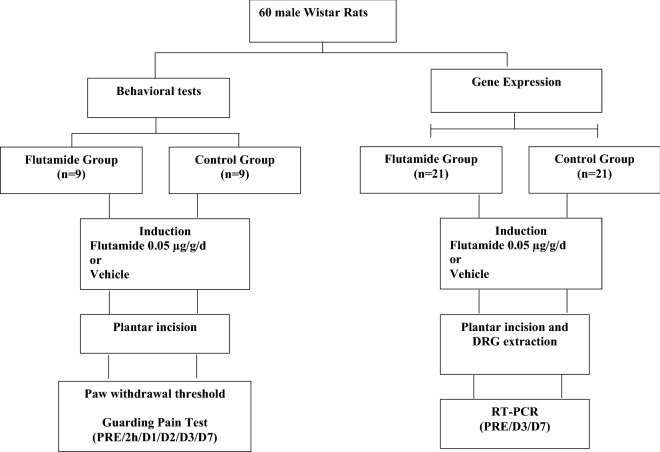
Postoperative pain was induced by a plantar incision and the study group received flutamide to block testosterone receptor. The animals were submitted to behavioural evaluation preoperatively, 2 h after incision, and on the 1st, 2nd, 3rd and 7th postoperative days. Von Frey test was used to evaluate paw withdrawal threshold after mechanical stimuli and the guarding pain test to assess spontaneous pain. The expression of the genes encoding the sodium channels at the dorsal root ganglia was determined by real time quantitative polymerase chain reaction.
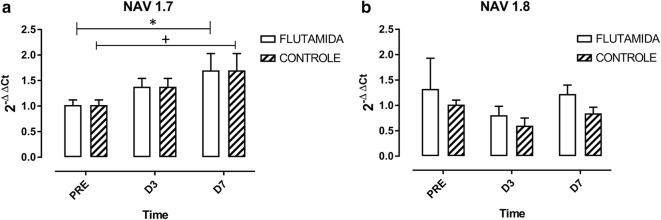
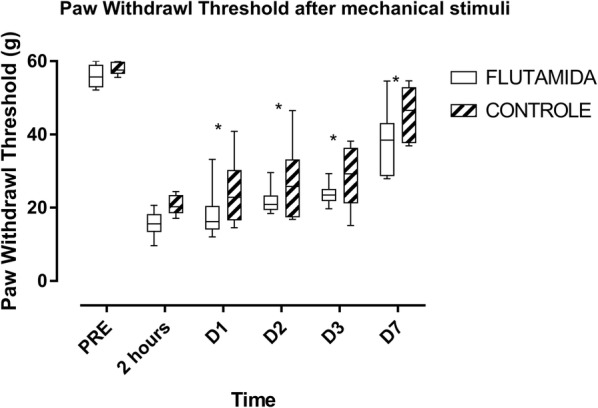
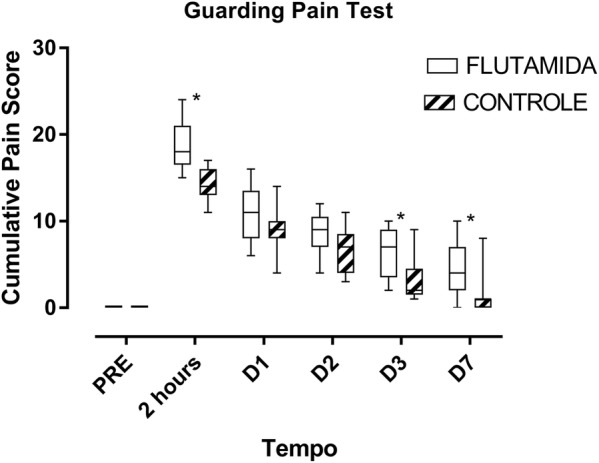
Animals treated with flutamide presented lower paw withdrawal threshold at the 1st, 2nd, 3rd, and 7th postoperative days. The guarding pain test showed significant decrease in the flutamide group at 2 h and on the 3rd and 7th postoperative days. No difference was detected between the study and control groups for the gene expression.
Our data suggest an antinociceptive effect of androgens following plantar incision. The expression of genes that encode voltage-gated sodium channels was not influenced by androgen blockade.
实验研究表明,睾酮可降低炎症和神经病理性刺激后的痛觉反应,但潜在机制尚未完全阐明。本研究旨在评估外周阻断睾酮对急性术后痛模型背根神经节中疼痛行为和编码 Nav1.7 和 Nav1.8 通道的基因表达水平的影响,以及雄激素阻断对这些基因表达的影响。
通过足底切口诱导术后疼痛,研究组给予氟他胺阻断睾酮受体。动物在术前、切口后 2 小时以及术后第 1、2、3 和 7 天进行行为评估。Von Frey 试验用于评估机械刺激后的足底撤回阈值,而守护疼痛试验用于评估自发性疼痛。通过实时定量聚合酶链反应确定背根神经节中编码钠离子通道的基因表达。
接受氟他胺治疗的动物在术后第 1、2、3 和 7 天的足底撤回阈值较低。氟他胺组在术后 2 小时和第 3、7 天的守护疼痛试验中显著下降。研究组和对照组之间的基因表达没有差异。
我们的数据表明雄激素对足底切口后具有镇痛作用。电压门控钠离子通道编码基因的表达不受雄激素阻断的影响。