1 Department of Anesthesiology, Tongji Hospital, Tongji Medical College, Huazhong University of Science and Technology, Wuhan, Hubei, People's Republic of China.
Mol Pain. 2018 Jan-Dec;14:1744806918782323. doi: 10.1177/1744806918782323. Epub 2018 May 23.
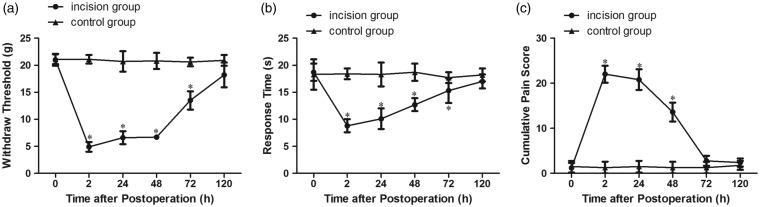
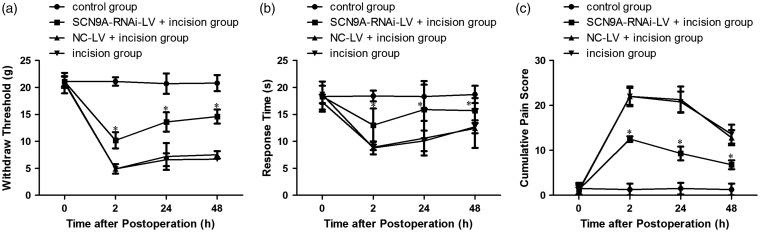
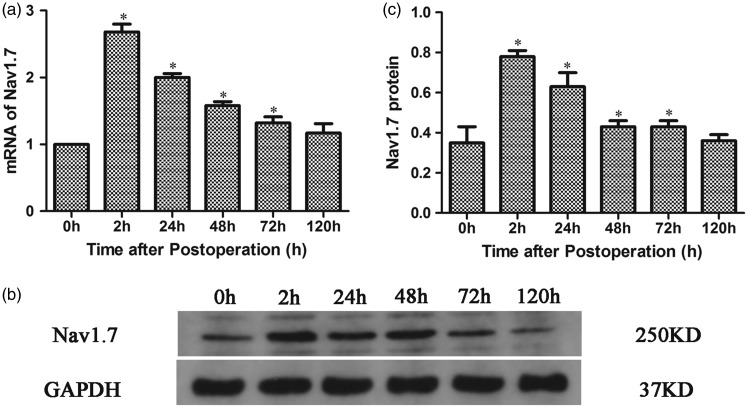
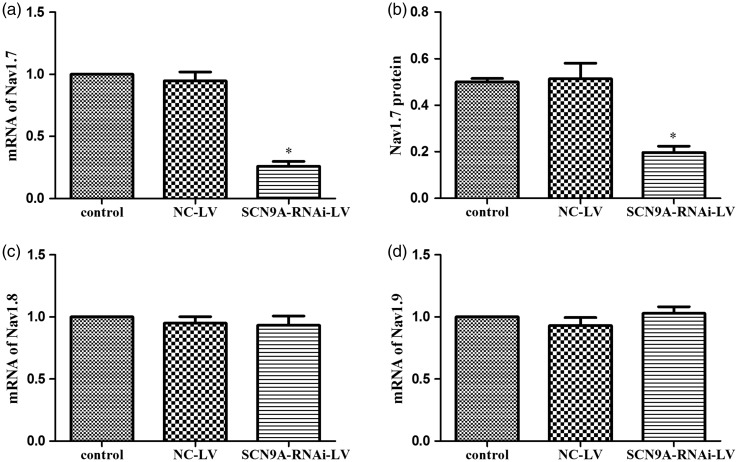
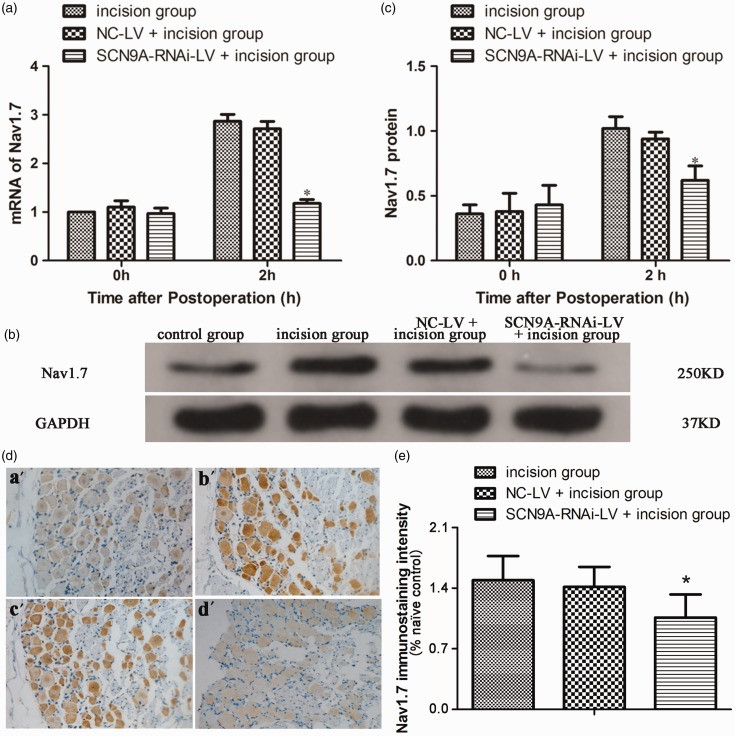
Postoperative pain remains a complex problem that is difficult to manage in the clinical context, seriously affecting rehabilitation and the quality of life of patients after surgery. Nociceptors, of which the cell bodies are located in the dorsal root ganglion, are crucial for initiating and conducting the pain signal. The peripheral voltage-gated sodium channels, including Na1.7, which is mainly expressed in the dorsal root ganglion, are key to understanding the mechanism underlying postoperative pain. Na1.7, in particular, of which mutations in the encoding gene ( SCN9A) can determine whether pain occurs, has aroused most attention. Previous studies have shown that Na1.7 in dorsal root ganglion is critical for the development of inflammatory pain and some neuropathic pain. However, the expression of Na1.7 in the dorsal root ganglion after surgery and its role in postoperative pain hypersensitivity remain unclear. Therefore, in this study, in order to gain a better understanding of the role of dorsal root ganglion Na1.7 in pain hypersensitivity following operation, we dynamically examined the pain-related behavior and expression of Na1.7 in L4-L6 dorsal root ganglion before and after plantar incision in rats (an acute postoperative pain model). After plantar incision, the mechanical and thermal pain threshold decreased significantly, the cumulative pain score was increased significantly, meanwhile quantitative polymerase chain reaction and Western blotting results showed that expression of Na1.7 in L4-L6 dorsal root ganglion was enhanced significantly. After pretreatment using SCN9A-RNAi-LV delivered via an intrathecal tube, immunohistochemistry showed that increased expression of Na1.7 in L4-L6 dorsal root ganglion after plantar incision was inhibited, as also confirmed by quantitative polymerase chain reaction and Western blotting. Moreover, pain hypersensitivity was alleviated. These results suggested that Na1.7 of L4-L6 dorsal root ganglion plays an important role in the development of pain hypersensitivity after plantar incision.
术后疼痛仍然是一个复杂的问题,在临床环境中难以处理,严重影响术后患者的康复和生活质量。伤害感受器的细胞体位于背根神经节,对于启动和传导疼痛信号至关重要。外周电压门控钠通道,包括主要表达于背根神经节的 Na1.7,是理解术后疼痛机制的关键。Na1.7,尤其是其编码基因(SCN9A)突变可以决定是否发生疼痛,引起了最多的关注。先前的研究表明,背根神经节中的 Na1.7 对于炎症性疼痛和一些神经性疼痛的发展至关重要。然而,术后背根神经节中 Na1.7 的表达及其在术后痛觉过敏中的作用尚不清楚。因此,在这项研究中,为了更好地了解背根神经节 Na1.7 在术后痛觉过敏中的作用,我们动态观察了足底切口前后大鼠 L4-L6 背根神经节中与疼痛相关的行为和 Na1.7 的表达(一种急性术后疼痛模型)。足底切口后,机械和热痛阈值显著降低,累积疼痛评分显著增加,同时定量聚合酶链反应和 Western blot 结果显示 L4-L6 背根神经节中 Na1.7 的表达显著增强。经鞘内管给予 SCN9A-RNAi-LV 预处理后,免疫组织化学显示足底切口后 L4-L6 背根神经节中 Na1.7 的表达增加被抑制,定量聚合酶链反应和 Western blot 也证实了这一点。此外,痛觉过敏得到缓解。这些结果表明,L4-L6 背根神经节中的 Na1.7 在足底切口后痛觉过敏的发展中起重要作用。