The Research Institute of St. Joe's Hamilton, 50 Charlton Ave E, Hamilton, ON, L8N 4A6, Canada.
McMaster University, School of Rehabilitation Science, Institute of Applied Health Science, Room 403, 1400 Main Street West, Hamilton, ON, L8S 1C7, Canada.
Trials. 2019 Aug 28;20(1):532. doi: 10.1186/s13063-019-3634-7.
Clinical trials management can be studied using project management theory. The CYCLE pilot randomized controlled trial (RCT) was conducted to determine the feasibility of a future rehabilitation trial of early in-bed cycling in the intensive care unit (ICU). In-bed cycling is a novel intervention, not typically available in ICUs. Implementation of this intervention requires personnel with specialized clinical expertise caring for critically ill patients and use of the in-bed cycle. Our objective was to describe the implementation and conduct of our pilot RCT using a project management approach.
We retrospectively reviewed activities, timelines, and personnel involved in the trial. We organized activities into four project management phases: initiation, planning, execution, and monitoring and controlling. Data sources included Methods Centre documents used for trial coordination and conduct, and the trial data set. We report descriptive statistics as counts and proportions and also medians and quartiles, and we summarize the lessons learned.
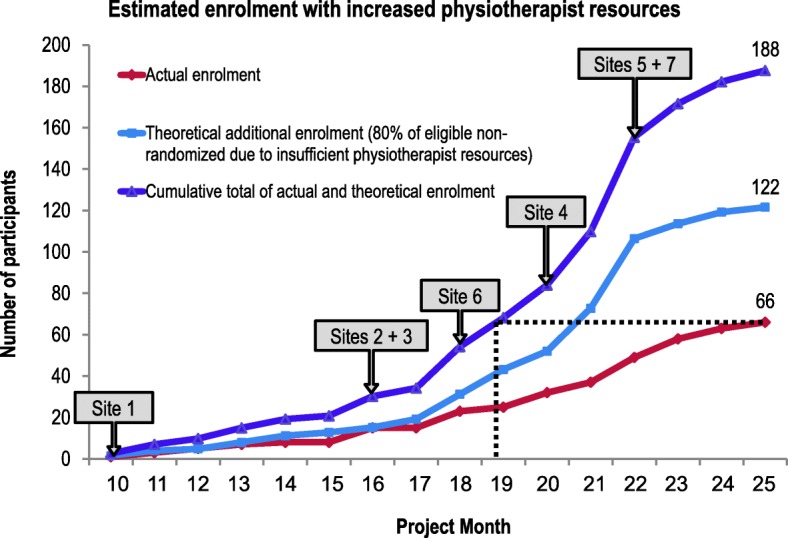
Seven ICUs in Canada participated in the trial. Time from research ethics board and contracts submission to first enrolment was a median (first quartile, third quartile) of 185 (146, 209) and 162 (114, 181) days, respectively. We trained 128 personnel on the CYCLE pilot RCT protocol, and 80 (63%) completed trial-related activities. Four sites required additional training after start-up due to staff turnover and leaves of absence. Over 15 months, we screened 864 patients: 256 were eligible and 66 were enrolled. Despite an 85% consent rate, 74% (190/256) of eligible patients were not randomized, largely (80% [152/190]) due to physiotherapist availability. Thirteen percent of recruitment weeks were lost due to physiotherapist staffing shortages. We highlight five key lessons learned: (1) prepare and anticipate site needs; (2) communicate regularly; (3) proactively analyse and act on process measure data; (4) develop contingency plans; (5) express appreciation to participating sites.
Our analysis highlights the scope of relevant activities, rigorous training and monitoring, number and types of required personnel, and time required to conduct a multicentre ICU rehabilitation intervention trial. Our lessons learned can help others interested in implementing complex intervention trials, such as rehabilitation.
ClinicalTrials.gov, NCT02377830 . Registered prospectively on 4 March 2015.
临床研究管理可以使用项目管理理论进行研究。CYCLE 先导随机对照试验(RCT)旨在确定在重症监护病房(ICU)中早期卧床自行车康复试验的可行性。卧床自行车是一种新型干预措施,通常在 ICU 中不可用。实施这种干预措施需要具有专门临床专业知识的人员来照顾重症患者,并使用卧床自行车。我们的目标是使用项目管理方法描述我们的先导 RCT 的实施和进行情况。
我们回顾性地审查了试验活动、时间表和参与人员。我们将活动组织成四个项目管理阶段:启动、规划、执行以及监控和控制。数据来源包括用于试验协调和进行的方法中心文件和试验数据集。我们报告了计数和比例的描述性统计数据,还报告了中位数和四分位数,并总结了经验教训。
加拿大的 7 家 ICU 参与了该试验。从研究伦理委员会和合同提交到首次入组的时间中位数(第 1 四分位数,第 3 四分位数)分别为 185(146,209)和 162(114,181)天。我们对 128 名 CYCLE 先导 RCT 方案的人员进行了培训,其中 80 人(63%)完成了与试验相关的活动。由于人员流动和请假,有 4 个地点在启动后需要额外的培训。在 15 个月的时间里,我们对 864 名患者进行了筛查:256 名符合条件,66 名入选。尽管同意率为 85%(190/256),但 74%(190/256)的符合条件的患者未随机分组,主要原因是物理治疗师的可用性(80%[152/190])。由于物理治疗师人手不足,13%的招募周数被浪费。我们强调了五个重要的经验教训:(1)准备并预测站点需求;(2)定期沟通;(3)主动分析和处理过程测量数据;(4)制定应急计划;(5)对参与站点表示感谢。
我们的分析强调了开展多中心 ICU 康复干预试验的相关活动范围、严格的培训和监测、所需人员的数量和类型,以及开展试验所需的时间。我们的经验教训可以帮助其他有兴趣实施复杂干预试验的人,如康复。
ClinicalTrials.gov,NCT02377830。于 2015 年 3 月 4 日前瞻性注册。