Department of Bioengineering, University of California, San Diego, La Jolla, California, USA.
Department of Bioengineering, University of California, San Diego, La Jolla, California, USA
mBio. 2019 Aug 27;10(4):e01247-19. doi: 10.1128/mBio.01247-19.
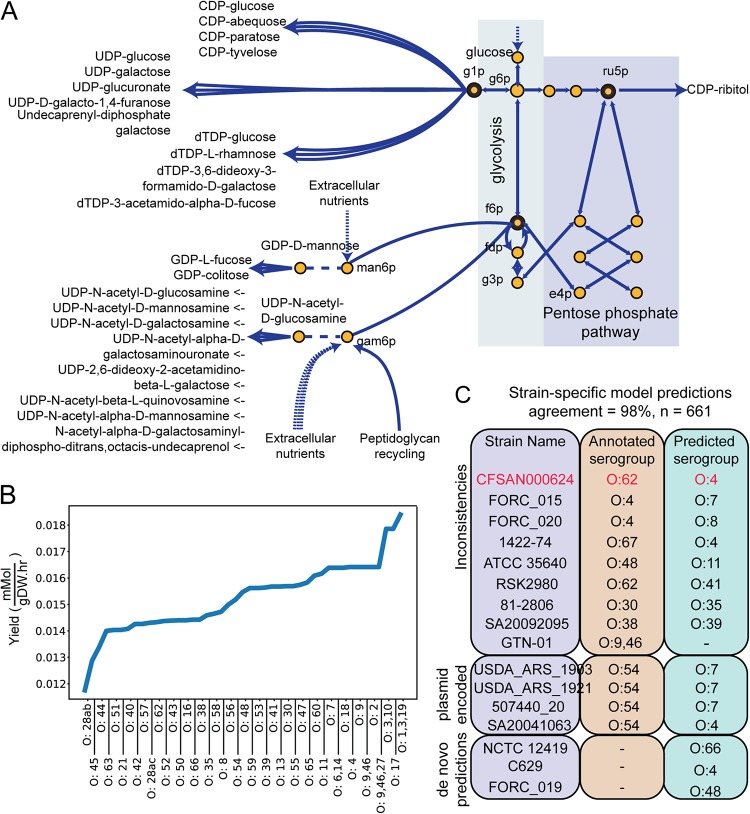
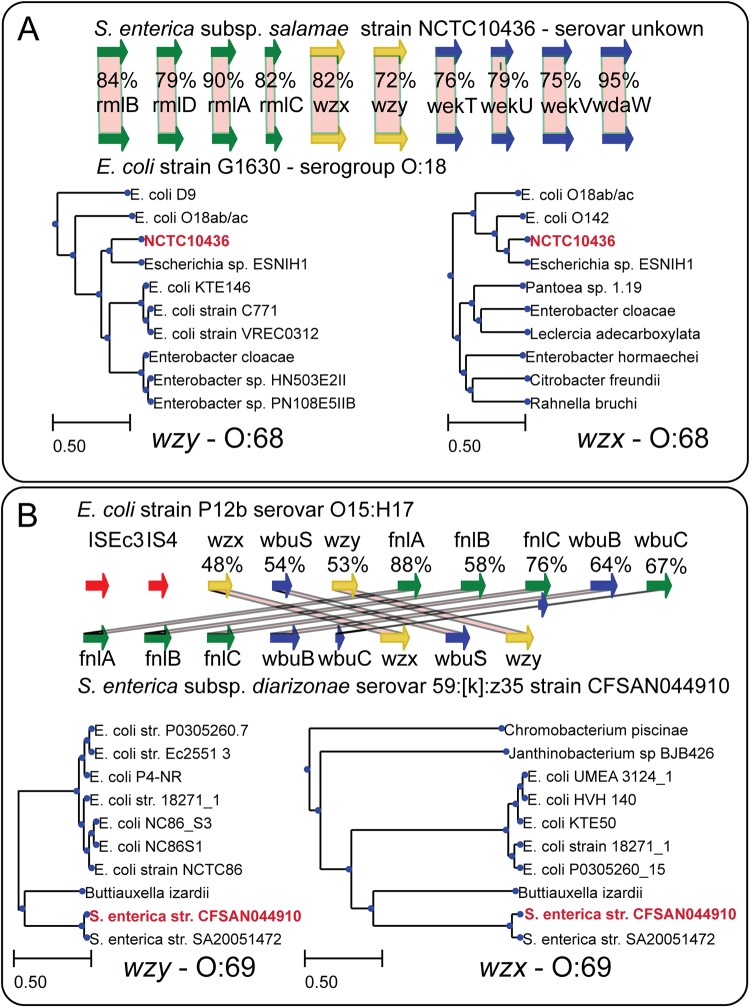
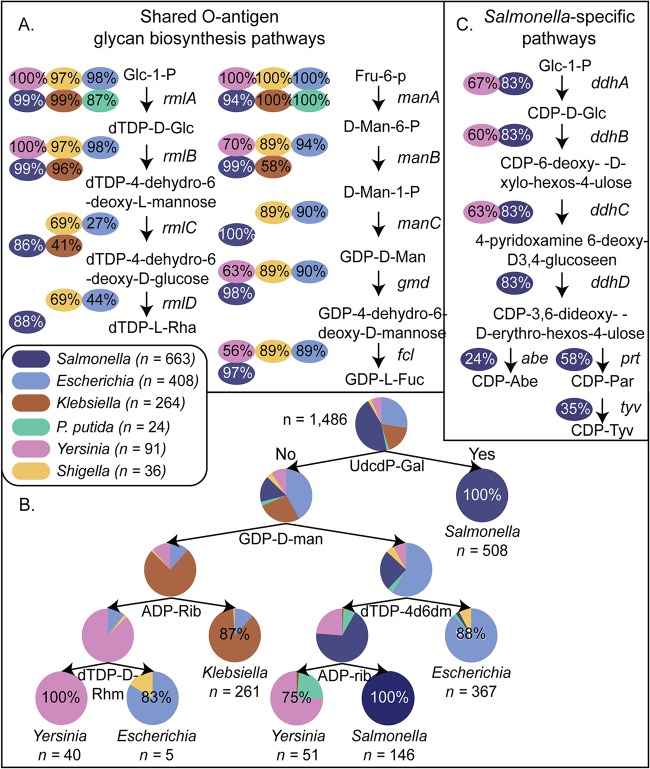
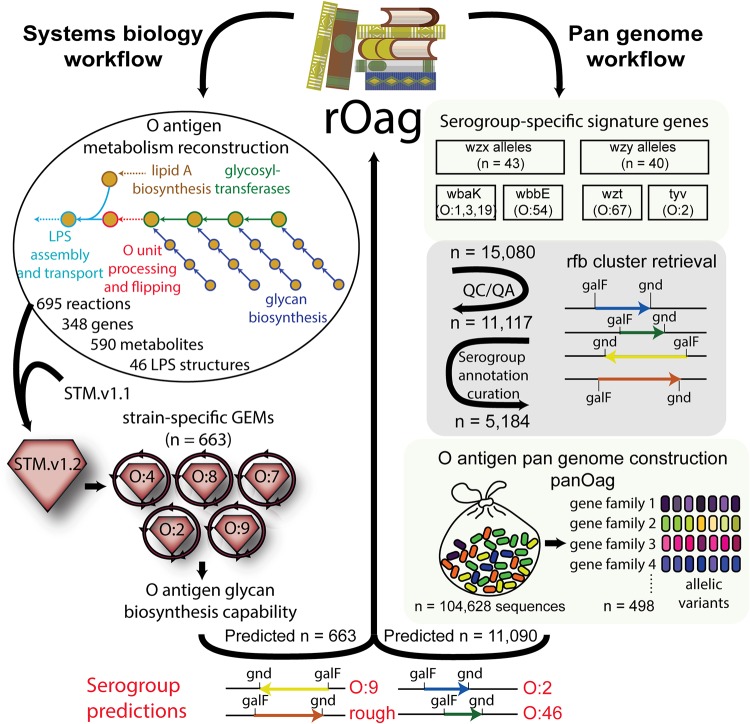
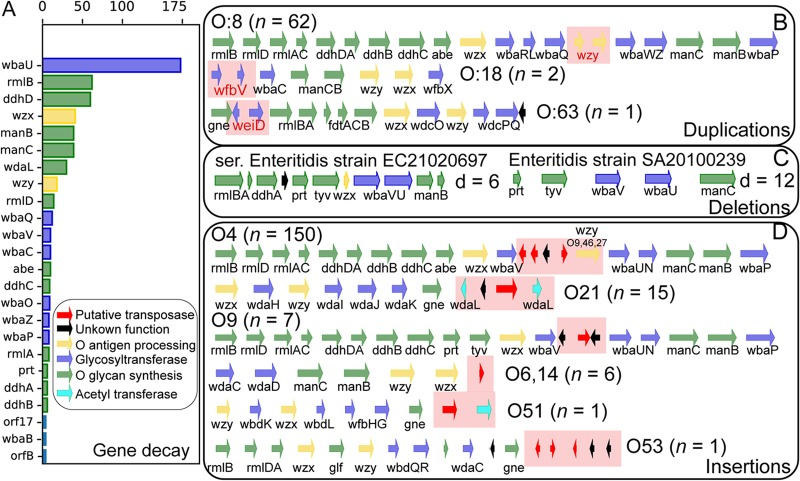
O-antigens are glycopolymers in lipopolysaccharides expressed on the cell surface of Gram-negative bacteria. Variability in the O-antigen structure constitutes the basis for the establishment of the serotyping schema. We pursued a two-pronged approach to define the basis for O-antigen structural diversity. First, we developed a bottom-up systems biology approach to O-antigen metabolism by building a reconstruction of O-antigen biosynthesis and used it to (i) update 410 existing strain-specific metabolic models, (ii) predict a strain's serogroup and its O-antigen glycan synthesis capability (yielding 98% agreement with experimental data), and (iii) extend our workflow to more than 1,400 Gram-negative strains. Second, we used a top-down pangenome analysis to elucidate the genetic basis for intraserogroup O-antigen structural variations. We assembled a database of O-antigen gene islands from over 11,000 sequenced strains, revealing (i) that gene duplication, pseudogene formation, gene deletion, and bacteriophage insertion elements occur ubiquitously across serogroups; (ii) novel serotypes in the group O:4 B2 variant, as well as an additional genotype variant for group O:4, and (iii) two novel O-antigen gene islands in understudied subspecies. We thus comprehensively defined the genetic basis for O-antigen diversity. Lipopolysaccharides are a major component of the outer membrane in Gram-negative bacteria. They are composed of a conserved lipid structure that is embedded in the outer leaflet of the outer membrane and a polysaccharide known as the O-antigen. O-antigens are highly variable in structure across strains of a species and are crucial to a bacterium's interactions with its environment. They constitute the first line of defense against both the immune system and bacteriophage infections and have been shown to mediate antimicrobial resistance. The significance of our research is in identifying the metabolic and genetic differences within and across O-antigen groups in strains. Our effort constitutes a first step toward characterizing the O-antigen metabolic network across Gram-negative organisms and a comprehensive overview of genetic variations in .
O-抗原是革兰氏阴性细菌细胞表面脂多糖中的糖聚合物。O-抗原结构的可变性构成了血清型建立的基础。我们采用了一种双管齐下的方法来确定 O-抗原结构多样性的基础。首先,我们通过构建 O-抗原生物合成的重建,发展了一种自下而上的系统生物学方法来研究 O-抗原代谢,并利用它来:(i) 更新 410 个现有的菌株特异性代谢模型,(ii) 预测菌株的血清群及其 O-抗原聚糖合成能力(与实验数据的吻合度达到 98%),以及 (iii) 将我们的工作流程扩展到 1400 多个革兰氏阴性菌株。其次,我们使用自上而下的泛基因组分析来阐明同血清群内 O-抗原结构变异的遗传基础。我们从超过 11000 个测序的菌株中组装了一个 O-抗原基因岛数据库,揭示了:(i) 基因复制、假基因形成、基因缺失和噬菌体插入元件在所有血清群中普遍存在;(ii) O:4 B2 变体组中出现了新的血清型,以及 O:4 组的另一个基因型变体,以及 (iii) 在研究较少的亚种中发现了两个新的 O-抗原基因岛。因此,我们全面定义了 O-抗原多样性的遗传基础。脂多糖是革兰氏阴性细菌外膜的主要成分。它们由一个保守的脂质结构组成,这个结构嵌入在外膜的外叶,还有一个被称为 O-抗原的多糖。O-抗原在同一物种的菌株之间在结构上有很大的可变性,这对细菌与环境的相互作用至关重要。它们是细菌对抗免疫系统和噬菌体感染的第一道防线,并且已经被证明可以介导抗菌药物耐药性。我们的研究意义在于确定不同 O-抗原组内和组间的代谢和遗传差异。我们的努力构成了在革兰氏阴性生物中描述 O-抗原代谢网络的第一步,也是对 中遗传变异的全面概述。