Epidemiology, Biostatistics and Prevention Institute, University of Zurich, Zurich, Switzerland.
Department of Neurology, University Hospital Bern and University of Bern, Bern, Switzerland/Neurology and Neurorehabilitation Centre, Lucerne Cantonal Hospital, Lucerne, Switzerland.
Mult Scler. 2020 Apr;26(4):489-500. doi: 10.1177/1352458518823955. Epub 2019 Jan 18.
Diagnosing multiple sclerosis (MS) early is crucial to avoid future disability. However, potentially preventable delays in the diagnostic cascade from contact with a physician to definite diagnosis still occur and their causes are still unclear.
To identify the possible causes of delays in the diagnostic process.
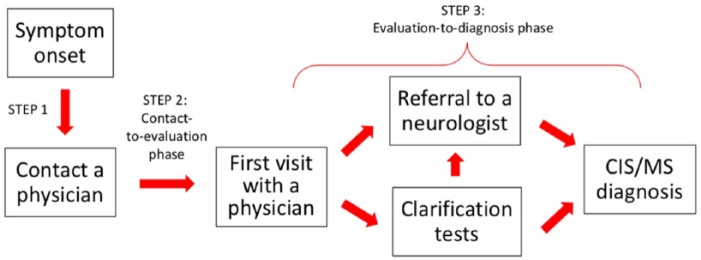
We analyzed the data of the Swiss MS Registry. With logistic regression, we modeled the time from the first contact to the first consultation (contact-to-evaluation time, ⩽1 month/>1 month) and the evaluation-to-diagnosis time (⩽6 months/>6 months). Potential factors were health system characteristics, sociodemographic variables, first symptoms, and MS type.
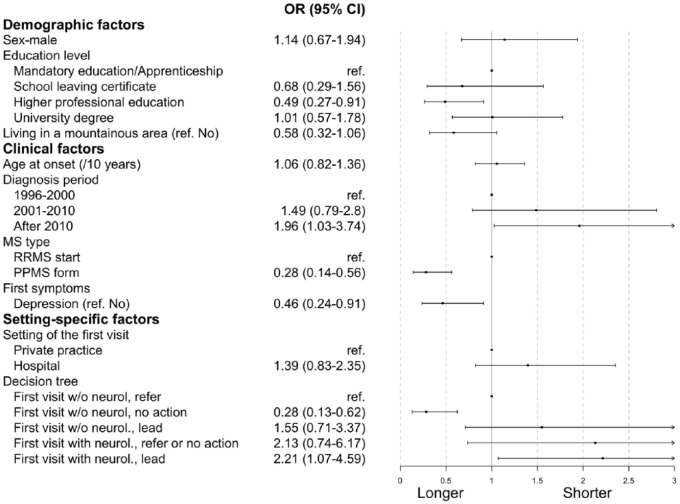
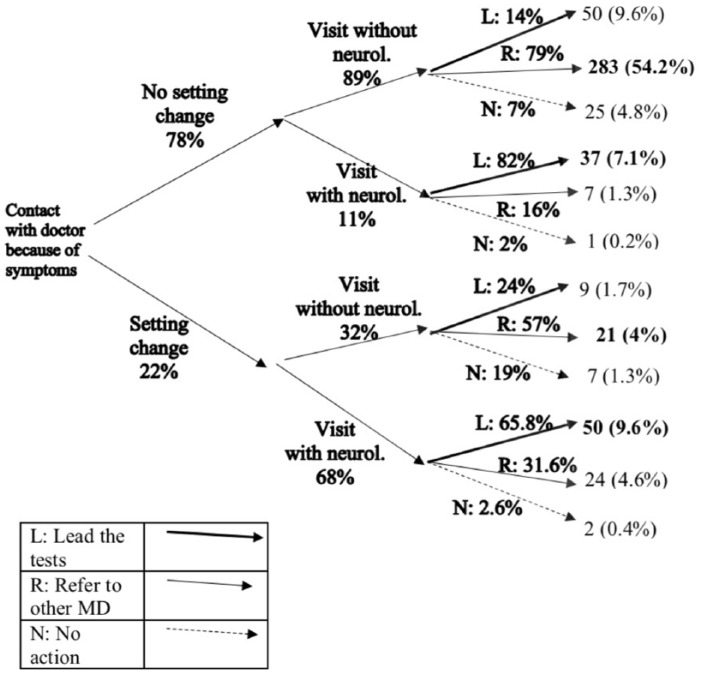
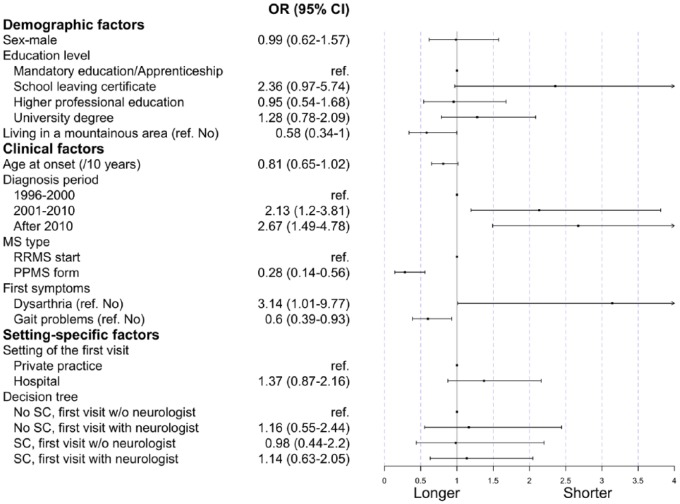
We included 522 participants. Mostly, general practitioners (67%) were contacted first, without delaying the diagnosis. In contrast, first symptoms and MS type were the major contributors to delays: gait problems were associated with longer contact-to-evaluation times, depression as a concomitant symptom with longer evaluation-to-diagnosis times, and having primary progressive MS prolonged both phases. In addition, living in mountainous areas was associated with longer contact-to-evaluation times, whereas diagnosis after 2000 was associated with faster diagnoses.
For a quicker diagnosis, awareness of MS as a differential diagnosis of gait disorders and the co-occurrence of depression at onset should be raised, and these symptoms should be attentively followed.
早期诊断多发性硬化症(MS)对于避免未来残疾至关重要。然而,从与医生接触到明确诊断的诊断过程中仍存在潜在可预防的延迟,其原因仍不清楚。
确定诊断过程中延迟的可能原因。
我们分析了瑞士 MS 登记处的数据。通过逻辑回归,我们构建了从首次接触到首次就诊(接触-评估时间,≤1 个月/>1 个月)和评估-诊断时间(≤6 个月/>6 个月)的时间模型。潜在因素包括卫生系统特征、社会人口统计学变量、首发症状和 MS 类型。
我们纳入了 522 名参与者。大多数情况下,首先联系的是全科医生(67%),并没有延迟诊断。相比之下,首发症状和 MS 类型是导致延迟的主要因素:步态问题与接触-评估时间延长有关,抑郁作为伴随症状与评估-诊断时间延长有关,原发性进展型 MS 则延长了两个阶段。此外,居住在山区与接触-评估时间延长有关,而 2000 年后的诊断与更快的诊断有关。
为了更快地诊断,应提高对 MS 作为步态障碍鉴别诊断的认识,并注意首发时的抑郁症状,以便及时进行诊断。