Henricks Angela M, Dwiel Lucas L, Deveau Nicholas H, Simon Amanda A, Ruiz-Jaquez Metztli J, Green Alan I, Doucette Wilder T
Department of Psychiatry, Geisel School of Medicine at Dartmouth, Hanover, NH, United States.
Department of Molecular and Systems Biology, Geisel School of Medicine at Dartmouth, Hanover, NH, United States.
Front Syst Neurosci. 2019 Aug 13;13:35. doi: 10.3389/fnsys.2019.00035. eCollection 2019.
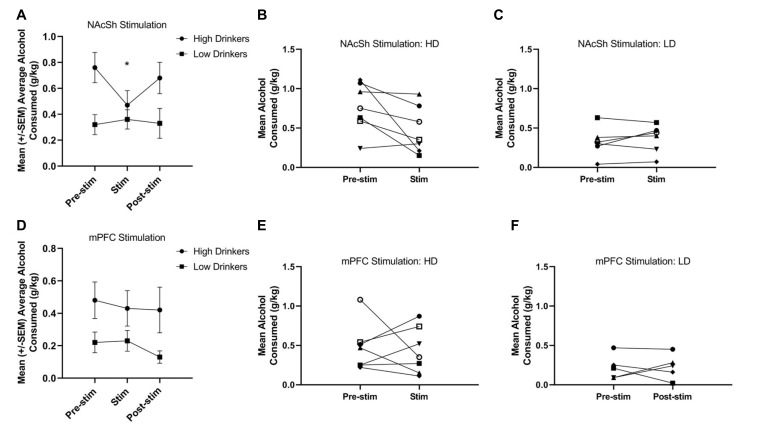
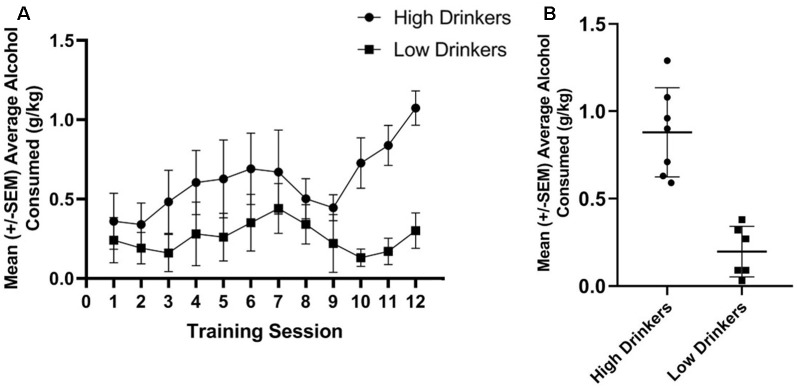
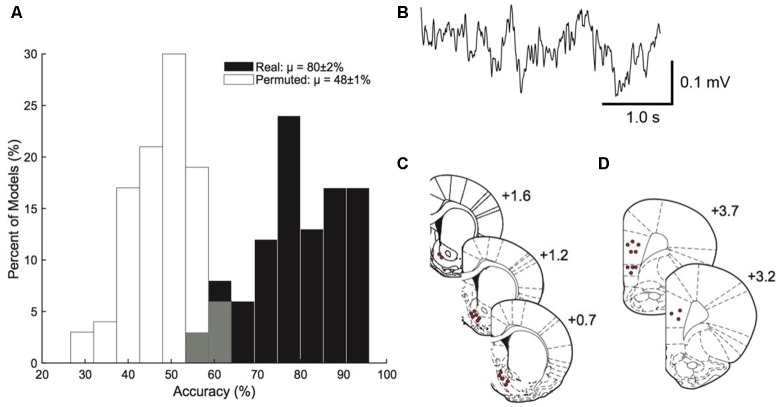
Individuals differ in their vulnerability to develop alcohol dependence, which is determined by innate and environmental factors. The corticostriatal circuit is heavily involved in the development of alcohol dependence and may contain neural information regarding vulnerability to drink excessively. In the current experiment, we hypothesized that we could characterize high and low alcohol-drinking rats (HD and LD, respectively) based on corticostriatal oscillations and that these subgroups would differentially respond to corticostriatal brain stimulation. Male Sprague-Dawley rats ( = 13) were trained to drink 10% alcohol in a limited access paradigm. In separate sessions, local field potentials (LFPs) were recorded from the nucleus accumbens shell (NAcSh) and medial prefrontal cortex (mPFC). Based on training alcohol consumption levels, we classified rats using a median split as HD or LD. Then, using machine-learning, we built predictive models to classify rats as HD or LD by corticostriatal LFPs and compared the model performance from real data to the performance of models built on data permutations. Additionally, we explored the impact of NAcSh or mPFC stimulation on alcohol consumption in HD vs. LD. Corticostriatal LFPs were able to predict HD vs. LD group classification with greater accuracy than expected by chance (>80% accuracy). Moreover, NAcSh stimulation significantly reduced alcohol consumption in HD, but not LD ( < 0.05), while mPFC stimulation did not alter drinking behavior in either HD or LD ( > 0.05). These data collectively show that the corticostriatal circuit is differentially involved in regulating alcohol intake in HD vs. LD rats, and suggests that corticostriatal activity may have the potential to predict a vulnerability to develop alcohol dependence in a clinical population.
个体对酒精依赖的易感性存在差异,这由先天和环境因素决定。皮质纹状体回路在酒精依赖的发展中起重要作用,可能包含与过度饮酒易感性相关的神经信息。在当前实验中,我们假设可以根据皮质纹状体振荡来区分高饮酒量和低饮酒量大鼠(分别为HD和LD),并且这些亚组对皮质纹状体脑刺激的反应会有所不同。雄性Sprague-Dawley大鼠(n = 13)在有限获取范式下接受训练,饮用10%的酒精。在不同的实验环节中,从伏隔核壳(NAcSh)和内侧前额叶皮质(mPFC)记录局部场电位(LFP)。根据训练期间的酒精摄入量水平,我们使用中位数分割法将大鼠分为HD或LD。然后,使用机器学习,我们建立预测模型,通过皮质纹状体LFP将大鼠分类为HD或LD,并将真实数据的模型性能与基于数据排列构建的模型性能进行比较。此外,我们探究了NAcSh或mPFC刺激对HD和LD大鼠酒精摄入量的影响。皮质纹状体LFP能够以高于随机预期的准确率预测HD组与LD组分类(准确率>80%)。此外,NAcSh刺激显著降低了HD大鼠的酒精摄入量,但对LD大鼠没有影响(P < 0.05),而mPFC刺激对HD或LD大鼠的饮酒行为均无改变(P > 0.05)。这些数据共同表明,皮质纹状体回路在调节HD和LD大鼠的酒精摄入量方面存在差异参与,并且表明皮质纹状体活动可能有潜力预测临床人群中酒精依赖发展的易感性。