Sirous Hajar, Chemi Giulia, Gemma Sandra, Butini Stefania, Debyser Zeger, Christ Frauke, Saghaie Lotfollah, Brogi Simone, Fassihi Afshin, Campiani Giuseppe, Brindisi Margherita
Bioinformatics Research Center, School of Pharmacy and Pharmaceutical Sciences, Isfahan University of Medical Sciences, Isfahan, Iran.
Department of Biotechnology, Chemistry and Pharmacy, Department of Excellence 2018-2022, University of Siena, Siena, Italy.
Front Chem. 2019 Aug 13;7:574. doi: 10.3389/fchem.2019.00574. eCollection 2019.
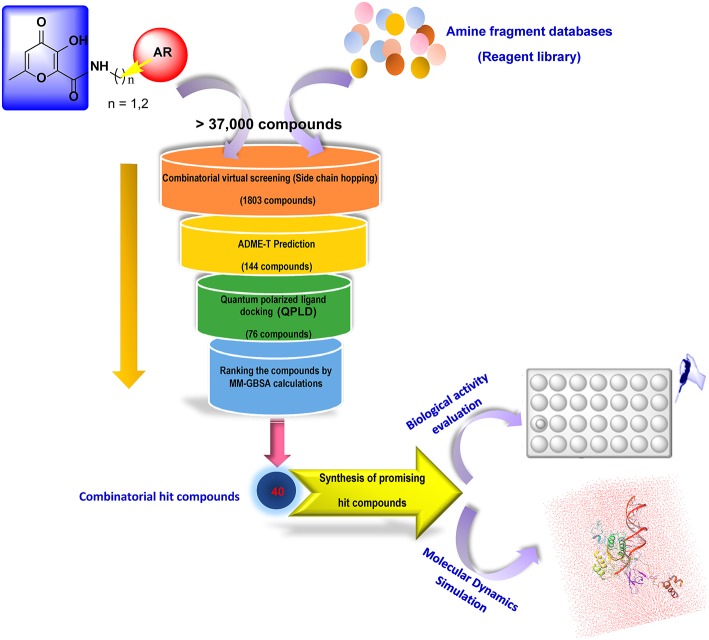
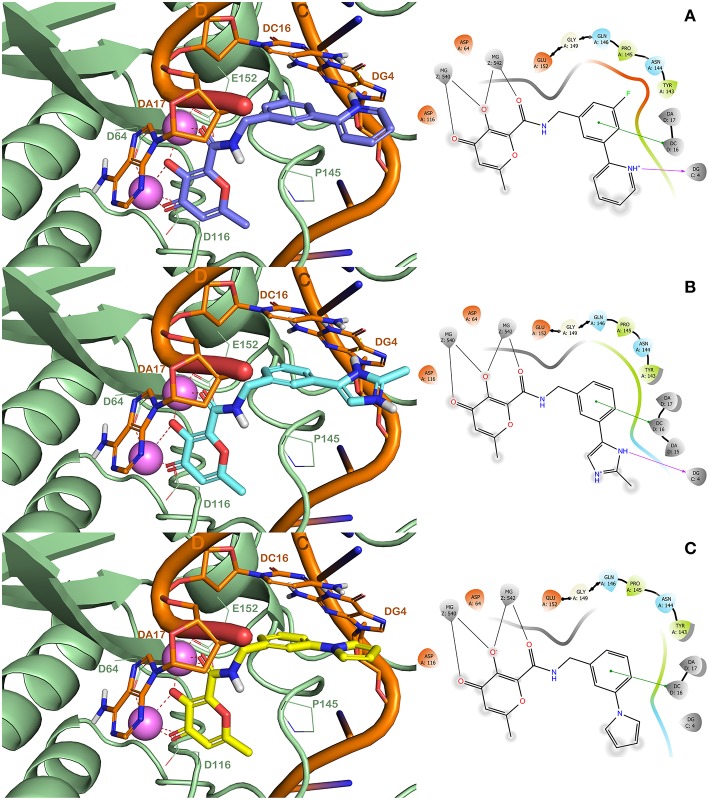
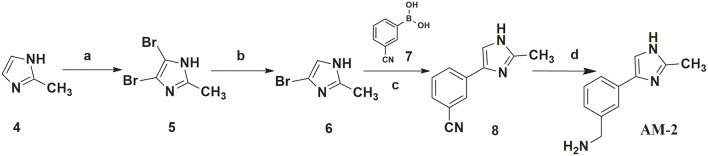
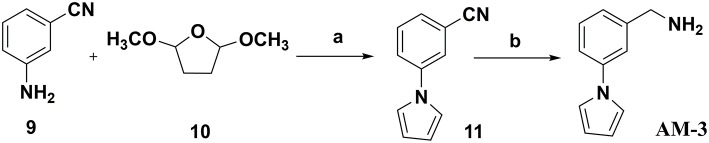
We describe herein the development and experimental validation of a computational protocol for optimizing a series of 3-hydroxy-pyran-4-one derivatives as HIV integrase inhibitors (HIV INIs). Starting from a previously developed micromolar inhibitors of HIV integrase (HIV IN), we performed an in-depth investigation based on an structure-based combinatorial library designing approach. This method allowed us to combine a combinatorial library design and side chain hopping with Quantum Polarized Ligand Docking (QPLD) studies and Molecular Dynamics (MD) simulation. The combinatorial library design allowed the identification of the best decorations for our promising scaffold. The resulting compounds were assessed by the mentioned QPLD methodology using a homology model of full-length binary HIV IN/DNA for retrieving the best performing compounds acting as HIV INIs. Along with the prediction of physico-chemical properties, we were able to select a limited number of drug-like compounds potentially displaying potent HIV IN inhibition. From this final set, based on the synthetic accessibility, we further shortlisted three representative compounds for the synthesis. The compounds were experimentally assessed for evaluating overall HIV-1 IN inhibition, HIV-1 IN strand transfer activity inhibition, HIV-1 activity inhibition and cellular toxicity. Gratifyingly, all of them showed relevant inhibitory activity in the tests along with no toxicity. Among them represents the most promising compound as potential anti-HIV agent, showing inhibitory activity against HIV IN in the low nanomolar range, comparable to that found for Raltegravir, and relevant potency in inhibiting HIV-1 replication and HIV-1 IN strand transfer activity. In summary, our results outline as a useful optimized hit for the potential treatment of HIV-1 infection by targeting HIV IN.
我们在此描述了一种计算协议的开发与实验验证,该协议用于优化一系列3-羟基-吡喃-4-酮衍生物作为HIV整合酶抑制剂(HIV INIs)。从先前开发的微摩尔级HIV整合酶(HIV IN)抑制剂出发,我们基于基于结构的组合文库设计方法进行了深入研究。该方法使我们能够将组合文库设计和侧链跳跃与量子极化配体对接(QPLD)研究及分子动力学(MD)模拟相结合。组合文库设计能够确定我们有前景的骨架的最佳修饰。使用全长二元HIV IN/DNA的同源模型,通过上述QPLD方法对所得化合物进行评估,以筛选出表现最佳的作为HIV INIs的化合物。除了预测物理化学性质外,我们还能够选择有限数量的可能具有强效HIV IN抑制作用的类药物化合物。基于合成可及性,从这一最终集合中,我们进一步筛选出三种代表性化合物进行合成。对这些化合物进行了实验评估,以评价其对HIV-1 IN的总体抑制、HIV-1 IN链转移活性抑制、HIV-1活性抑制及细胞毒性。令人欣慰的是,所有这些化合物在测试中均显示出相关抑制活性且无毒性。其中一种化合物作为潜在的抗HIV药物最具前景,其对HIV IN的抑制活性在低纳摩尔范围内,与拉替拉韦相当,并且在抑制HIV-1复制和HIV-1 IN链转移活性方面具有显著效力。总之,我们的结果表明该化合物是通过靶向HIV IN潜在治疗HIV-1感染的一种有用的优化命中物。