Chang Joon Ha, Cheong Jun Young, Yuk Jong Min, Kim Chanhoon, Kim Sung Joo, Seo Hyeon Kook, Kim Il-Doo, Lee Jeong Yong
Center for Nanomaterials and Chemical Reactions, Institute for Basic Science (IBS), 1689 Yuseong Dae-ro 70, Daejeon 305-701, Republic of Korea.
Department of Materials Science & Engineering, Korea Advanced Institute of Science & Technology, 335 Science Road, Daejeon 305-701, Republic of Korea.
ACS Omega. 2017 Oct 3;2(10):6329-6336. doi: 10.1021/acsomega.7b01046. eCollection 2017 Oct 31.
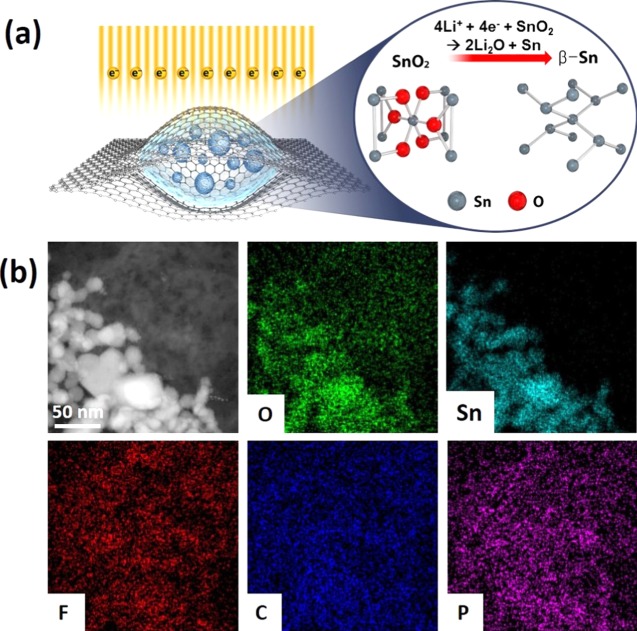
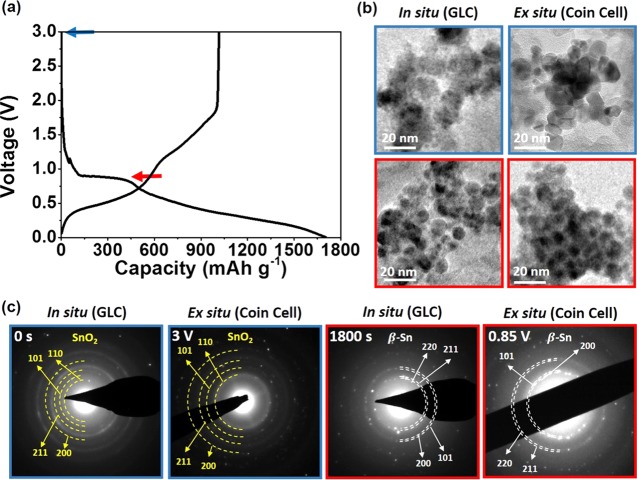
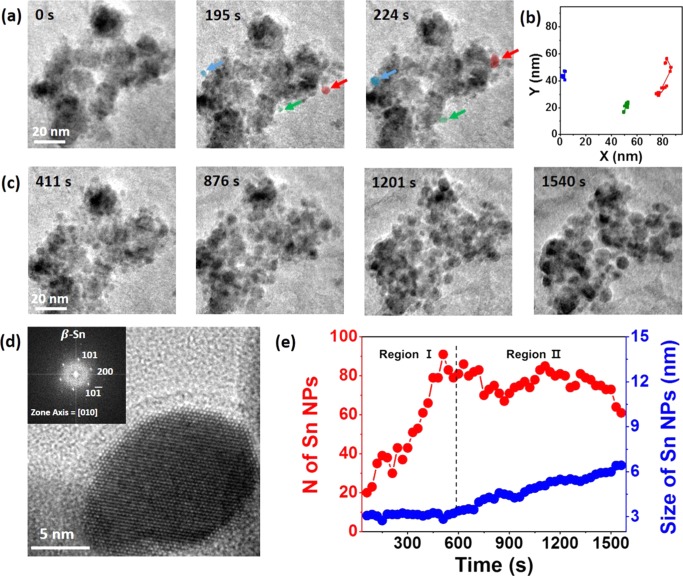
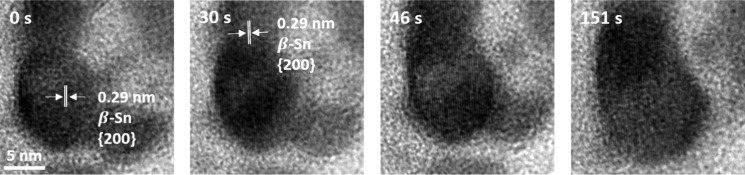
The conversion reaction is important in lithium-ion batteries because it governs the overall battery performance, such as initial Coulombic efficiency, capacity retention, and rate capability. Here, we have demonstrated in situ observation of the complete conversion reaction and agglomeration of nanoparticles (NPs) upon lithiation by using graphene liquid cell transmission electron microscopy. The observation reveals that the Sn NPs are nucleated from the surface of SnO, followed by merging with each other. We demonstrate that the agglomeration has a stepwise process, including rotation of a NP, formation of necks, and subsequent merging of individual NPs.
转化反应在锂离子电池中很重要,因为它决定了电池的整体性能,如初始库仑效率、容量保持率和倍率性能。在此,我们通过使用石墨烯液体池透射电子显微镜对锂化过程中纳米颗粒(NP)的完全转化反应和团聚进行了原位观察。观察结果表明,Sn NPs从SnO表面成核,随后相互合并。我们证明团聚过程具有逐步性,包括NP的旋转、颈部的形成以及单个NP的后续合并。