Tiwari Madhu, Gupta Vinod Kumar, Singh Ram Adhar, Ji Gopal, Prakash Rajiv
School of Materials Science and Technology, Indian Institute of Technology (BHU) Varanasi, Varanasi-221005 Uttar Pradesh, India.
Department of Chemistry, Kashi Naresh Government Post Graduate College, Sant Ravidas Nagar, Bhadohi-221401 Uttar Pradesh, India.
ACS Omega. 2018 Apr 11;3(4):4081-4093. doi: 10.1021/acsomega.8b00083. eCollection 2018 Apr 30.
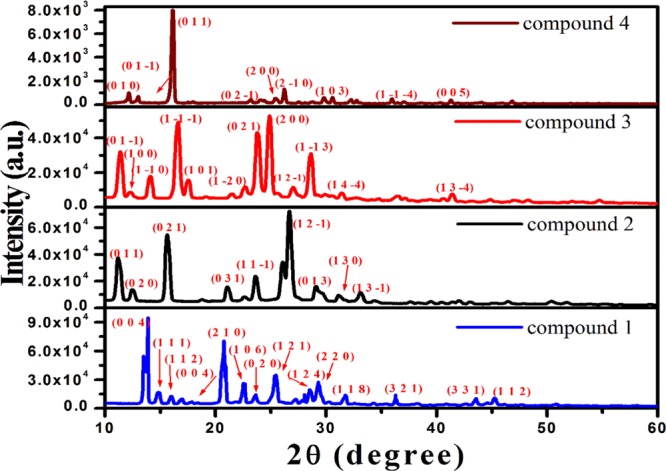
In this work, donor-π-acceptor-type four crystalline compounds have been tested for the first time to restrict the corrosion of mild steel in 1 M HCl. The details of the compounds are: C1, 4-,-dimethylamino-β-nitrostyrene; C2, 2-(4-(dimethylamino) benzylidene)malononitrile; C3, ethyl 2-cyano-3-(4-(dimethylamino) phenyl)acrylate; and C4, methyl 2-cyano-3-(4-(dimethylamino)phenyl)acrylate. The corrosion inhibition potentials of the compounds have been primarily investigated by electrochemical techniques, such as linear polarization resistance, Tafel polarization curves, and electrochemical impedance spectroscopy. The secondary investigation is performed by scanning electron microscopy, fluorescence surface imaging, spectroscopic techniques (UV-visible and Fourier transform infrared spectroscopy), and X-ray diffraction patterns. The results disclosed that 50 mg L of the compounds (1-4) in 1 M HCl provided the maximum inhibition efficiency as 93% (1), 88% (2), 82% (3), and 86% (4). The function of the compounds as corrosion inhibitors is explained with equilibrium corrosion potential, adsorption isotherms, and the frontier molecular orbital energies of the compounds ( and ) estimated by cyclic voltammetry curves and UV-visible spectra.
在本研究中,首次对供体-π-受体型四种结晶化合物抑制低碳钢在1 M盐酸中的腐蚀进行了测试。这些化合物的详细信息如下:C1,4-,-二甲基氨基-β-硝基苯乙烯;C2,2-(4-(二甲基氨基)亚苄基)丙二腈;C3,2-氰基-3-(4-(二甲基氨基)苯基)丙烯酸乙酯;C4,2-氰基-3-(4-(二甲基氨基)苯基)丙烯酸甲酯。主要通过电化学技术,如线性极化电阻、塔菲尔极化曲线和电化学阻抗谱,研究了这些化合物的缓蚀电位。通过扫描电子显微镜、荧光表面成像、光谱技术(紫外-可见光谱和傅里叶变换红外光谱)以及X射线衍射图谱进行了二次研究。结果表明,在1 M盐酸中加入50 mg/L的化合物(1-4)时,最大缓蚀效率分别为93%(1)、88%(2)、82%(3)和86%(4)。通过平衡腐蚀电位、吸附等温线以及通过循环伏安曲线和紫外-可见光谱估算的化合物的前线分子轨道能量( 和 )来解释化合物作为缓蚀剂的作用。