Dominguez Noemi, Torres Brenda, Barrera Luis A, Rincon Julio E, Lin Yirong, Chianelli Russell R, Ahsan Md Ariful, Noveron Juan C
Department of Metallurgical, Materials and Biomedical Engineering, Materials Research and Technology Institute, Department of Chemistry, and Department of Mechanical Engineering, The University of Texas at El Paso, El Paso, Texas 79968, United States.
ACS Omega. 2018 Aug 30;3(8):10243-10249. doi: 10.1021/acsomega.8b00654. eCollection 2018 Aug 31.
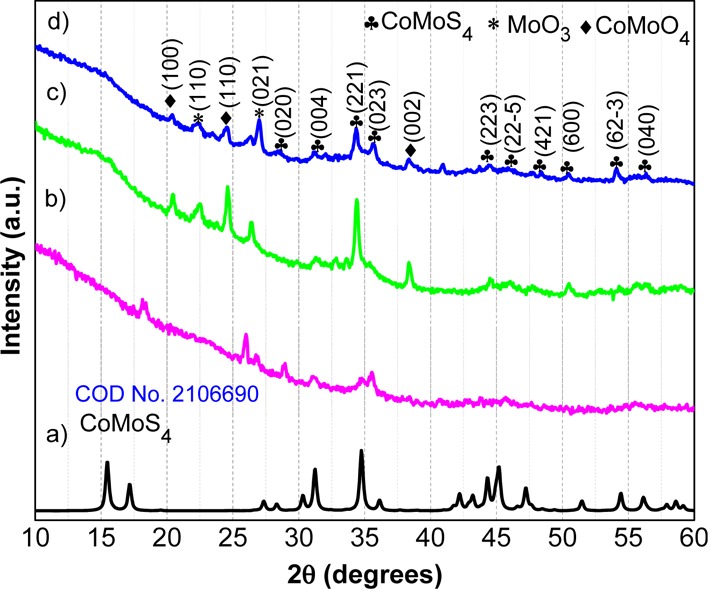
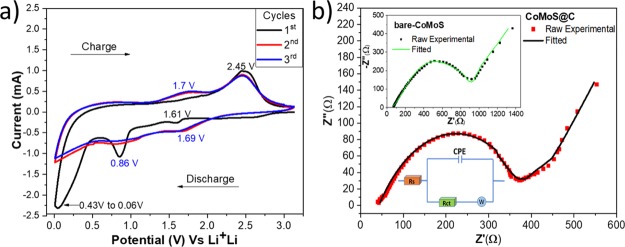
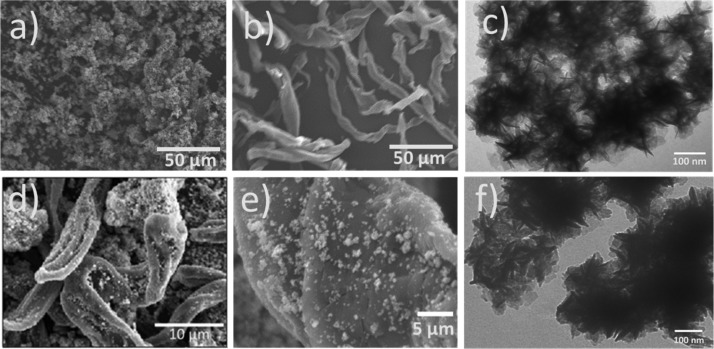
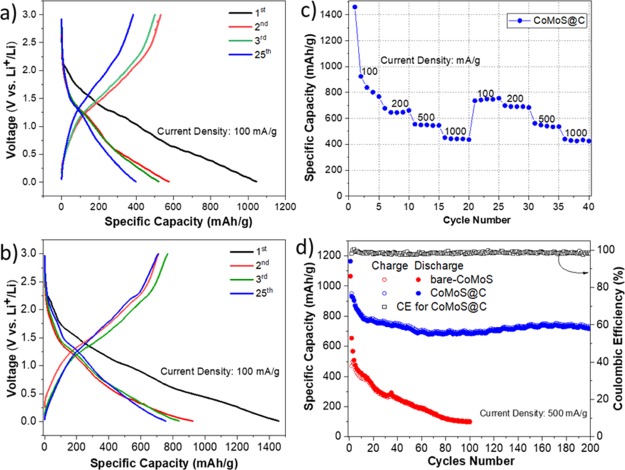
Our work reports the hydrothermal synthesis of a bimetallic composite CoMoS, followed by the addition of cellulose fibers and its subsequent carbonization under Ar atmosphere (CoMoS@C). For comparison, CoMoS was heat-treated under the same conditions and referred as bare-CoMoS. X-ray diffraction analysis indicates that CoMoS@C composite matches with the CoMoS phase with additional peaks corresponding to MoO and CoMoO phases, which probably arise from air exposure during the carbonization process. Scanning electron microscopy images of CoMoS@C exhibit how the CoMoS material is anchored to the surface of carbonized cellulose fibers. As anode material, CoMoS@C shows a superior performance than bare-CoMoS. The CoMoS@C composite presents an initial high discharge capacity of ∼1164 mA h/g and retains a high specific discharge capacity of ∼715 mA h/g after 200 cycles at a current density of 500 mA/g compared to that of bare-CoMoS of 102 mA h/g. The high specific capacity and good cycling stability could be attributed to the synergistic effects of CoMoS and carbonized cellulose fibers. The use of biomass in the anode material represents a very easy and cost-effective way to improve the electrochemical Li-ion battery performance.
我们的工作报道了双金属复合材料CoMoS的水热合成,随后添加纤维素纤维并在氩气气氛下进行碳化(CoMoS@C)。作为对比,CoMoS在相同条件下进行热处理,称为裸CoMoS。X射线衍射分析表明,CoMoS@C复合材料与CoMoS相匹配,还有对应于MoO和CoMoO相的额外峰,这可能是由于碳化过程中暴露于空气中所致。CoMoS@C的扫描电子显微镜图像展示了CoMoS材料如何锚定在碳化纤维素纤维表面。作为阳极材料,CoMoS@C表现出比裸CoMoS更优异的性能。CoMoS@C复合材料初始放电容量约为1164 mA h/g,在500 mA/g的电流密度下循环200次后,仍保持约715 mA h/g的高比放电容量,而裸CoMoS仅为102 mA h/g。高比容量和良好的循环稳定性可归因于CoMoS与碳化纤维素纤维的协同效应。在阳极材料中使用生物质是一种非常简便且经济高效的提高锂离子电池电化学性能的方法。