Affiliated Cancer Hospital & Institute of Guangzhou Medical University, Key Laboratory of Protein Modification and Degradation, School of Basic Medical Sciences, Guangzhou Medical University, Guangzhou, China.
State Key Laboratory of Respiratory Disease, Guangzhou Medical University, Guangzhou, China.
BMC Cancer. 2019 Aug 28;19(1):851. doi: 10.1186/s12885-019-6041-2.
Gradual loss of terminal differentiation markers and gain of stem cell-like properties is a major hall mark of cancer malignant progression. The stem cell pluripotent transcriptional factor SOX family play critical roles in governing tumor plasticity and lineage specification. This study aims to establish a novel SOX signature to monitor the extent of tumor dedifferentiation and predict prognostic significance in hepatocellular carcinoma (HCC).
The RNA-seq data from The Cancer Genome Atlas (TCGA) LIHC project were chronologically divided into the training (n = 188) and testing cohort (n = 189). LIRI-JP project from International Cancer Genome Consortium (ICGC) data portal was used as an independent validation cohort (n = 232). Kaplan-Meier and multivariable Cox analyses were used to examine the clinical significance and prognostic value of the signature genes.
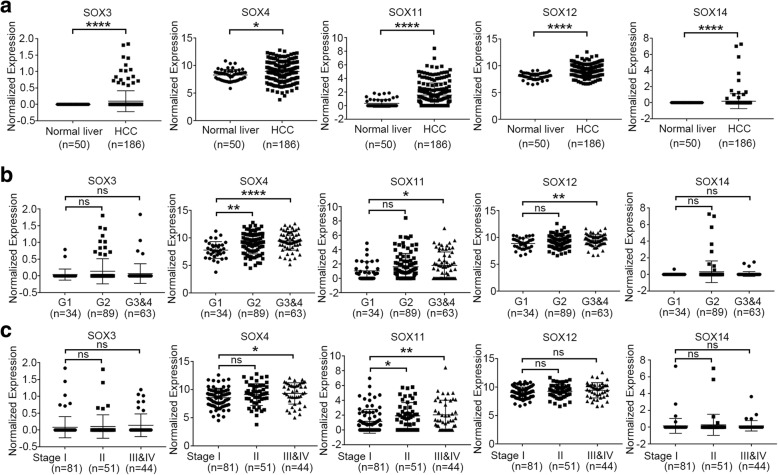
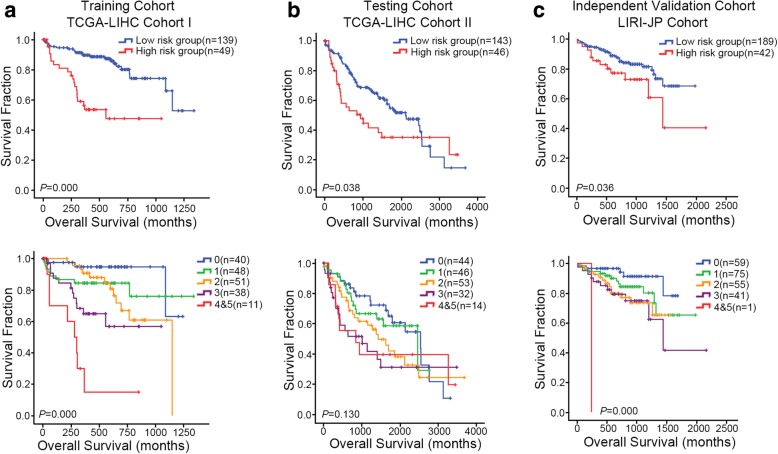
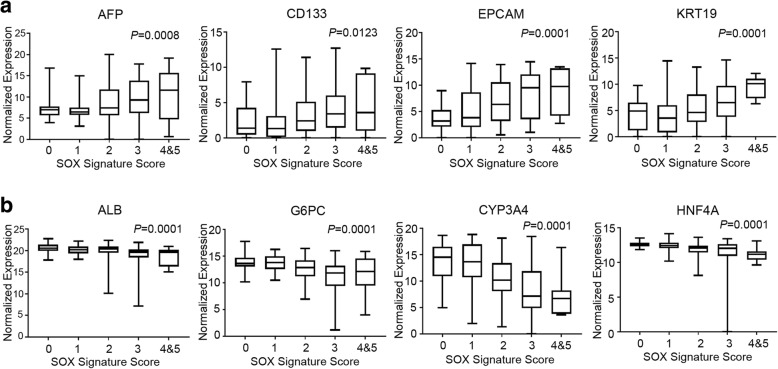
The SOX gene family members were found to be aberrantly expressed in clinical HCC patients. A five-gene SOX signature with prognostic value was established in the training cohort. The SOX signature genes were found to be closely associated with tumor grade and tumor stage. Liver cancer dedifferentiation markers (AFP, CD133, EPCAM, and KRT19) were found to be progressively increased while hepatocyte terminal differentiation markers (ALB, G6PC, CYP3A4, and HNF4A) were progressively decreased from HCC patients with low SOX signature scores to patients with high SOX signature scores. Kaplan-Meier survival analysis further indicated that the newly established SOX signature could robustly predict patient overall survival in both training, testing, and independent validation cohort.
An oncogenic dedifferentiation SOX signature presents a great potential in predicting prognostic significance in HCC, and might provide novel biomarkers for precision oncology further in the clinic.
终末分化标志物的逐渐丧失和干细胞样特性的获得是癌症恶性进展的主要标志。干细胞多能转录因子 SOX 家族在调控肿瘤可塑性和谱系特化方面发挥着关键作用。本研究旨在建立一种新的 SOX 特征,以监测肿瘤去分化的程度,并预测肝细胞癌 (HCC) 的预后意义。
从癌症基因组图谱 (TCGA) LIHC 项目的 RNA-seq 数据中,按照时间顺序将其分为训练集 (n=188) 和测试集 (n=189)。国际癌症基因组联盟 (ICGC) 数据门户的 LIRI-JP 项目被用作独立验证队列 (n=232)。Kaplan-Meier 和多变量 Cox 分析用于检查特征基因的临床意义和预后价值。
发现 SOX 基因家族成员在临床 HCC 患者中异常表达。在训练队列中建立了具有预后价值的五个基因 SOX 特征。发现 SOX 特征基因与肿瘤分级和肿瘤分期密切相关。肝癌去分化标志物 (AFP、CD133、EPCAM 和 KRT19) 逐渐增加,而肝细胞终末分化标志物 (ALB、G6PC、CYP3A4 和 HNF4A) 则逐渐减少,从 SOX 特征评分低的 HCC 患者到 SOX 特征评分高的患者。Kaplan-Meier 生存分析进一步表明,新建立的 SOX 特征能够在训练、测试和独立验证队列中稳健地预测患者的总生存率。
致癌性去分化 SOX 特征在预测 HCC 的预后意义方面具有很大的潜力,并且可能为临床进一步提供新的精准肿瘤学标志物。