Pothier William, Cellard Caroline, Corbière Marc, Villotti Patrizia, Achim Amélie M, Lavoie Andréanne, Turcotte Mélissa, Vallières Chantal, Roy Marc-André
École de psychologie de l'Université Laval, 2325 Allée des Bibliothèques, G1V 0A6 Québec, Canada.
Centre de recherche CERVO, 2601 Chemin de la Canardière, G1J 2G3 Québec, Canada.
Schizophr Res Cogn. 2019 Aug 19;18:100158. doi: 10.1016/j.scog.2019.100158. eCollection 2019 Dec.
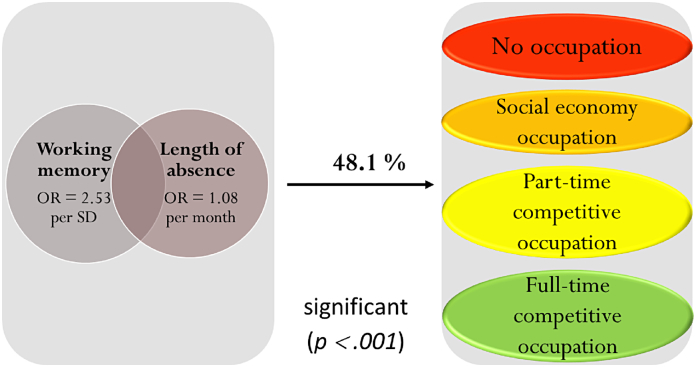
Working or studying is a common goal among people with recent-onset psychosis. Cognitive deficits have been reported to influence occupational outcome, but to date few studies have evaluated if cognitive deficits independently predict occupational outcome when taking into account other important determinants, such as self-esteem, motivation, length of time absent from employment/school, job/school search behaviours, subjective cognitive complaints and psychotic symptoms. Hence, this longitudinal study aimed to evaluate the role of cognition, as well as other key factors relevant to occupational outcome, to predict occupational status six months after baseline in people with recent-onset psychosis. A total of 27 participants receiving treatment in rehabilitation programs were included in the study. Neuropsychological, psychological, clinical and occupational measures were administered at baseline, and occupational status was collected six months later. Ordinal regression indicated that working memory and length of time absent from employment/school at baseline predicted 48.1% of the variance of occupational status at six months, with both variables showing a unique significant contribution to the model. These results suggest that working memory could be integrated in comprehensive models of occupational outcome in people with recent-onset psychosis. In addition, supported employment and education programs could target cognitive deficits and length of time absent from employment/school to help these individuals to acquire a job or return to school given their strong predictive value on occupational outcome.
工作或学习是近期发病的精神病患者的一个共同目标。据报道,认知缺陷会影响职业结局,但迄今为止,很少有研究评估在考虑其他重要决定因素(如自尊、动机、失业/辍学时间、求职/求学行为、主观认知主诉和精神病症状)时,认知缺陷是否能独立预测职业结局。因此,这项纵向研究旨在评估认知以及与职业结局相关的其他关键因素在预测近期发病的精神病患者基线后六个月职业状况方面的作用。共有27名在康复项目中接受治疗的参与者被纳入研究。在基线时进行神经心理学、心理学、临床和职业测量,并在六个月后收集职业状况。有序回归表明,工作记忆和基线时的失业/辍学时间预测了六个月时职业状况方差的48.1%,这两个变量对模型均显示出独特的显著贡献。这些结果表明,工作记忆可以纳入近期发病的精神病患者职业结局的综合模型中。此外,支持性就业和教育项目可以针对认知缺陷和失业/辍学时间,鉴于它们对职业结局具有很强的预测价值,帮助这些个体获得工作或重返学校。