Hodgkinson Tom, Shen Bojiang, Diwan Ashish, Hoyland Judith A, Richardson Stephen M
Division of Cell Matrix Biology and Regenerative Medicine, School of Biological Sciences, Faculty of Biology, Medicine and Health, University of Manchester Manchester Academic Health Sciences Centre Manchester UK.
Centre for the Cellular Microenvironment, Institute of Molecular, Cell and Systems Biology, College of Medical, Veterinary and Life Sciences University of Glasgow Glasgow UK.
JOR Spine. 2019 Mar 8;2(1):e1045. doi: 10.1002/jsp2.1045. eCollection 2019 Mar.
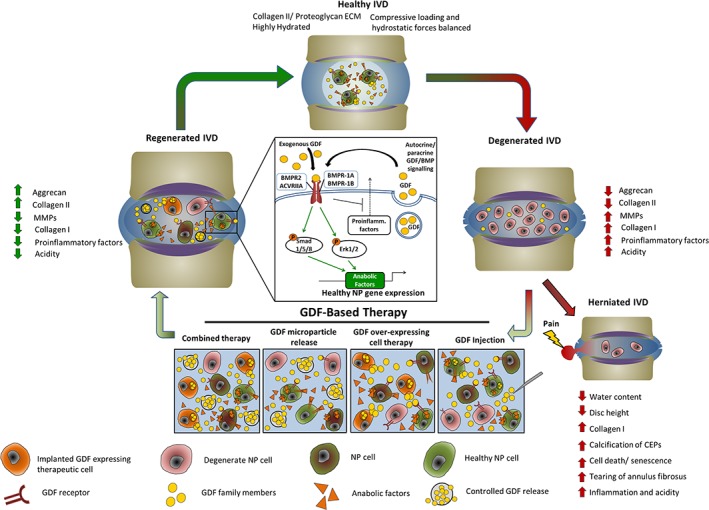
Intervertebral disc (IVD) degeneration is a major contributing factor to chronic low back pain and disability, leading to imbalance between anabolic and catabolic processes, altered extracellular matrix composition, loss of tissue hydration, inflammation, and impaired mechanical functionality. Current treatments aim to manage symptoms rather than treat underlying pathology. Therefore, IVD degeneration is a target for regenerative medicine strategies. Research has focused on understanding the molecular process of degeneration and the identification of various factors that may have the ability to halt and even reverse the degenerative process. One such family of growth factors, the growth differentiation factor (GDF) family, have shown particular promise for disc regeneration in in vitro and in vivo models of IVD degeneration. This review outlines our current understanding of IVD degeneration, and in this context, aims to discuss recent advancements in the use of GDF family members as anabolic factors for disc regeneration. An increasing body of evidence indicates that GDF family members are central to IVD homeostatic processes and are able to upregulate healthy nucleus pulposus cell marker genes in degenerative cells, induce mesenchymal stem cells to differentiate into nucleus pulposus cells and even act as chemotactic signals mobilizing resident cell populations during disc injury repair. The understanding of GDF signaling and its interplay with inflammatory and catabolic processes may be critical for the future development of effective IVD regeneration therapies.
椎间盘退变是慢性下腰痛和残疾的主要促成因素,导致合成代谢和分解代谢过程失衡、细胞外基质组成改变、组织水分流失、炎症以及机械功能受损。目前的治疗旨在缓解症状而非治疗潜在病理状况。因此,椎间盘退变是再生医学策略的一个目标。研究集中在理解退变的分子过程以及识别可能有能力阻止甚至逆转退变过程的各种因素。生长分化因子(GDF)家族这类生长因子在椎间盘退变的体外和体内模型中对椎间盘再生显示出特别的前景。本综述概述了我们目前对椎间盘退变的理解,并在此背景下,旨在讨论使用GDF家族成员作为椎间盘再生的合成代谢因子的最新进展。越来越多的证据表明,GDF家族成员对椎间盘稳态过程至关重要,并且能够上调退变细胞中健康髓核细胞标记基因,诱导间充质干细胞分化为髓核细胞,甚至在椎间盘损伤修复过程中作为趋化信号动员驻留细胞群。对GDF信号传导及其与炎症和分解代谢过程相互作用的理解可能对有效的椎间盘再生疗法的未来发展至关重要。