1st Medical Department, University Cancer Center Leipzig (UCCL), University Leipzig Medical Center, Leipzig, Germany.
Institute for Medical Informatics, Statistics and Epidemiology (IMISE), Medical Faculty of the University Leipzig, Leipzig, Germany.
J Cachexia Sarcopenia Muscle. 2020 Feb;11(1):135-144. doi: 10.1002/jcsm.12484. Epub 2019 Aug 28.
Body fat and/or muscle composition influences prognosis in several cancer types. For advanced gastric and gastroesophageal junction cancer, we investigated which body composition parameters carry prognostic information beyond well-established clinical parameters using robust model selection strategy such that parameters identified can be expected to generalize and to be reproducible beyond our particular data set. Then we modelled how differences in these parameters translate into survival outcomes.
Fat and muscle parameters were measured on baseline computed tomography scans in 761 patients with advanced gastric or gastroesophageal junction cancer from the phase III EXPAND trial, undergoing first-line chemotherapy. Cox regression analysis for overall survival (OS) and progression-free survival (PFS) included body composition parameters and clinical prognostic factors. All continuous variables were entered linearly into the model as there was no evidence of non-linear prognostic impact. For transferability, the final model included only parameters that were picked by Bayesian information criterion model selection followed by bootstrap analysis to identify the most robust model.
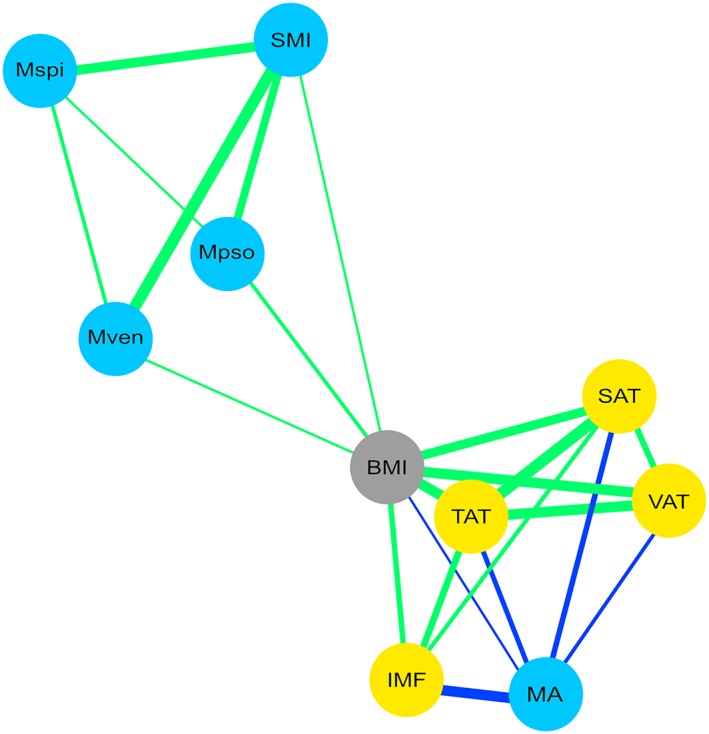
Muscle and fat parameters formed correlation clusters without relevant between-cluster correlation. Mean muscle attenuation (MA) clusters with the fat parameters. In multivariate analysis, MA was prognostic for OS (P < 0.0001) but not for PFS, while skeletal muscle index was prognostic for PFS (P = 0.02) but not for OS. Worse performance status Eastern Cooperative Oncology Group (ECOG 1/0), younger age (on a linear scale), and the number of metastatic sites were strong negative clinical prognostic factors for both OS and PFS. MA remained in the model for OS (P = 0.0001) following Bayesian information criterion model selection in contrast to skeletal muscle index that remained prognostic for PFS (P = 0.009). Applying stricter criteria for transferability, MA represented the only prognostic body composition parameter for OS, selected in >80% of bootstrap replicates. Finally, Cox model-derived survival curves indicated that large differences in MA translate into only moderate differences in expected OS in this cohort.
Among body composition parameters, only MA has robust prognostic impact for OS. Data suggest that treatment approaches targeting muscle quality are unlikely to prolong OS noticeably on their own in advanced gastric cancer patients, indicating that multimodal approaches should be pursued in the future.
体脂和/或肌肉成分会影响多种癌症类型的预后。对于晚期胃癌和胃食管交界处癌,我们使用稳健的模型选择策略研究了哪些身体成分参数提供了超出既定临床参数的预后信息,以便可以预期所确定的参数可以推广并在我们特定的数据集之外具有可重复性。然后,我们构建了这些参数差异如何转化为生存结果的模型。
在 III 期 EXPAND 试验中,对 761 名接受一线化疗的晚期胃癌或胃食管交界处癌患者的基线计算机断层扫描(CT)扫描中测量脂肪和肌肉参数。总生存期(OS)和无进展生存期(PFS)的 Cox 回归分析包括身体成分参数和临床预后因素。由于没有证据表明存在非线性预后影响,因此所有连续变量均以线性形式输入到模型中。为了便于转移,最终模型仅包含贝叶斯信息准则模型选择后以及为了识别最稳健的模型而进行的自举分析所选择的参数。
肌肉和脂肪参数形成了没有相关聚类间相关性的聚类。平均肌肉衰减(MA)与脂肪参数聚类。在多变量分析中,MA 对 OS 具有预后意义(P < 0.0001),但对 PFS 无意义,而骨骼肌指数对 PFS 具有预后意义(P = 0.02),但对 OS 无意义。较差的东部合作肿瘤学组(ECOG)表现状态 1/0、较年轻的年龄(线性)和转移部位的数量是 OS 和 PFS 的强烈负临床预后因素。在进行贝叶斯信息准则模型选择后,MA 仍保留在 OS 模型中(P = 0.0001),而骨骼肌指数仍对 PFS 具有预后意义(P = 0.009)。应用更严格的可转移性标准,MA 代表了唯一具有 OS 预后意义的身体成分参数,在> 80%的自举复制中选择了该参数。最后,Cox 模型衍生的生存曲线表明,在该队列中,MA 的较大差异仅转化为预期 OS 的适度差异。
在身体成分参数中,只有 MA 对 OS 具有稳健的预后影响。数据表明,针对肌肉质量的治疗方法不太可能单独显著延长晚期胃癌患者的 OS,这表明未来应采用多模式方法。