Fleseriu Maria, Petersenn Stephan, Biller Beverly M K, Kadioglu Pinar, De Block Christophe, T'Sjoen Guy, Vantyghem Marie-Christine, Tauchmanova Libuse, Wojna Judi, Roughton Michael, Lacroix André, Newell-Price John
Northwest Pituitary Center, Oregon Health & Science University, Portland, OR, USA.
ENDOC Center for Endocrine Tumors, Hamburg, Germany.
Clin Endocrinol (Oxf). 2019 Dec;91(6):776-785. doi: 10.1111/cen.14081. Epub 2019 Oct 1.
Many patients with Cushing's disease (CD) require chronic pharmacotherapy to control their hypercortisolism. We evaluated the efficacy and safety of long-acting pasireotide during a long-term extension study in patients with CD.
Open-label extension to a 12-month Phase III study of long-acting pasireotide in CD (N = 150; NCT01374906).
Patients with mean urinary free cortisol (mUFC) ≤ upper limit of normal (ULN) or receiving clinical benefit at core study end could continue long-acting pasireotide during the extension.
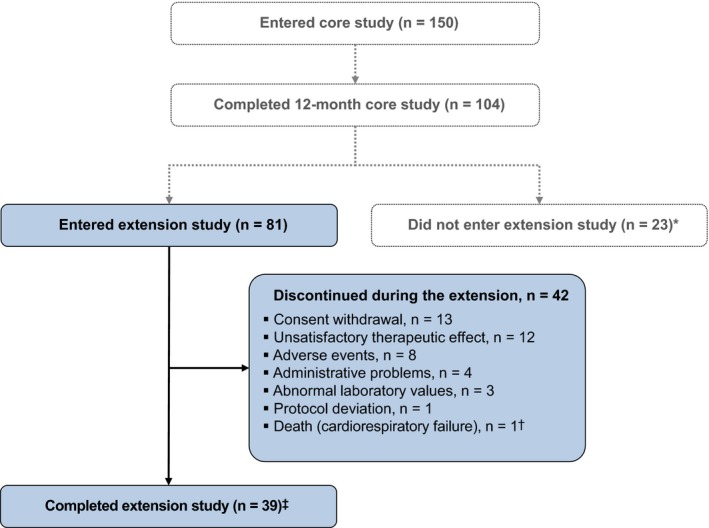
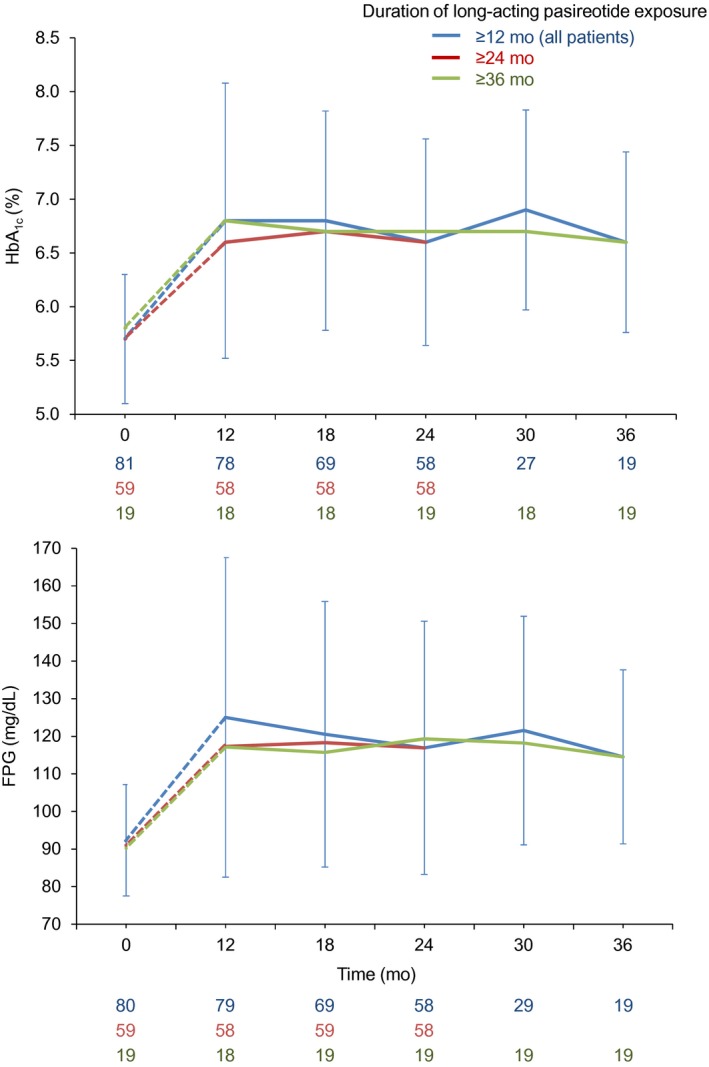
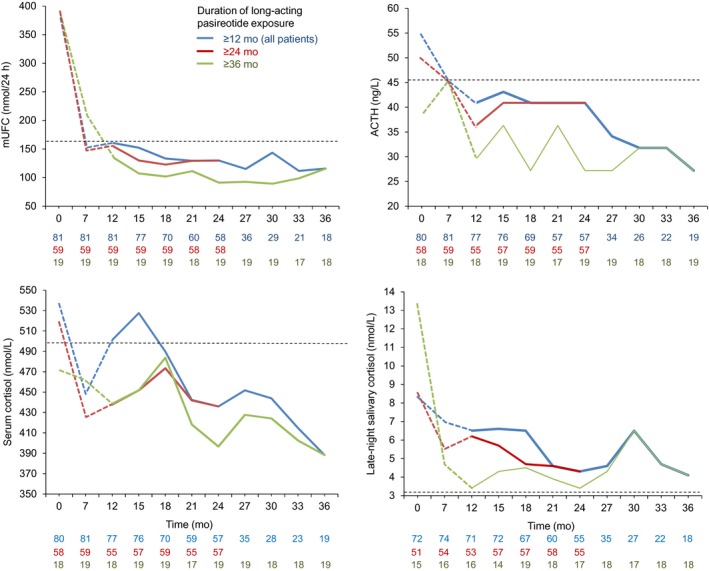
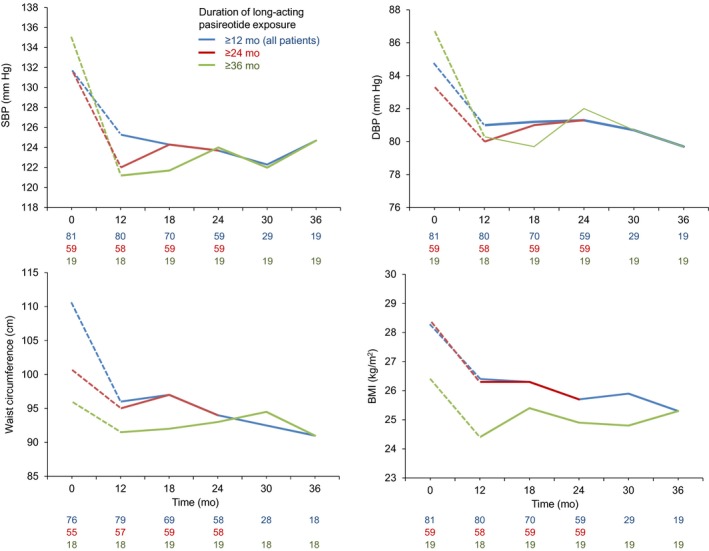
Eighty-one of 150 (54.0%) enrolled patients entered the extension. Median overall exposure to pasireotide at study end was 23.9 months; 39/81 (48.1%) patients completed the extension (received ≥ 12 months' treatment during the extension and could transit to a separate pasireotide safety study). mUFC was ≤ULN in 42/81 (51.9%), 13/81 (16.0%) and 43/81 (53.1%) patients at extension baseline, month (M) 36 and last assessment. Median mUFC remained within normal limits. Median late-night salivary cortisol was 2.6 × ULN at core baseline and 1.3 × ULN at M36. Clinical improvements were sustained over time. Forty-two (51.9%) patients discontinued during the extension: 25 (30.9%) before M24 and 17 (21.0%) after M24. Hyperglycaemia-related AEs occurred in 39.5% of patients. Mean fasting glucose (FPG) and glycated haemoglobin (HbA ) were stable during the extension, with antidiabetic medication initiated/escalated in some patients. Sixty-six (81.5%) and 71 (88.9%) patients were classified as having diabetes (HbA ≥ 6.5%, FPG ≥ 7.0 mmol/L, antidiabetic medication use, or history of diabetes) at extension baseline and last assessment.
Long-acting pasireotide provided sustained biochemical and clinical improvements, with no new safety signals emerging, supporting its use as an effective long-term therapy for CD.
许多库欣病(CD)患者需要长期药物治疗来控制其皮质醇增多症。我们在一项针对CD患者的长期扩展研究中评估了长效帕西瑞肽的疗效和安全性。
对长效帕西瑞肽治疗CD的12个月III期研究(N = 150;NCT01374906)进行开放标签扩展。
平均尿游离皮质醇(mUFC)≤正常上限(ULN)或在核心研究结束时获得临床益处的患者可在扩展期继续使用长效帕西瑞肽。
150名入组患者中有81名(54.0%)进入扩展期。研究结束时帕西瑞肽的中位总暴露时间为23.9个月;39/81(48.1%)的患者完成了扩展期(在扩展期接受了≥12个月的治疗,并且可以转至另一项帕西瑞肽安全性研究)。在扩展期基线、第36个月(M36)和最后一次评估时,mUFC≤ULN的患者分别为42/81(51.9%)、13/81(16.0%)和43/81(53.1%)。mUFC中位数仍在正常范围内。核心基线时午夜唾液皮质醇中位数为2.6×ULN,M36时为1.3×ULN。临床改善随时间持续存在。42名(51.9%)患者在扩展期停药:25名(30.9%)在M24之前停药,17名(21.0%)在M24之后停药。39.5%的患者发生了与高血糖相关的不良事件。扩展期内平均空腹血糖(FPG)和糖化血红蛋白(HbA)稳定,部分患者开始使用降糖药物或增加了降糖药物剂量。在扩展期基线和最后一次评估时,分别有66名(81.5%)和71名(88.9%)患者被分类为患有糖尿病(HbA≥6.5%,FPG≥7.0 mmol/L,使用降糖药物或有糖尿病史)。
长效帕西瑞肽可提供持续的生化和临床改善,且未出现新的安全信号,支持其作为CD的有效长期治疗药物使用。